


ГДЗ по английскому языку 5 класс Ваулина рабочая тетрадь Spotlight страница - 19

Авторы: Ваулина Ю.Е., Дули Д., Подоляко О.Е., Эванс В.
Серия: Spotlight
Тип книги: Рабочая тетрадь
Год: 2012-2023
Рекомендуем посмотреть




 Премиум
Подробное решение страница № 19 по английскому языку рабочая тетрадь Spotlight для учащихся 5 класса Spotlight , авторов Ваулина, Дули, Подоляко, Эванс 2012-2023
### Итоговый ответ
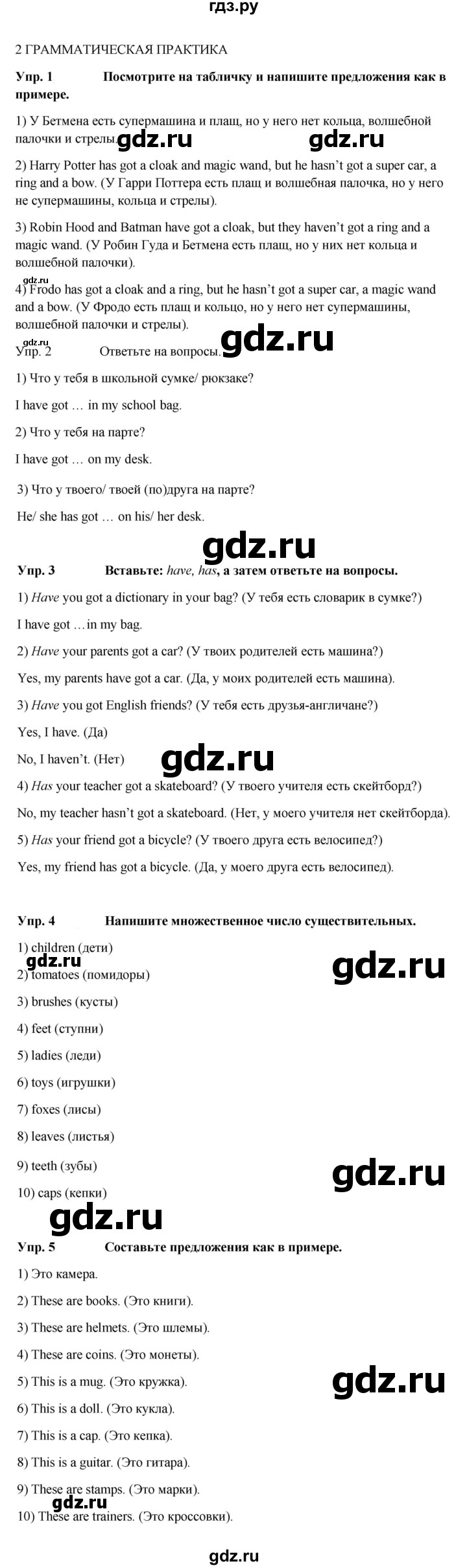
#### 1. Look at the table and write sentences as in the example.
* **Harry Potter** has got a cloak and a magic wand, but he hasn't got a super car, a ring or a bow.
* **Robin Hood and Batman** have got a cloak (cloaks), but they haven't got a ring or a magic wand.
* **Frodo** has got a cloak and a ring, but he hasn't got a super car, a magic wand or a bow.
---
#### 2. Answer the questions. *(Примерные ответы)*
* What have you got in your school bag?
**I have got books, notebooks and a pencil case in my school bag.**
* What have you got on your desk?
**I have got a pen and a notebook on my desk.**
* What has your friend got on his/her desk?
**He/She has got a ruler and a pencil case on his/her desk.**
---
#### 3. Complete with: *have*, *has*, then answer the questions.
1. **Have** you got a dictionary in your bag? — **No, I haven't.** *(или: Yes, I have.)*
2. **Have** your parents got a car? — **Yes, they have.** *(или: No, they haven't.)*
3. **Have** you got English friends? — **No, I haven't.** *(или: Yes, I have.)*
4. **Has** your teacher got a skateboard? — **No, he/she hasn't.** *(или: Yes, he/she has.)*
5. **Has** your friend got a bicycle? — **Yes, he/she has.** *(или: No, he/she hasn't.)*
---
#### 4. Write the plurals.
1. child — **children**
2. tomato — **tomatoes**
3. brush — **brushes**
4. foot — **feet**
5. lady — **ladies**
6. toy — **toys**
7. fox — **foxes**
8. leaf — **leaves**
9. tooth — **teeth**
10. cap — **caps**
11. man — **men**
12. mouse — **mice**
---
#### 5. Make questions as in the example.
* Is that a helmet or a cap?
* Are these books or stamps?
* Are these coins or trainers?
* Is that a doll or a mug?
* Is that a guitar or a camera?
---
### Объяснение и правила
1. **Конструкция *have got / has got* (иметь, обладать):**
* **has got** используется с местоимениями он/она/оно (*he, she, it*) и существительными в единственном числе (*Harry Potter, Frodo, your teacher, your friend*). В отрицании — **hasn't got**.
* **have got** используется с местоимениями *I, you, we, they* и существительными во множественном числе (*Robin Hood and Batman, your parents*). В отрицании — **haven't got**.
* В вопросах глагол *Have / Has* выносится в начало предложения перед подлежащим:
*Have you got...? / Has he got...?*
2. **Правила образования множественного числа существительных:**
* **Обычные правила:**
* Добавление **-s**: *cap $\rightarrow$ caps, toy $\rightarrow$ toys* (после гласной + y буква *y* не меняется).
* Добавление **-es** после шипящих (*-sh, -x*): *brush $\rightarrow$ brushes, fox $\rightarrow$ foxes*.
* После согласной + **-o**: *tomato $\rightarrow$ tomatoes*.
* Замена **-y** на **-ies** после согласной: *lady $\rightarrow$ ladies*.
* Замена **-f/-fe** на **-ves**: *leaf $\rightarrow$ leaves*.
* **Исключения (нужно выучить наизусть):**
* *child $\rightarrow$ children* (ребёнок $\rightarrow$ дети)
* *foot $\rightarrow$ feet* (ступня $\rightarrow$ ступни)
* *tooth $\rightarrow$ teeth* (зуб $\rightarrow$ зубы)
* *man $\rightarrow$ men* (мужчина $\rightarrow$ мужчины)
* *mouse $\rightarrow$ mice* (мышь $\rightarrow$ мыши)
3. **Указательные местоимения в вопросах:**
* **Is that...?** используется для одного предмета вдали (единственное число с артиклем *a/an*).
* **Are these...?** используется для нескольких предметов рядом (множественное число без артикля *a/an*).
Спасибо за оценку!
 Решебник №2 к тетради 2012 / страница / 19
 Для этого задания есть уникальное решение
Наши преподаватели подготовили для этого задания уникальное решение – не как у всех

Открой больше возможностей
Войди через VK — задавай вопросы ИИ и сохраняй ГДЗ в избранное
