

ГДЗ по английскому языку 8 класс Баранова Starlight Углубленный уровень страница - 131

Авторы: Баранова К.М., Дули Д., Копылова В.В., Мильруд Р.П., Эванс В.
Серия: Starlight
Тип книги: Учебник
Год: 2017-2023
Рекомендуем посмотреть


Подробное решение страница № 131 по английскому языку Starlight для учащихся 8 класса Starlight Углубленный уровень, авторов Баранова, Дули, Копылова, Мильруд, Эванс 2017-2023

 ИИ-решебник / страница / 131
Ответ подготовлен нейросетью и может содержать ошибки
Объяснение и пошаговое решение
### Итоговые ответы
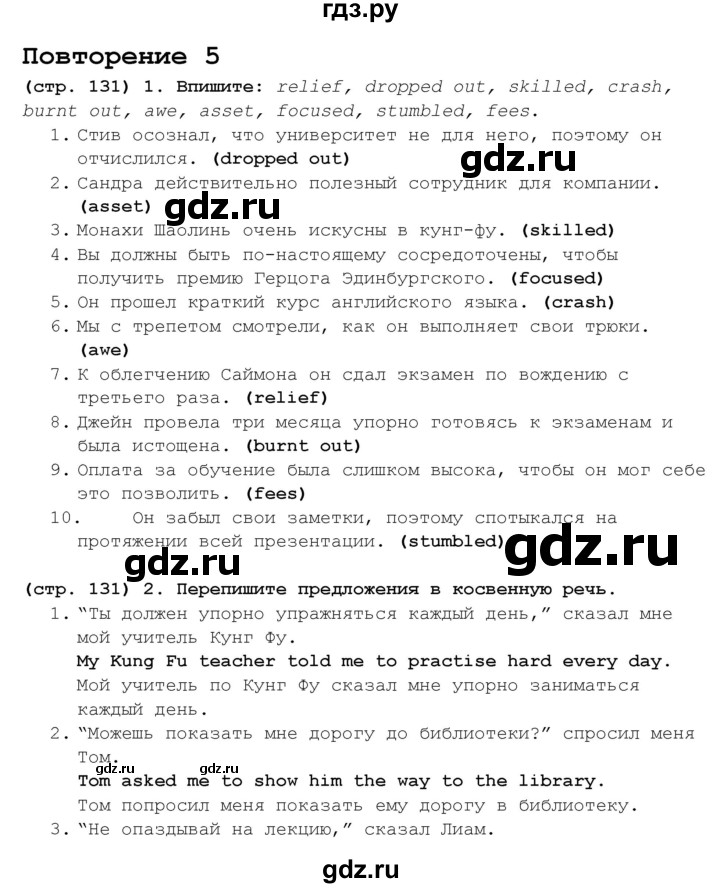
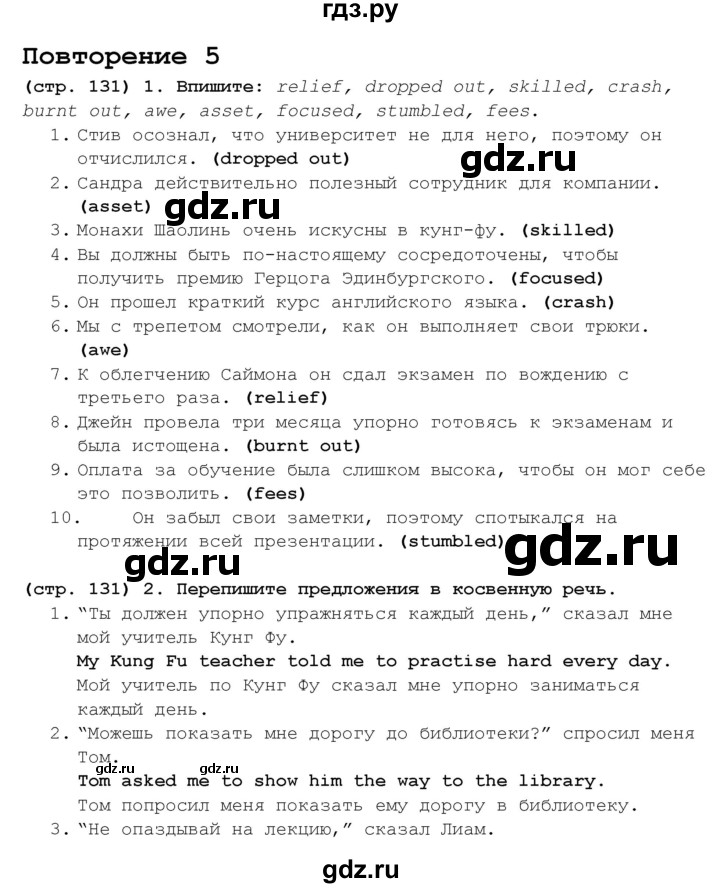
#### 1. Complete with the words: *relief, dropped out, skilled, crash, burnt out, awe, asset, focused, stumbled, fees*
1. Steve realised university wasn't for him so he **dropped out**.
2. Sandra is a real **asset** to the company.
3. The Shaolin monks are highly **skilled** in Kung Fu.
4. You have to be **focused** to get a D of E Award.
5. He took a **crash** course in English.
6. We watched in **awe** as he performed his tricks.
7. To Simon's **relief**, he passed his driving test when he took it for the third time.
8. Jane had spent three months studying hard for her exams and was **burnt out**.
9. The tuition **fees** were too high for him to afford.
10. He forgot his notes so he **stumbled** through his presentation.
---
#### 2. Rewrite the sentences in reported speech
1. My Kung Fu teacher told me that I **had to** practise hard every day.
2. Tom asked me **if / whether I could show him** the way to the library.
3. Liam told / warned me **not to be** late for the lecture.
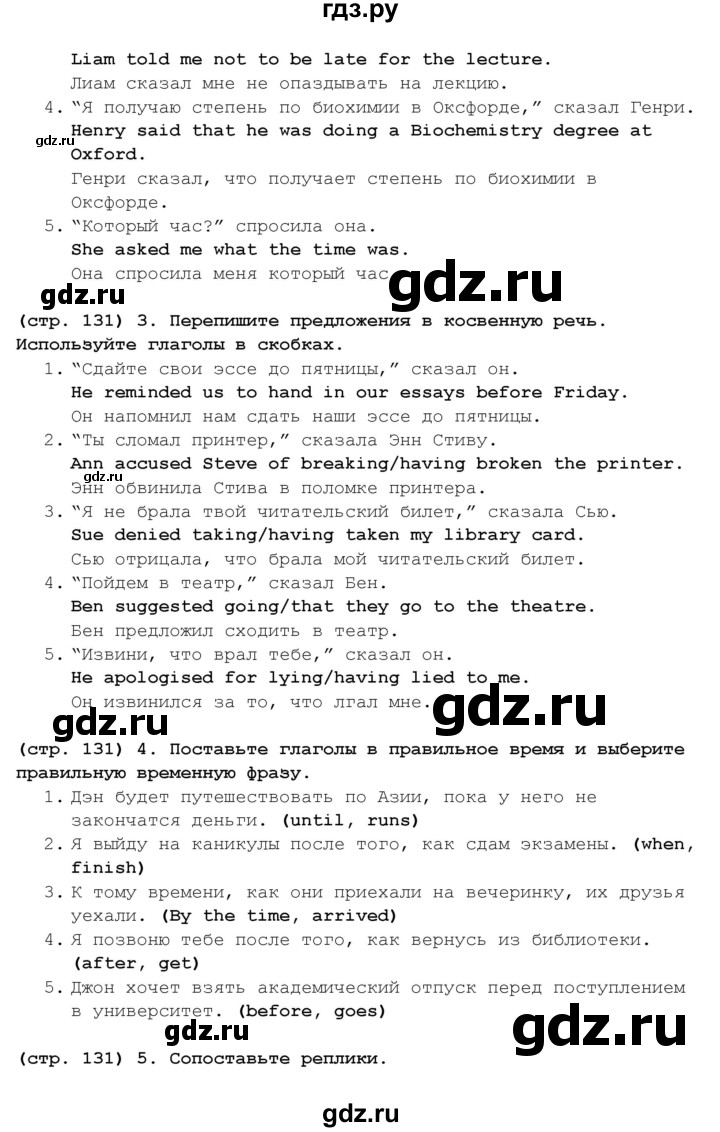
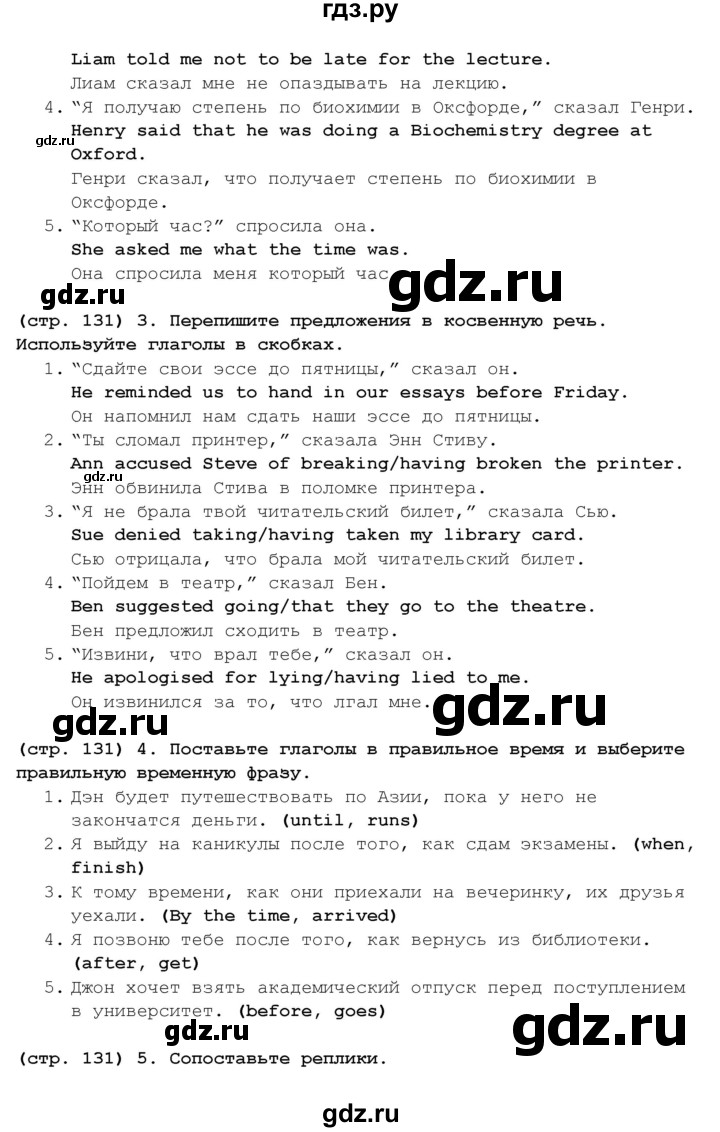
4. Henry said (that) **he was doing** a Biochemistry degree at Oxford.
5. She asked **what time it was**.
---
#### 3. Rewrite the sentences in reported speech using the verbs in brackets
1. He **reminded us to hand in our essays** before Friday.
2. Ann **accused Steve of breaking** the printer.
3. Sue **denied taking** (или *having taken*) my library card.
4. Ben **suggested going** to the theatre.
5. He **apologised for lying** (или *having lied*) to me.
---
#### 4. Put the verbs into the correct tenses and choose the correct time phrase
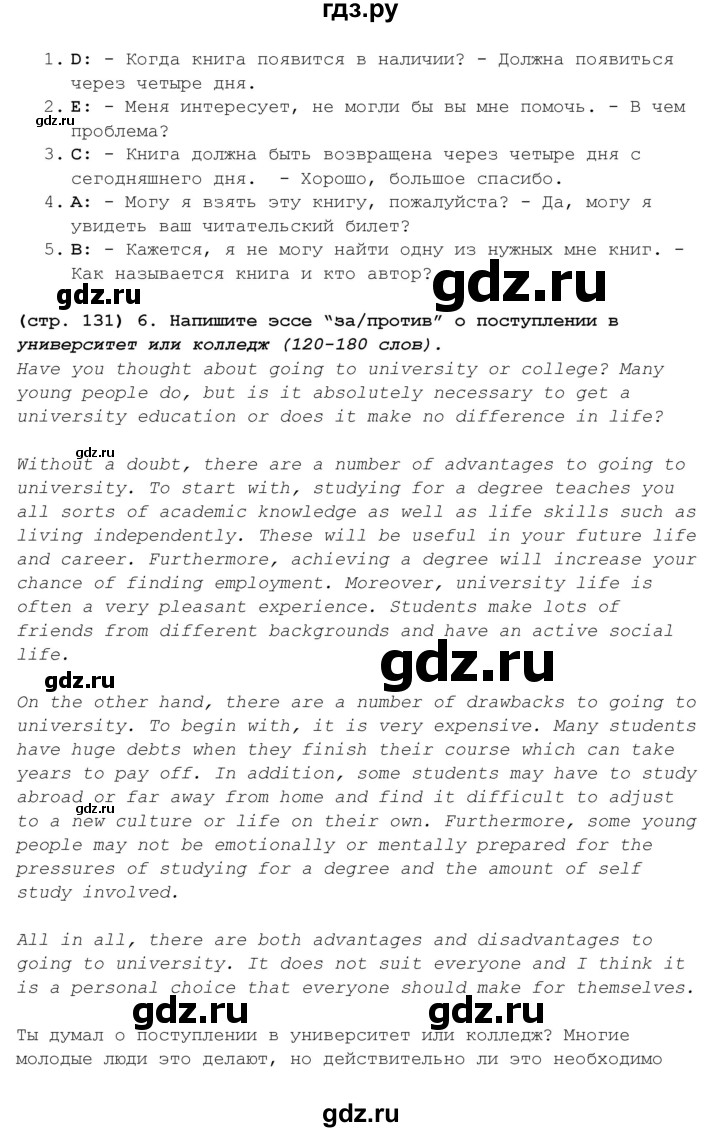
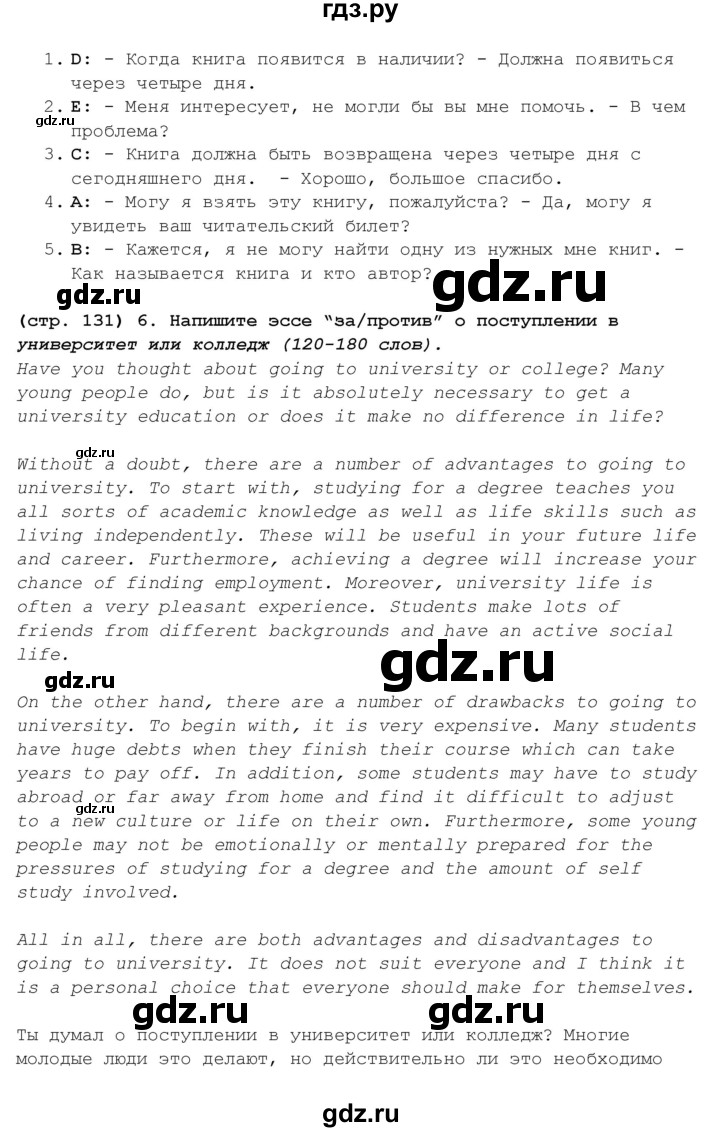
1. Dan will travel across Asia **until** he **runs** out of money.
2. I'll go on holiday **when** I **finish** my exams.
3. **By the time** they **arrived** at the party, their friends had left.
4. I'll call you **after** I **get** back from the library.
5. John wants to take a gap year **before** he **goes** to university.
---
#### 5. Match the exchanges
1 — **D** (*When will the book be back in? — It is due back in four days.*)
2 — **E** (*I wonder if you could help me. — What's the problem?*)
3 — **C** (*This book is due back four days from today. — OK, thank you very much.*)
4 — **A** (*Can I take this book out, please? — Yes, can I see your library card, please?*)
5 — **B** (*I can't seem to find one of the books I need. — What's the title of the book and the author?*)
---
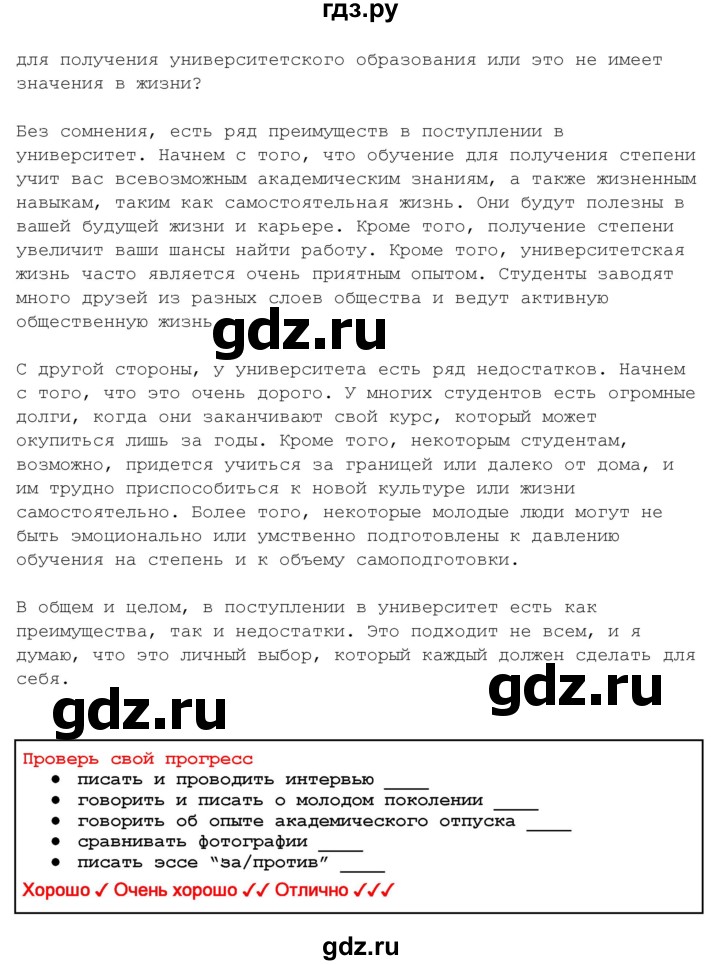
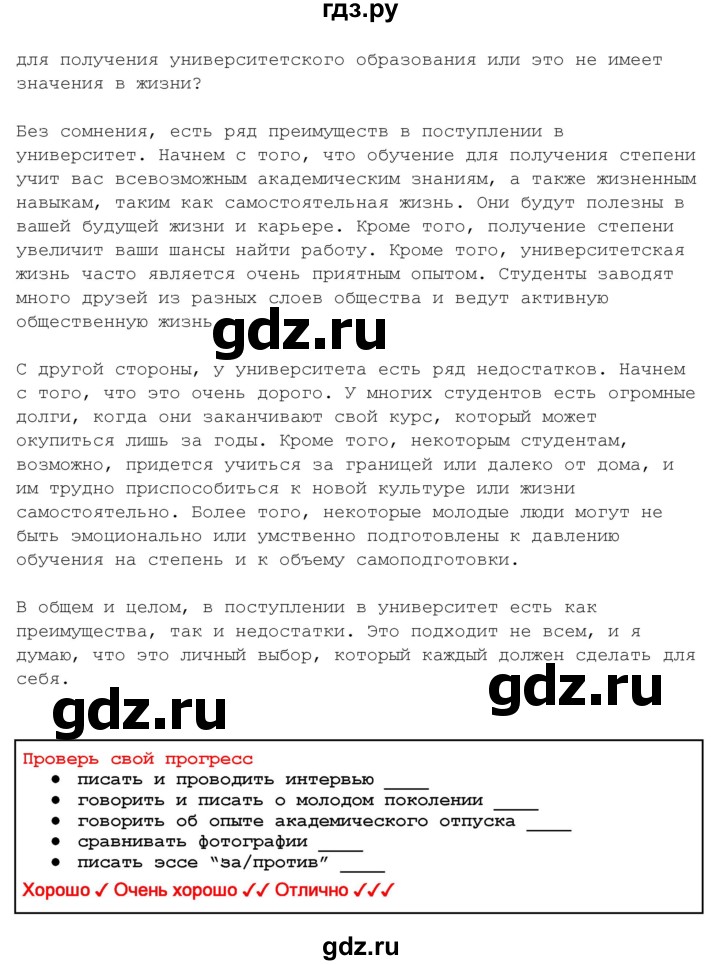
#### 6. For-and-against essay: Going to university or college (100–120 words)
> Every year, thousands of school leavers decide whether to continue their education. Going to university has both advantages and disadvantages.
>
> On the one hand, higher education provides in-depth knowledge and practical skills. A university degree often opens doors to prestigious, well-paid careers. In addition, students become more independent and meet people with similar interests.
>
> On the other hand, studying at university can be very expensive because of high tuition fees and living costs. Furthermore, it takes several years, and there is no guarantee of finding a dream job immediately after graduation.
>
> In conclusion, while university education requires time and money, I believe it is a valuable investment in one's future.
*(112 words)*
---
### Объяснение и правила
#### Задание 1 (Лексика)
* **drop out** — бросить учебу (университет, школу).
* **asset to the company** — ценный сотрудник / ценное приобретение для компании.
* **highly skilled** — высококвалифицированный, обладающий большим мастерством.
* **focused** — сосредоточенный, целеустремленный.
* **crash course** — интенсивный, экспресс-курс.
* **in awe** — в благоговении, с восхищением.
* **to someone's relief** — к чьему-то облегчению.
* **burnt out** — эмоционально или физически истощенный («выгоревший»).
* **tuition fees** — плата за обучение.
* **stumble through** — запинаться, с трудом пробираться через речь/презентацию.
#### Задание 2 (Косвенная речь / Reported Speech)
1. Модальный глагол **must** (выражающий необходимость/правило) в косвенной речи меняется на **had to**.
2. Общий вопрос переводится с помощью союзов **if / whether**, порядок слов становится прямым (*I could show* вместо *can you show*), местоимения согласуются по смыслу.
3. Отрицательное повеление (*Don't...*) передается конструкцией **not + to-infinitive** (*not to be*).
4. Время **Present Continuous** (*am doing*) меняется на **Past Continuous** (*was doing*), местоимение *I* заменяется на *he*.
5. Специальный вопрос переводится с сохранением вопросительного слова (*what time*), порядок слов меняется на прямой (*it was*), время сдвигается из **Present Simple** в **Past Simple**.
#### Задание 3 (Глаголы говорения / Reporting Verbs)
* **remind + object + to-infinitive**: *reminded us to hand in...*
* **accuse + object + of + V-ing**: *accused Steve of breaking...*
* **deny + V-ing / having + V3**: *denied taking / having taken...*
* **suggest + V-ing**: *suggested going...*
* **apologise + for + V-ing**: *apologised for lying...*
#### Задание 4 (Придаточные времени / Time Clauses)
1. **until** (до тех пор пока не); в придаточных времени для обозначения будущего используется **Present Simple** (*runs*), а не Future Simple.
2. **when** (когда); в придаточном времени используется **Present Simple** (*finish*).
3. **By the time** (к тому времени как); указывает на предшествование: сначала ушли друзья (*had left* — Past Perfect), затем они пришли (*arrived* — Past Simple).
4. **after** (после того как); в придаточном времени будущего времени используется **Present Simple** (*get*).
5. **before** (перед тем как, до того как); после союза используется **Present Simple** (*goes*).
Оцени решение:
Спасибо за оценку!