


ГДЗ по английскому языку 11 класс Афанасьева Spotlight Базовый уровень страница - 105

Авторы: Афанасьева О.В., Дули Д., Михеева И.В., Оби Б., Эванс В.
Серия: Spotlight
Тип книги: Учебник
Год: 2015-2024
Рекомендуем посмотреть


 Премиум
Подробное решение страница № 105 по английскому языку Spotlight для учащихся 11 класса Spotlight Базовый уровень, авторов Афанасьева, Дули, Михеева, Оби, Эванс 2015-2024
### Итоговые ответы
---
#### **Ex. 5 (Reading)**
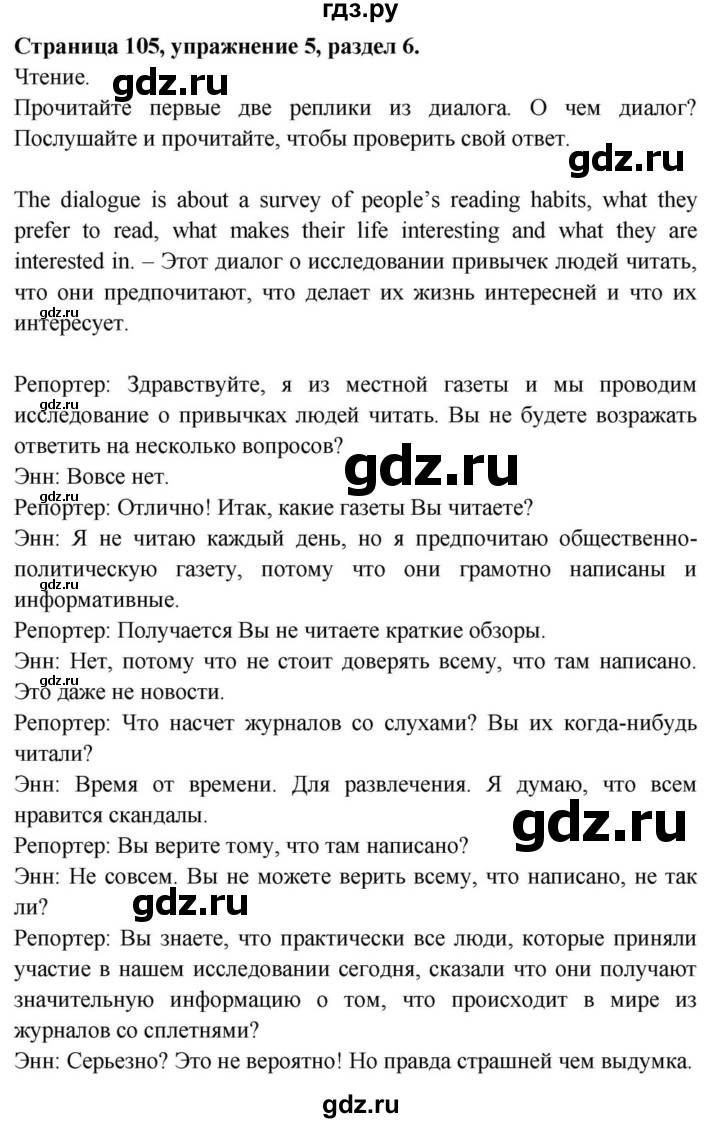
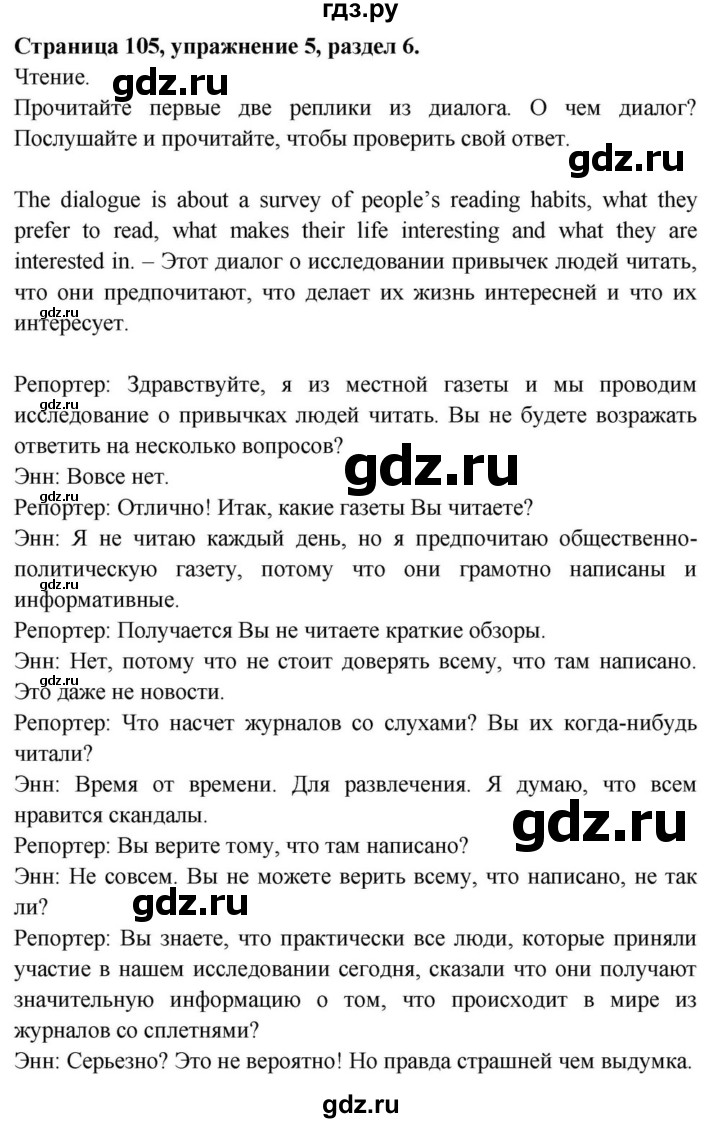
The dialogue is about **people's reading habits and their opinions on different types of newspapers and magazines**.
---
#### **Ex. 6a (Reading)**
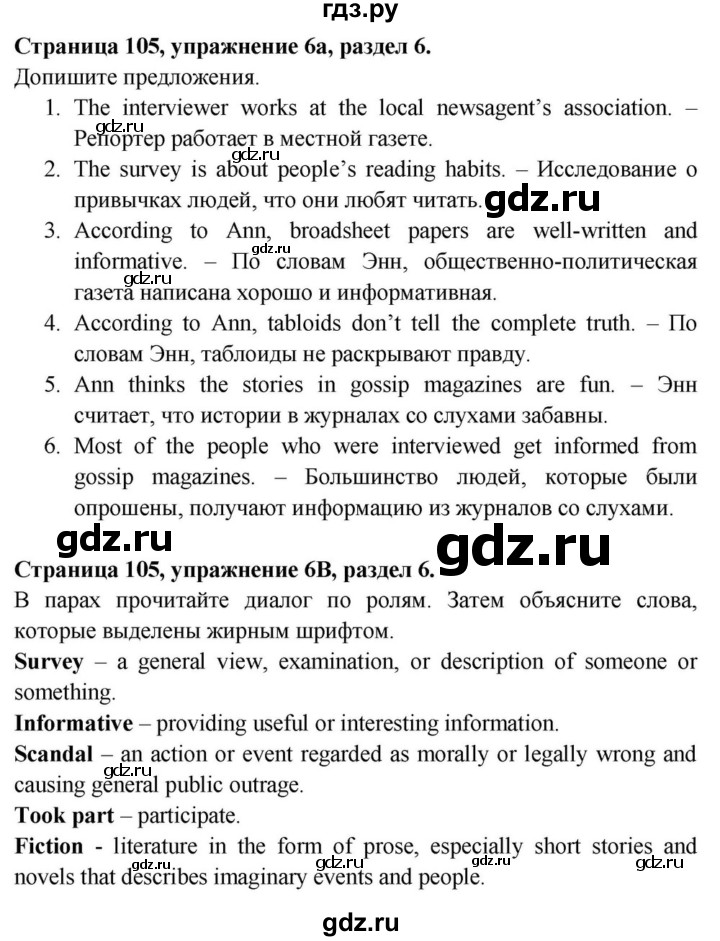
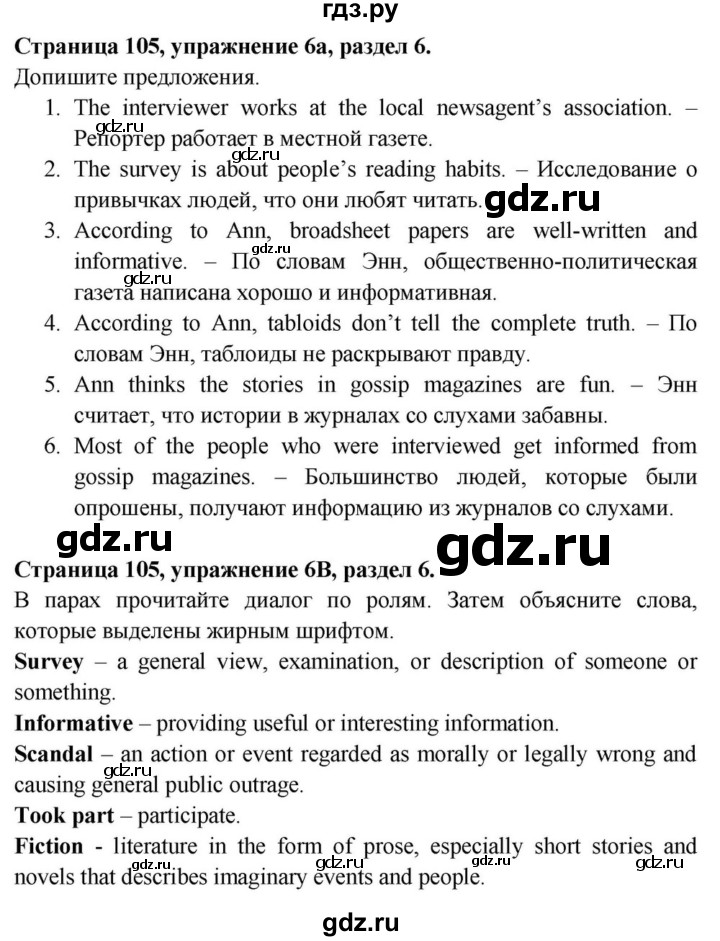
1. The interviewer works at **the local newsagents’ association**.
2. The survey is about **people's reading habits**.
3. According to Ann, broadsheet papers are **well-written and informative**.
4. According to Ann, tabloids don't **really write news / contain real news**.
5. Ann thinks the stories in gossip magazines are **just for fun** *(or: **not to be believed**)*.
6. Most of the people who were interviewed learn about the world **from gossip magazines**.
---
#### **Ex. 6b (Vocabulary in bold)**
* **broadsheet papers**: large-format newspapers that focus on serious and detailed news coverage *(серьезные широкоформатные газеты)*.
* **take (everything) with a pinch of salt**: to not completely believe something or be skeptical about it *(относиться к чему-то с долей скептицизма/недоверия)*.
* **gossip magazines**: magazines that report on the private lives and scandals of celebrities *(журналы о сплетнях/жизни знаменитостей)*.
* **scandal**: an action or event regarded as morally or legally wrong and causing general public outrage *(скандал)*.
* **truth is stranger than fiction**: real life can be more unbelievable than invented stories *(правда бывает удивительнее вымысла)*.
---
#### **Ex. 7 (Speaking — Sample Dialogue)**
**A:** What are you reading?
**B:** Just the latest issue of *Celebrity Life*. Look at this: *"Hollywood star adopts tenth pet tiger!"*
**A:** You can't honestly believe that! It's complete nonsense. Tabloids and gossip magazines just invent stories to sell copies.
**B:** I know it might not be entirely true, but it's entertaining to read on my break.
**A:** You’d be better off reading a broadsheet to find out what's actually happening in the world.
**B:** Maybe so, but everyone enjoys a bit of light-hearted gossip now and then!
---
#### **Ex. 8 (Listening)**
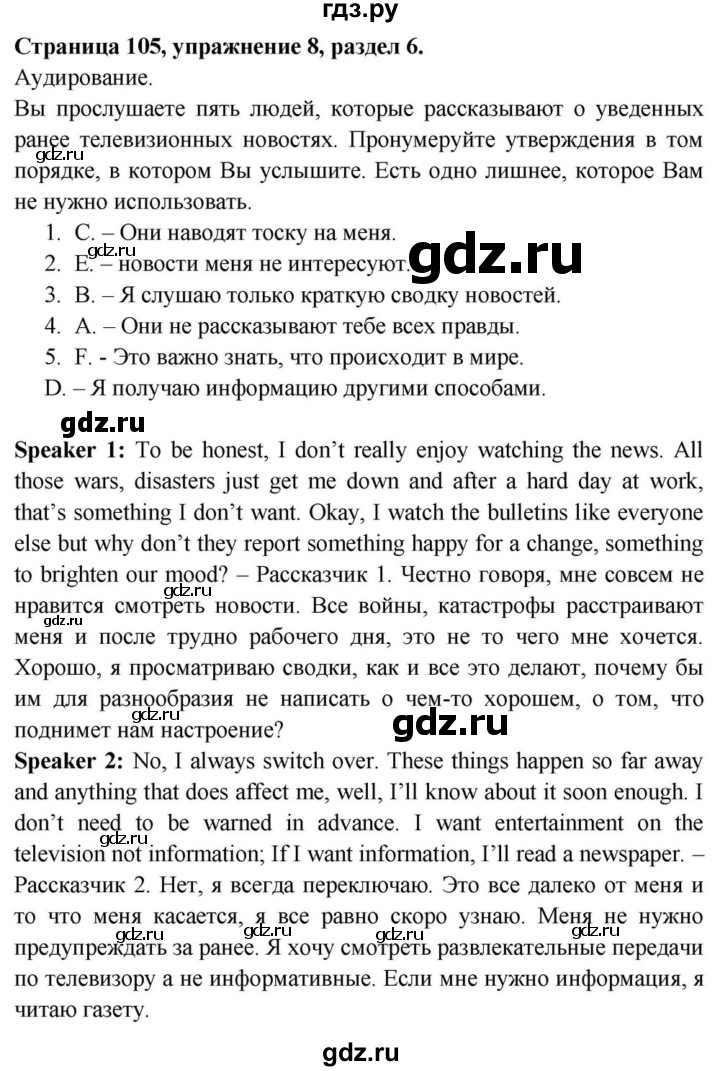
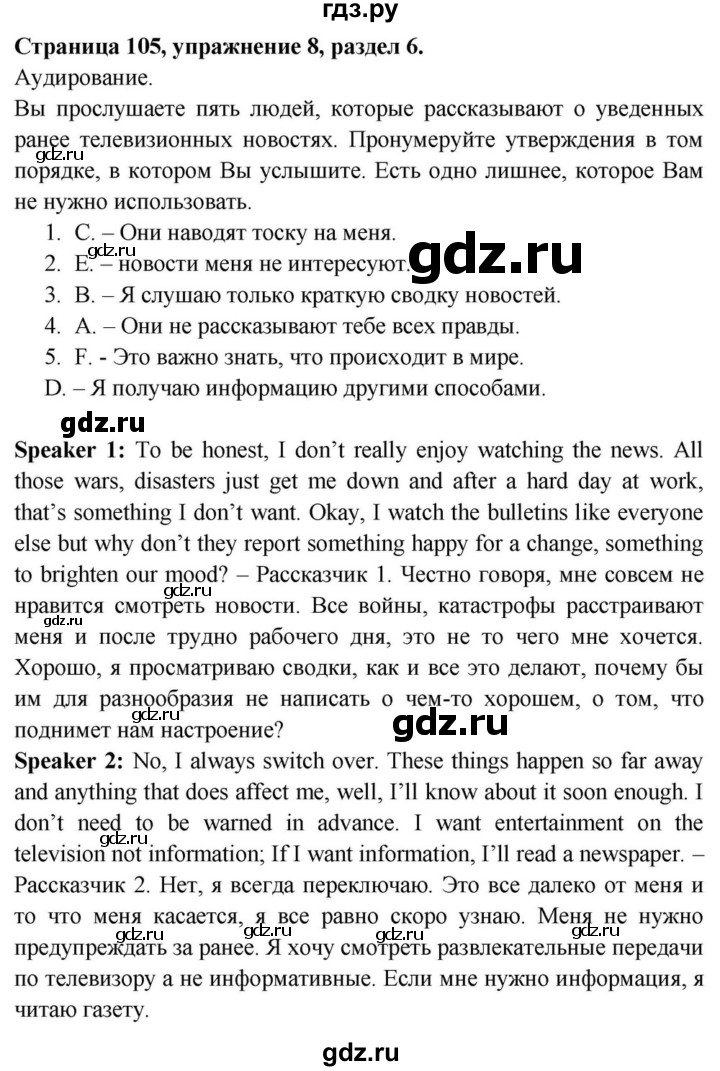
| Speaker | A | B | C | D | E | F |
| :---: | :---: | :---: | :---: | :---: | :---: | :---: |
| **Statement** | **6** | **3** | **1** | **7** | **5** | **2** |
*(Лишнее утверждение: **4**)*
---
#### **Ex. 9 (Say it right: Approving & Disapproving)**
* **Approval (Одобрение):**
* **3** Good for you! *(Молодец! / Рад(а) за тебя!)*
* **7** Nice one! *(Отличная работа! / Здорово!)*
* **Disapproval (Неодобрение):**
* **1** Serves him right! *(Так ему и надо!)*
* **2** I can't believe she did that! *(Поверить не могу, что она так поступила!)*
* **4** Oh Mike, you didn't! *(О, Майк, только не говори, что ты это сделал!)*
* **5** Oh, that's just not on! *(Это никуда не годится / Это недопустимо!)*
* **6** What? That's awful! *(Что? Это ужасно!)*
**Примеры реплик первого собеседника:**
1. *A: Apparently, the film star sacked his manager because he was rude to fans.* — **B: Serves him right!**
2. *A: Sarah told everyone my secret.* — **B: I can't believe she did that!**
3. *A: I passed all my final exams with top marks!* — **B: Good for you!**
4. *A: I accidentally dropped your favorite mug.* — **B: Oh Mike, you didn't!**
5. *A: The landlord increased the rent twice in one month.* — **B: Oh, that's just not on!**
6. *A: The local shelter was damaged in the storm.* — **B: What? That's awful!**
7. *A: I managed to get front-row tickets to the concert.* — **B: Nice one!**
---
#### **Ex. 10 (Idioms: *talk* / *speak*)**
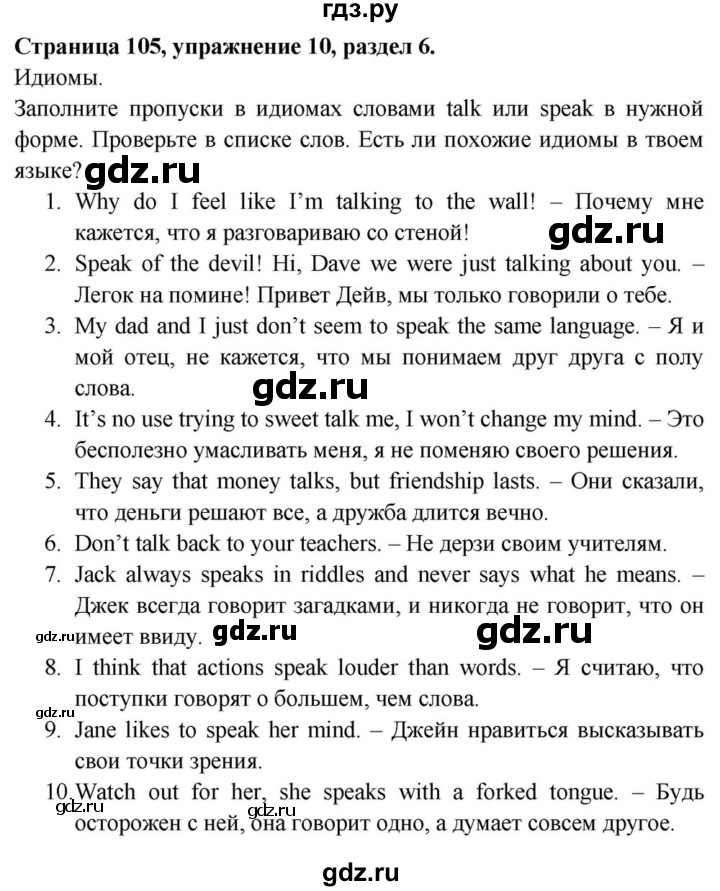
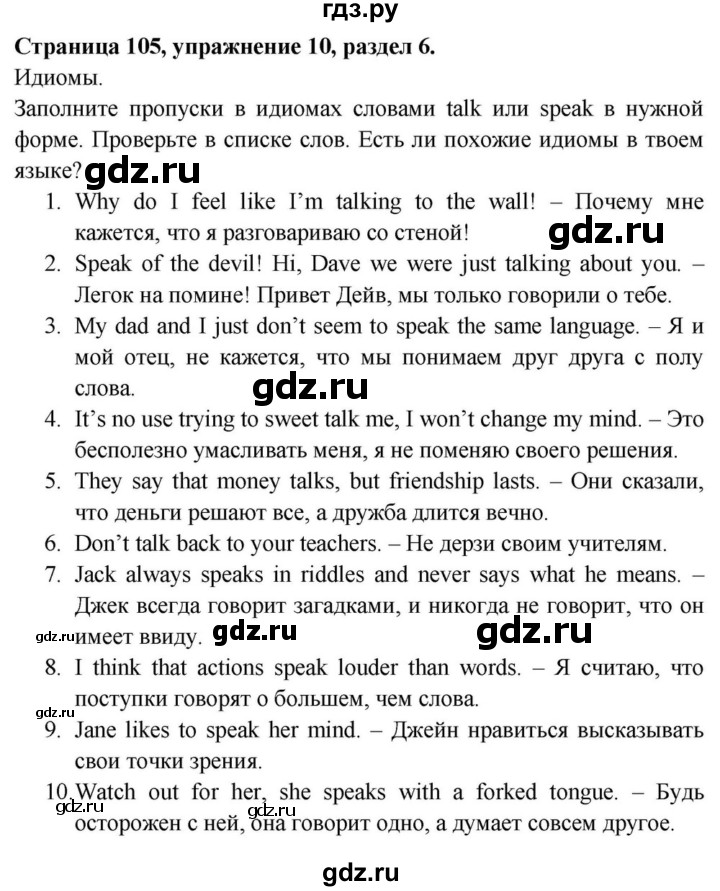
1. Why do I feel like I'm **talking** to the wall!
2. I thought the worse was over but I **spoke** too soon.
3. Not all of us thought the party was boring; **speak** for yourself!
4. It's no use trying to sweet-**talk** me, I won't change my mind.
5. They say that money **talks**, but friendship lasts.
6. Don't **talk** back to your teachers.
7. She was so excited about the trip she **talked** my head off for hours!
8. I think that actions **speak** louder than words.
9. Jane likes to **speak** her mind.
10. Watch out for her, she **speaks** with a forked tongue.
---
### Объяснения и разбор правил
#### **Ex. 6a & 6b**
Все ответы формулируются строго по содержанию текста:
* Реплика *«we're doing a survey on people's reading habits»* даёт информацию о теме опроса и работодателе интервьюера.
* Энн четко разделяет издания: *broadsheets* (серьёзная пресса — *well-written and informative*) и *tabloids / gossip magazines* (желтая пресса и таблоиды — *not really news, just for fun*).
#### **Ex. 10 (Устойчивые выражения с глаголами *talk* и *speak*)**
1. **talk to a brick wall** — *говорить как со стенкой* (в тексте форма *talking*, так как Present Continuous: *am talking*).
2. **speak too soon** — *поторопиться с выводами, сказать слишком рано* (в прошедшем времени: *spoke*).
3. **speak for yourself** — *говори за себя* (повелительное наклонение: *speak*).
4. **sweet-talk someone** — *умасливать, льстить* (инфинитив после частицы *to*).
5. **money talks** — *деньги решают всё / деньгами можно добиться многого* (Present Simple, согласуется с неисчисляемым существительным *money* $\rightarrow$ *talks*).
6. **talk back (to sb)** — *огрызаться, дерзить* (инфинитив после *Don't*).
7. **talk sb's head off** — *заговорить до смерти, трещать без умолку* (прошедшее время Past Simple: *talked*).
8. **actions speak louder than words** — *дела говорят громче слов* (пословица, Present Simple во множественном числе $\rightarrow$ *speak*).
9. **speak one's mind** — *высказывать своё мнение прямо/откровенно* (инфинитив: *to speak*).
10. **speak with a forked tongue** — *лицемерить, говорить неправду* (Present Simple, 3-е лицо ед. ч. $\rightarrow$ *speaks*).
**Аналоги в русском языке:**
* *Actions speak louder than words* $\rightarrow$ «Не по словам судят, а по делам».
* *Talking to the wall* $\rightarrow$ «Как об стенку горох» / «Как со стенкой говорю».
* *Speak your mind* $\rightarrow$ «Резать правду-матку».
Спасибо за оценку!







Открой больше возможностей
Войди через VK — задавай вопросы ИИ и сохраняй ГДЗ в избранное
