


ГДЗ по английскому языку 11 класс Афанасьева Spotlight Базовый уровень страница - 106

Авторы: Афанасьева О.В., Дули Д., Михеева И.В., Оби Б., Эванс В.
Серия: Spotlight
Тип книги: Учебник
Год: 2015-2024
Рекомендуем посмотреть


 Премиум
Подробное решение страница № 106 по английскому языку Spotlight для учащихся 11 класса Spotlight Базовый уровень, авторов Афанасьева, Дули, Михеева, Оби, Эванс 2015-2024
### Ответы к упражнениям (Spotlight 11, стр. 106)
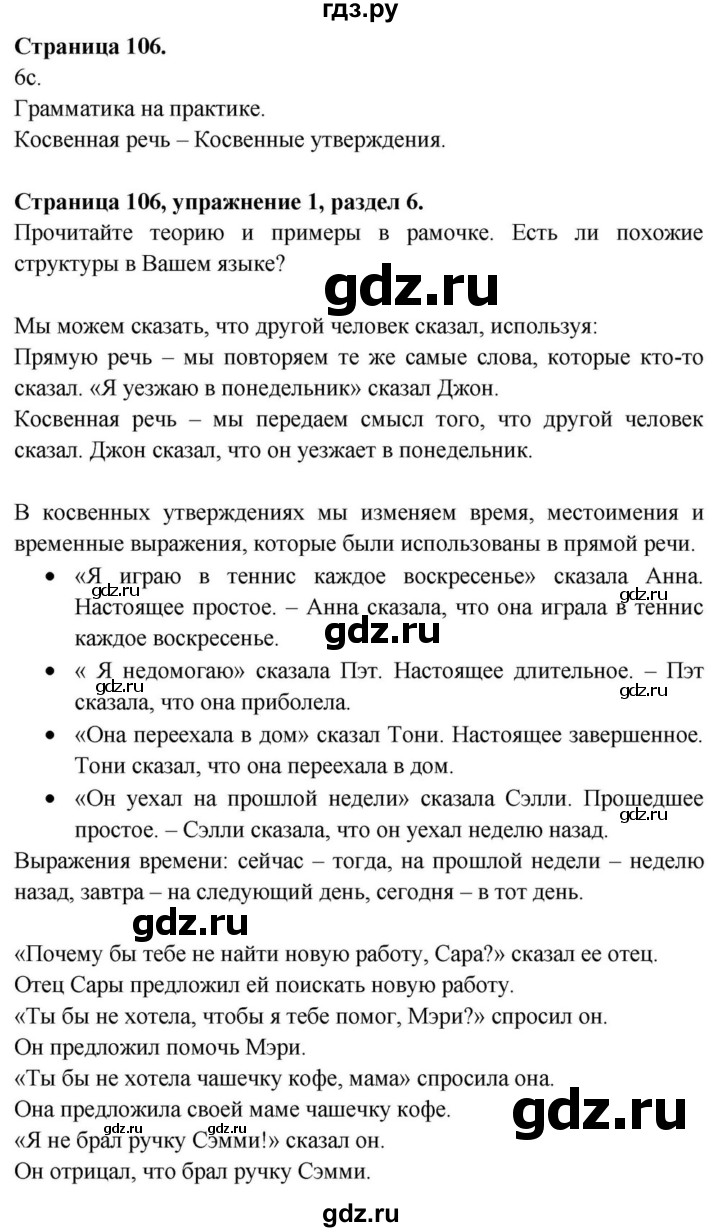
#### Exercise 1
**Вопрос:** *Are there similar structures in your language?*
**Ответ:**
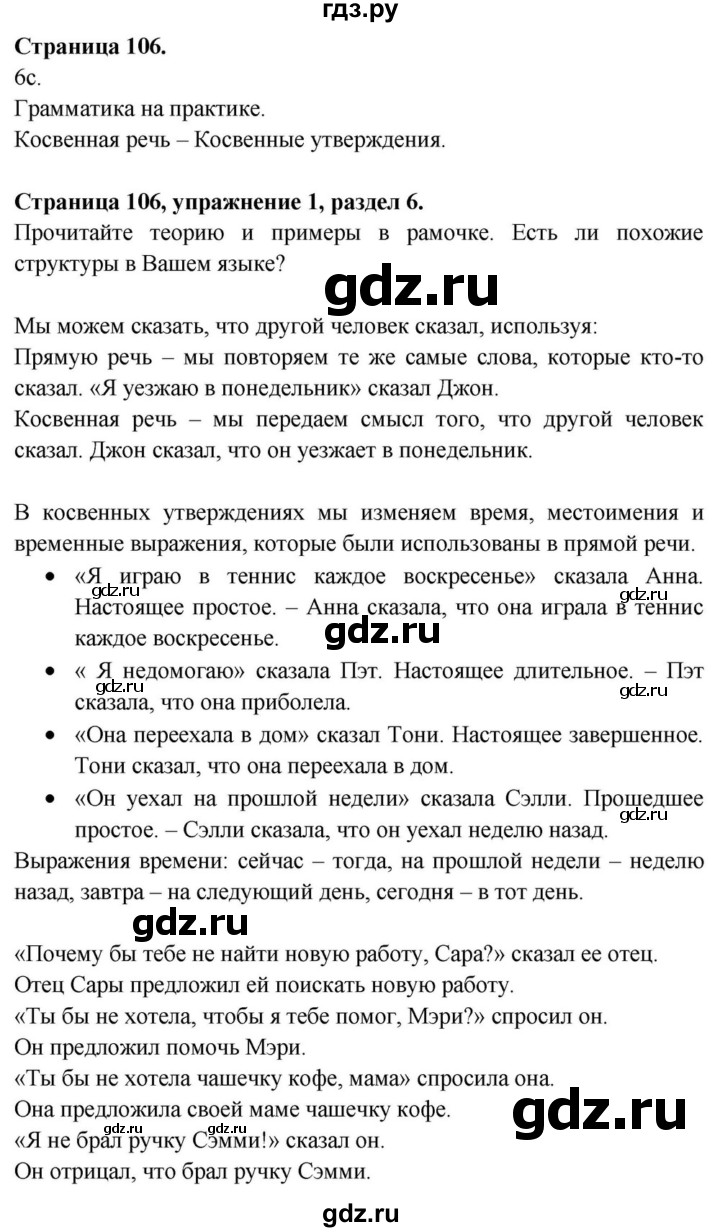
Yes, there are similar structures in Russian (прямая и косвенная речь). However, unlike English, Russian does not have the rule of sequence of tenses (согласование времён). In Russian, the tense of the verb in reported speech usually stays the same as in direct speech, and only pronouns are changed.
---
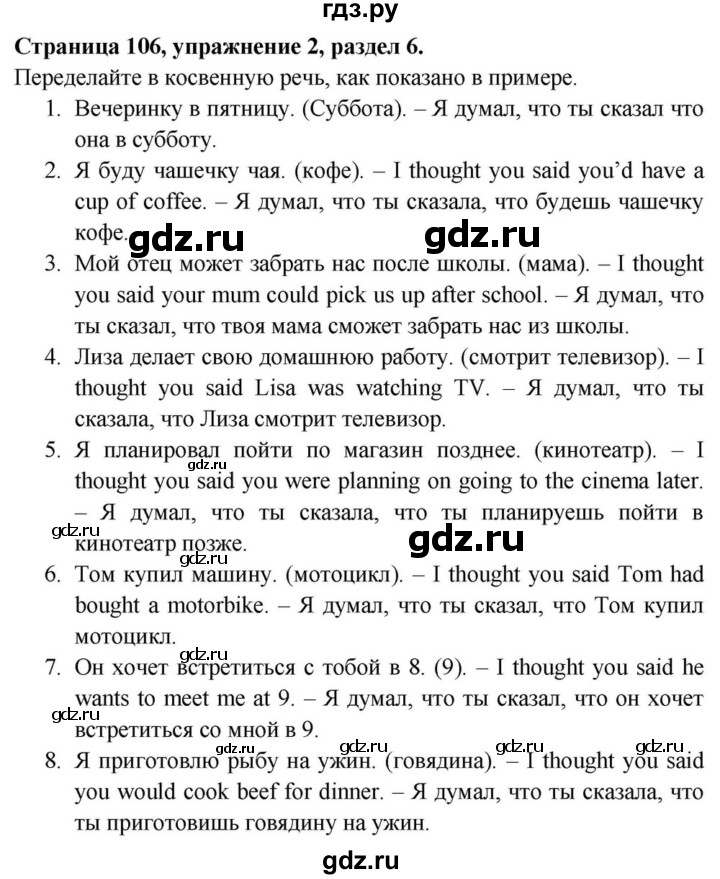
#### Exercise 2
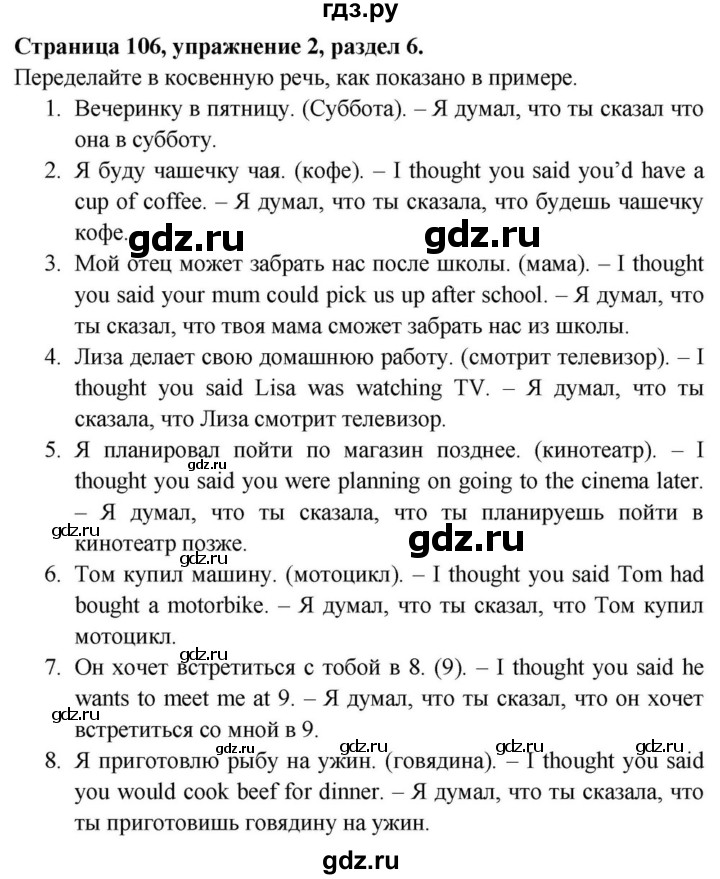
1. The party's on Friday. (Saturday) — *I thought you said it was on Saturday.*
2. I'll have a cup of tea. (coffee) — **I thought you said you would have a cup of coffee.**
3. My dad can pick us up after school. (mum) — **I thought you said your mum could pick us up after school.**
4. Lisa is doing her homework. (watch TV) — **I thought you said Lisa was watching TV.**
5. I was planning to go shopping later. (cinema) — **I thought you said you were planning to go to the cinema later.** *(или: ...had been planning...)*
6. Tom has bought a car. (motorbike) — **I thought you said Tom had bought a motorbike.**
7. He wants to meet you at 8. (9) — **I thought you said he wanted to meet me at 9.**
8. I will cook fish for dinner. (beef) — **I thought you said you would cook beef for dinner.**
---
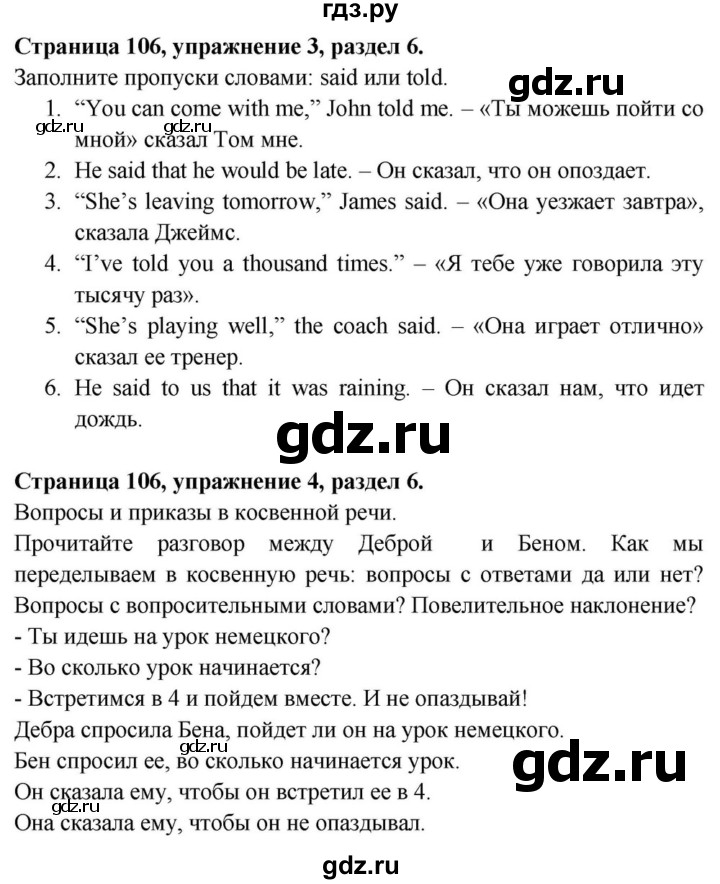
#### Exercise 3
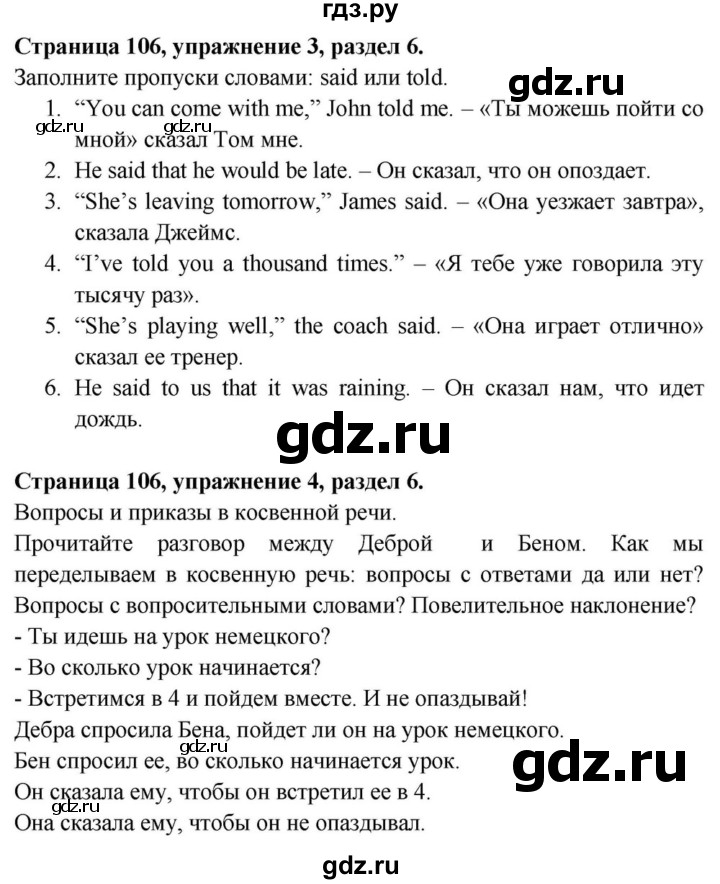
1. "You can come with me," John **told** me.
2. He **said** that he would be late.
3. "She's leaving tomorrow," James **said**.
4. "I've **told** you a thousand times."
5. "She's playing well," the coach **said**.
6. He **said** to us that it was raining.
---
#### Exercise 4
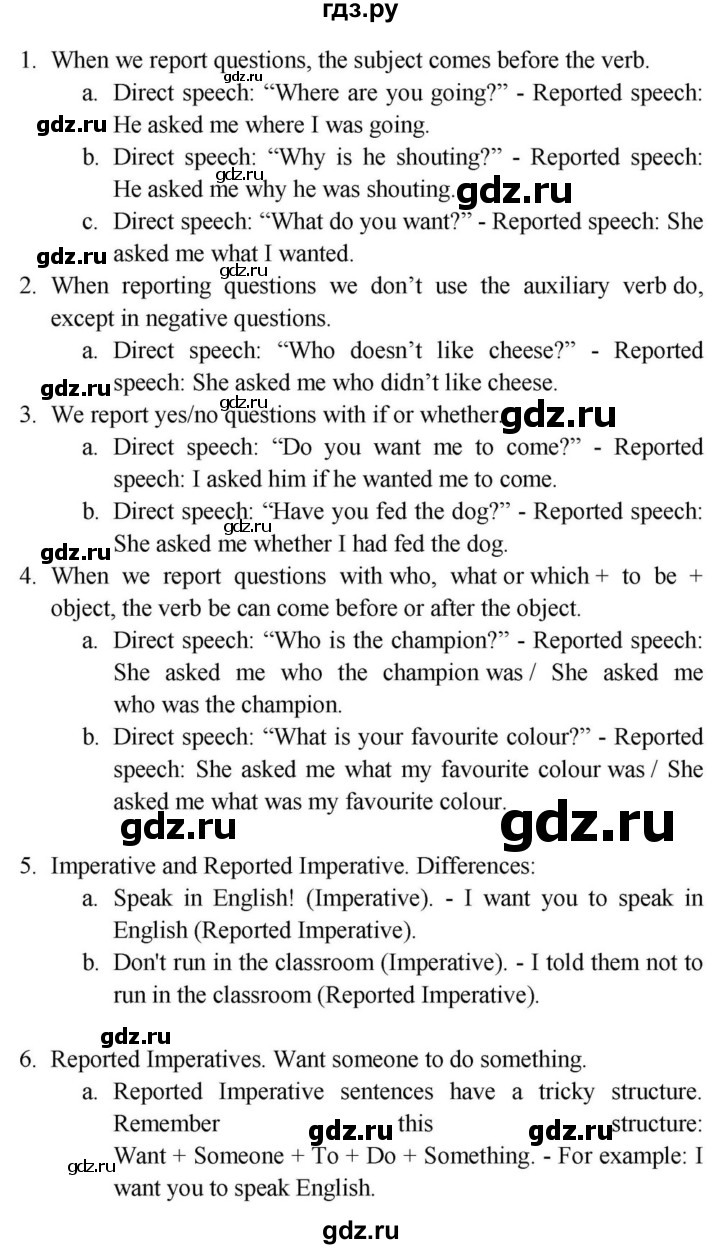
* **A yes/no question:** We use the reporting verb *ask* + *if* / *whether* + subject + verb in statement word order (с прямым порядком слов и сдвигом времени назад).
* **A wh- question:** We use the reporting verb *ask* + *wh-question word* (what, where, when, etc.) + subject + verb in statement word order (с прямым порядком слов и сдвигом времени назад).
* **The imperative:** We use *tell* / *ask* + object + *(not) to-infinitive* (инфинитив с частицей *to* для утверждения или *not to* для запрета).
---
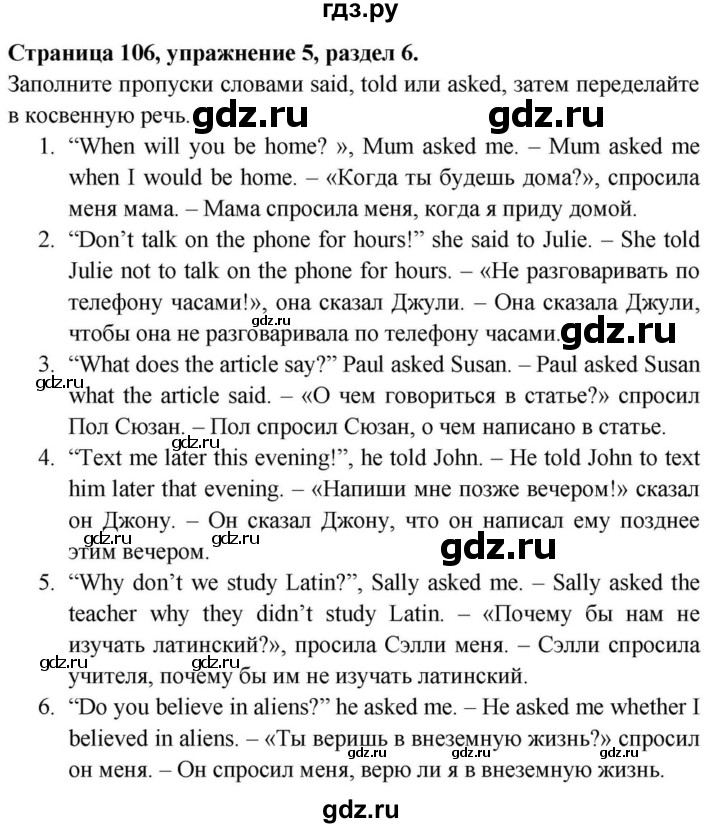
#### Exercise 5
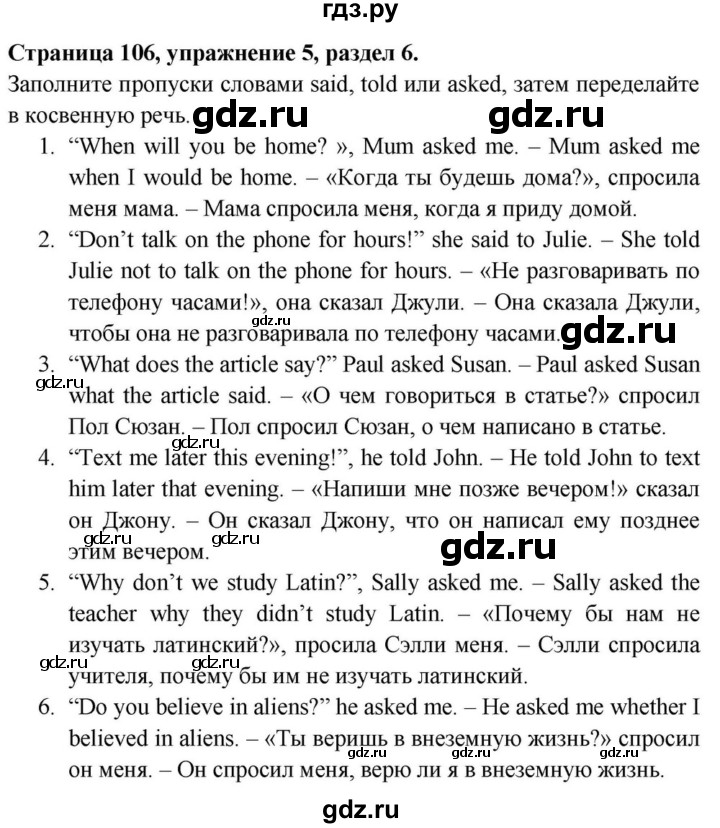
1. "When will you be home?" Mum **asked** me.
$\rightarrow$ **Mum asked me when I would be home.**
2. "Don't talk on the phone for hours!" she **said** to Julie.
$\rightarrow$ **She told Julie not to talk on the phone for hours.**
3. "What does the article say?" Paul **asked** Susan.
$\rightarrow$ **Paul asked Susan what the article said.**
4. "Text me later this evening!" he **told** John.
$\rightarrow$ **He told John to text him later that evening.**
5. "Why don't we study Latin?" Sally **asked** the teacher.
$\rightarrow$ **Sally asked the teacher why they didn't study Latin.**
6. "Do you believe in aliens?" he **asked** me.
$\rightarrow$ **He asked me if/whether I believed in aliens.**
---
### Объяснение правил и решений
1. **Согласование времён (Sequence of Tenses):**
Если глагол, вводящий косвенную речь, стоит в прошедшем времени (*said, told, asked, thought*), время смыслового глагола сдвигается на один шаг в прошлое (*Backshift*):
* Present Simple $\rightarrow$ Past Simple (*wants $\rightarrow$ wanted*)
* Present Continuous $\rightarrow$ Past Continuous (*is doing $\rightarrow$ was watching*)
* Present Perfect $\rightarrow$ Past Perfect (*has bought $\rightarrow$ had bought*)
* Future Simple (*will*) $\rightarrow$ Future-in-the-Past (*would*)
* Can $\rightarrow$ Could
2. **Разница между *say* и *tell*:**
* После **tell** обязательно указывается лицо, к которому обращаются (косвенное дополнение без предлога): *told me, told John*.
* После **say** дополнение либо отсутствует (*he said that...*), либо используется с предлогом **to** (*he said to us*).
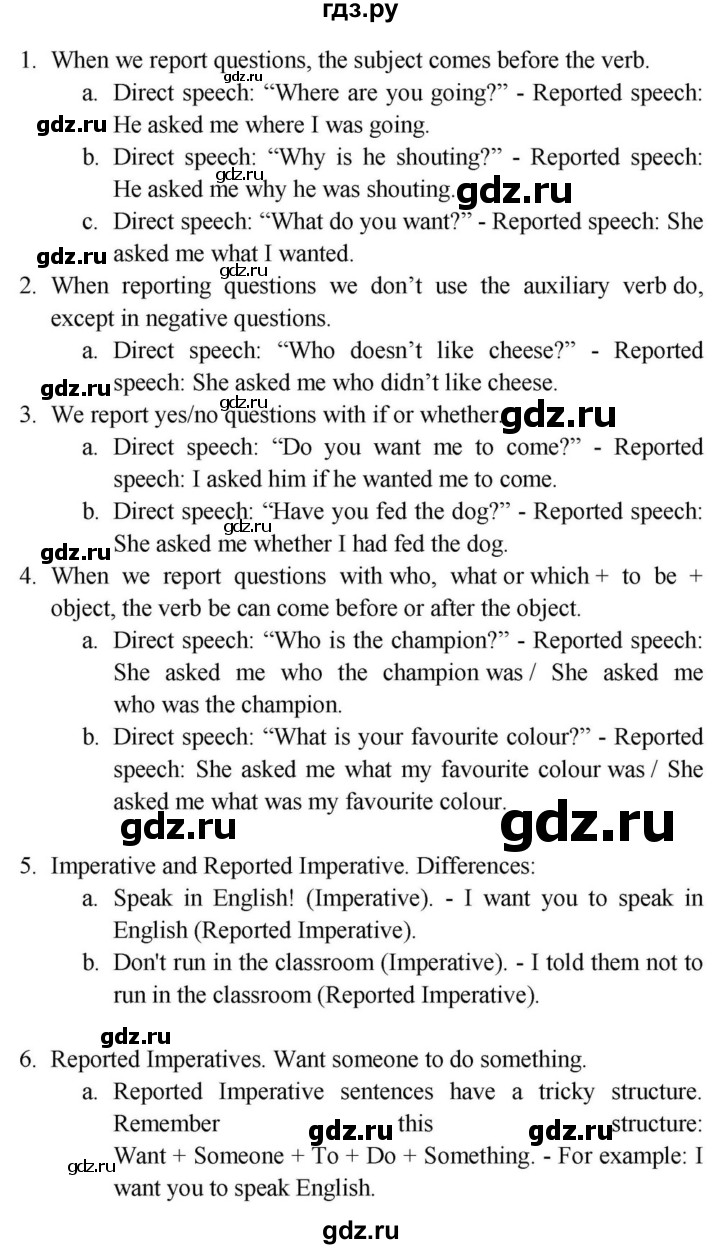
3. **Косвенные вопросы (Reported Questions):**
* Порядок слов всегда **прямой** (подлежащее стоит перед сказуемым, вспомогательные глаголы *do/does/did* не используются).
* В общих вопросах (Yes/No) в качестве союза используются **if** или **whether**.
* В специальных вопросах (Wh-questions) вопросительное слово (*what, when, why*) выполняет роль союза.
4. **Повелительное наклонение (Reported Commands / Imperatives):**
* Приказы и просьбы передаются конструкцией **глагол (told/asked) + объект + to-инфинитив** (например, *to text*).
* Отрицательные команды (запреты) передаются через **not to-инфинитив** (например, *not to talk*).
5. **Замена местоимений и указателей времени:**
* Местоимения меняются по смыслу (*I $\rightarrow$ you/he/she*, *you $\rightarrow$ me*).
* Указатели времени и места сдвигаются: *this evening $\rightarrow$ that evening*, *tomorrow $\rightarrow$ the following day*, *now $\rightarrow$ then*.
Спасибо за оценку!

Открой больше возможностей
Войди через VK — задавай вопросы ИИ и сохраняй ГДЗ в избранное
