ГДЗ по английскому языку 5 класс Баранова Starlight Углубленный уровень страница - 83

Авторы: Баранова К.М., Дули Д., Копылова В.В., Мильруд Р.П., Эванс В.
Серия: Starlight
Тип книги: Учебник
Год: 2015-2023
Рекомендуем посмотреть


Подробное решение страница № 83 по английскому языку Starlight для учащихся 5 класса Starlight Углубленный уровень, авторов Баранова, Дули, Копылова, Мильруд, Эванс 2015-2023

 ИИ-решебник / страница / 83
Ответ подготовлен нейросетью и может содержать ошибки
Объяснение и пошаговое решение
### Итоговые ответы к упражнениям (стр. 83)
---
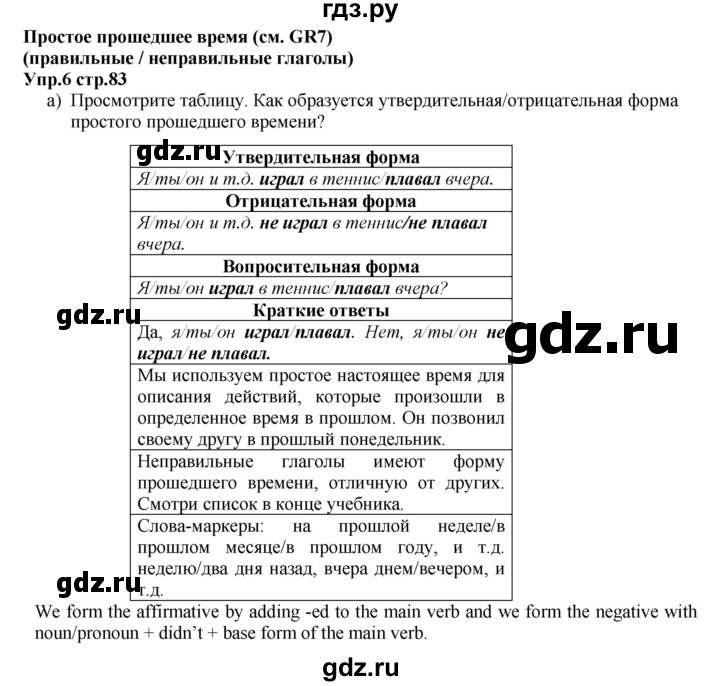
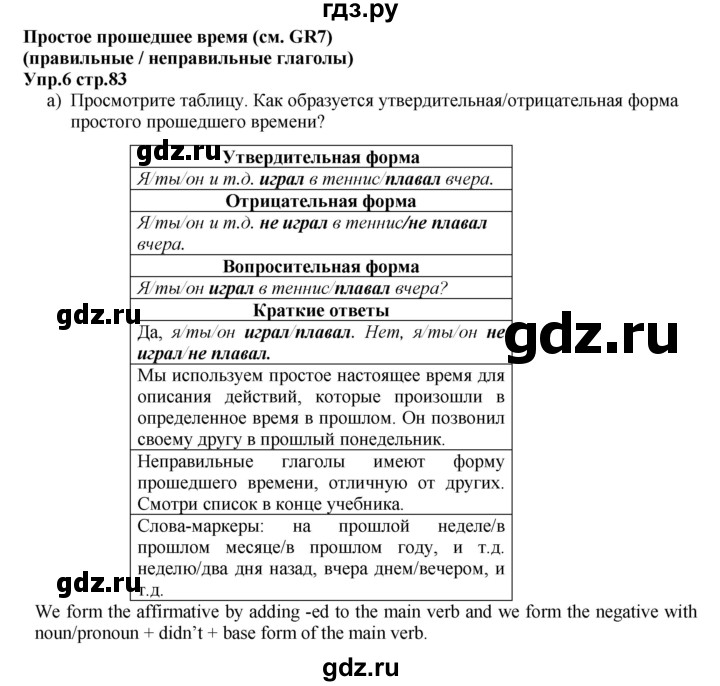
#### **Exercise 6 a)**
* **Affirmative (утвердительная форма):**
Образуется с помощью подлежащего и глагола в прошедшем времени (для правильных глаголов добавляется окончание **-ed**, у неправильных глаголов используется **вторая форма** из таблицы неправильных глаголов).
* *Схема:* **Subject + V-ed / V2** (*I played / He swam*).
* **Negative (отрицательная форма):**
Образуется с помощью вспомогательного глагола **didn't** (**did not**) и начальной формы смыслового глагола (инфинитива без частицы *to*).
* *Схема:* **Subject + didn't + V1** (*I didn't play / He didn't swim*).
---
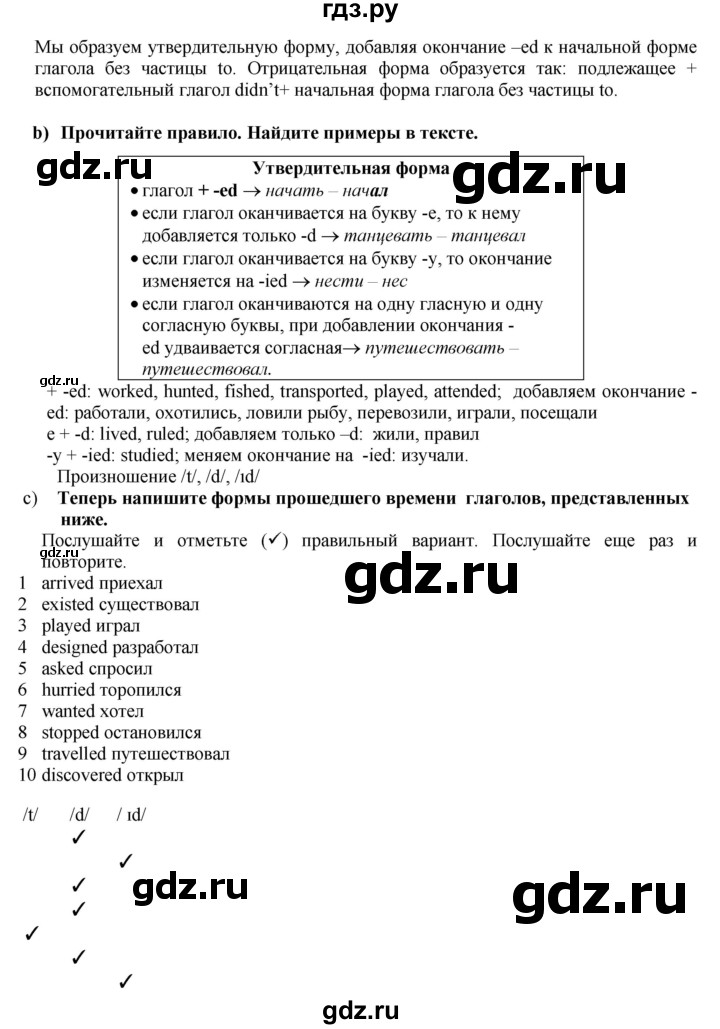
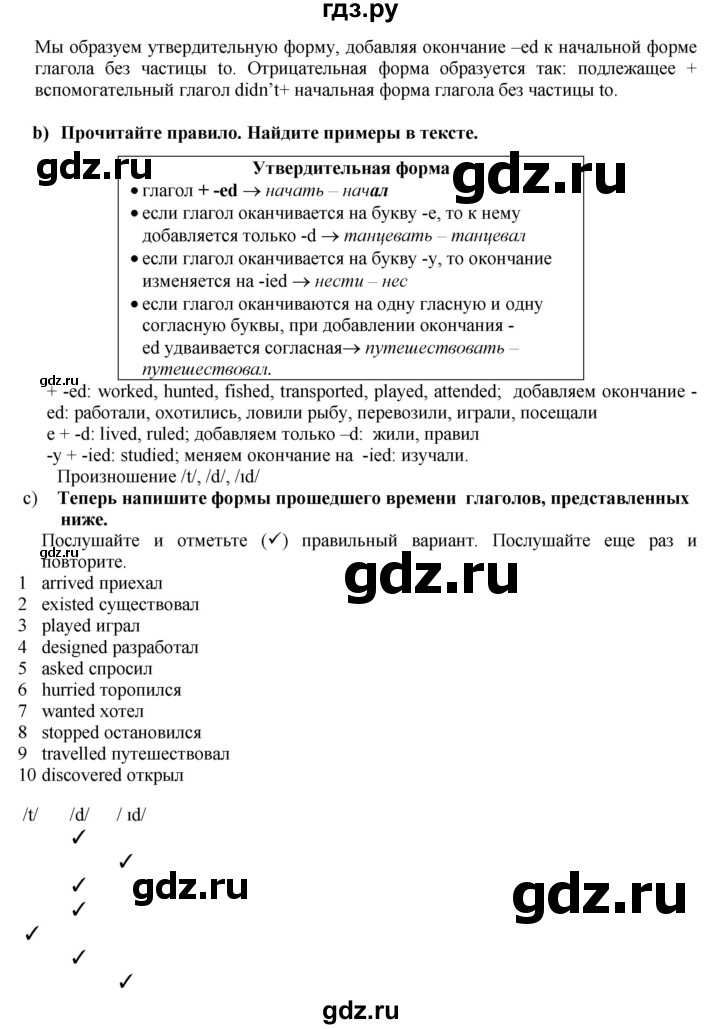
#### **Exercise 6 b)**
Примеры образования форм прошедшего времени по правилам правописания:
* **verb + -ed:** *worked, played, looked*
* **verb ending in -e + -d:** *lived, arrived, danced*
* **verb ending in consonant + -y $\rightarrow$ -ied:** *hurried, carried, tried*
* **verb ending in one stressed vowel between two consonants $\rightarrow$ double consonant + -ed:** *stopped, travelled, planned*
---
#### **Exercise 6 c)**
Формы глаголов и распределение по звучанию окончания **-ed**:
| /t/ | /d/ | /ɪd/ |
| :--- | :--- | :--- |
| 5 **asked** | 1 **arrived** | 2 **existed** |
| 8 **stopped** | 3 **played** | 7 **wanted** |
| | 4 **designed** | |
| | 6 **hurried** | |
| | 9 **travelled** | |
| | 10 **discovered** | |
---
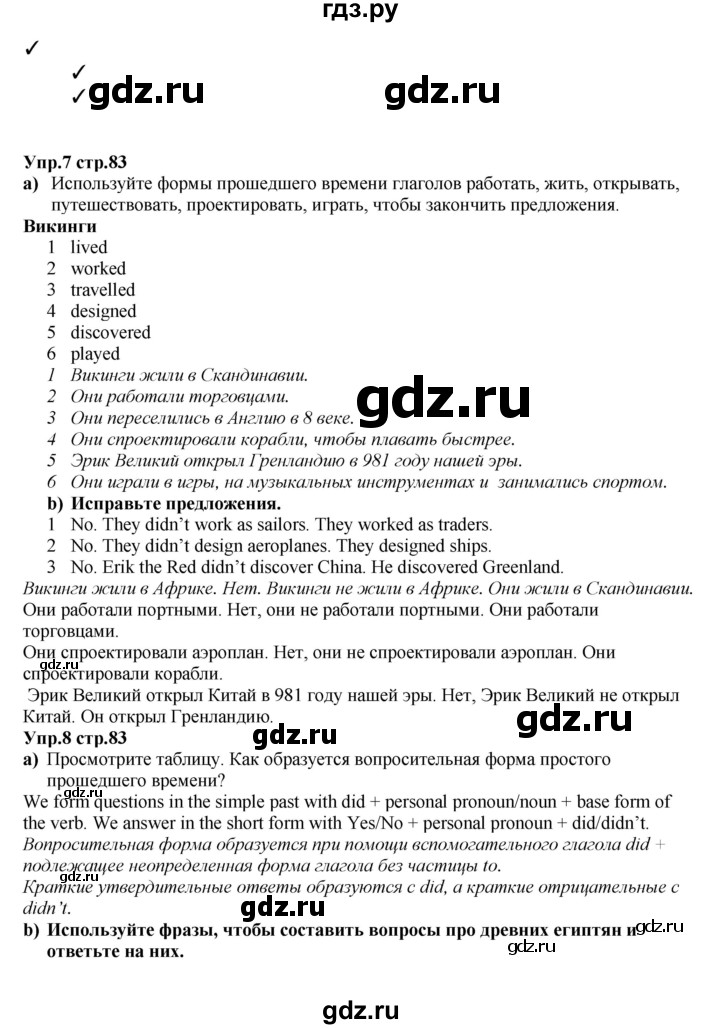
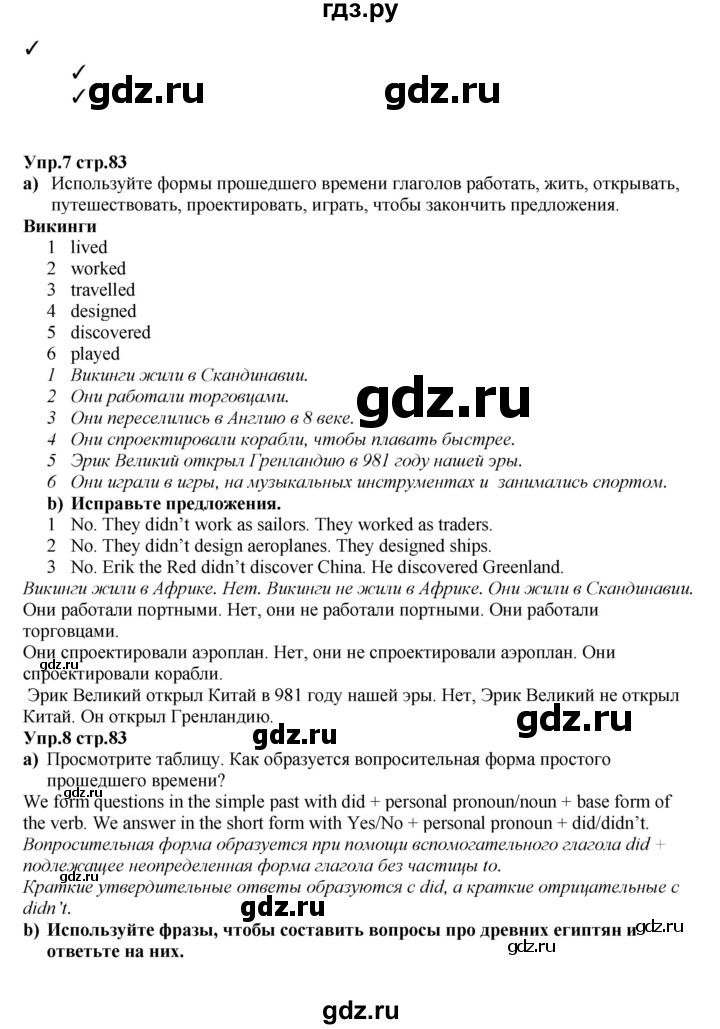
#### **Exercise 7 a)**
1. The Vikings **lived** in Scandinavia.
2. They **worked** as traders.
3. They **travelled** to England in the 8th century.
4. They **designed** ships to sail fast.
5. Erik the Red **discovered** Greenland in 981 AD.
6. They **played** games, music and sports.
---
#### **Exercise 7 b)**
1. The Vikings lived in Africa.
**No. The Vikings didn't live in Africa. They lived in Scandinavia.**
2. They worked as sailors.
**No. They didn't work as sailors. They worked as traders.**
3. They designed aeroplanes.
**No. They didn't design aeroplanes. They designed ships.**
4. Erik the Red discovered China in 981 AD.
**No. Erik the Red didn't discover China in 981 AD. He discovered Greenland.**
---
#### **Exercise 8 a)**
* **Interrogative (вопросительная форма):**
Образуется с помощью вспомогательного глагола **Did**, который ставится перед подлежащим, а основной глагол остаётся в начальной форме (инфинитив без частицы *to*).
* *Схема:* **Did + subject + V1 ...?** (*Did you play tennis?*)
---
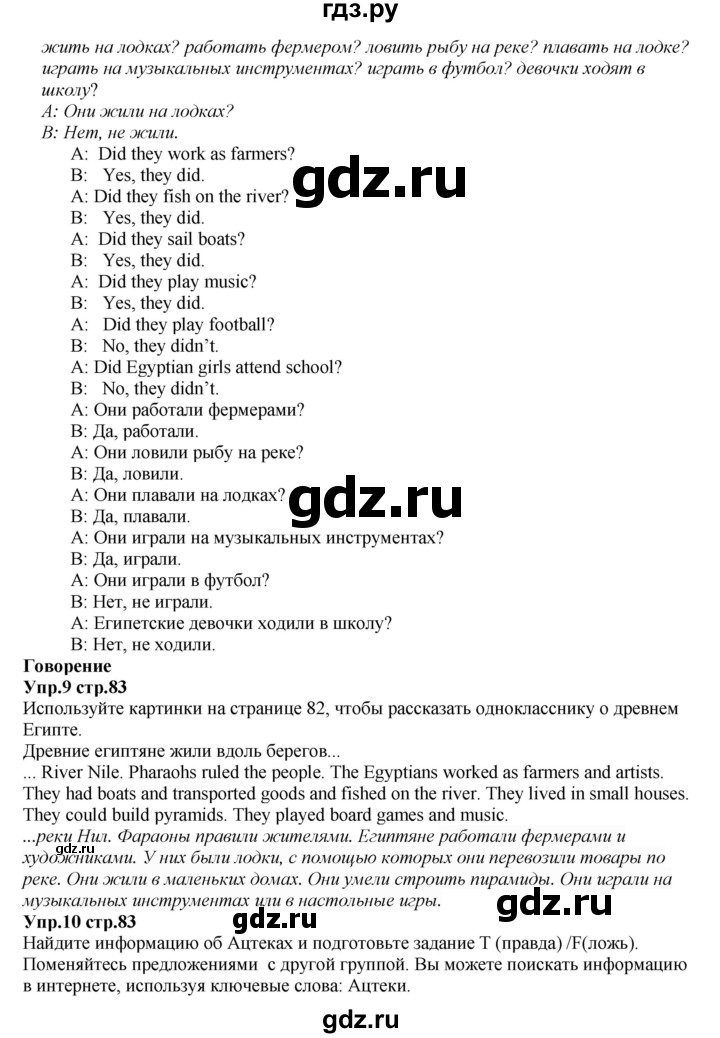
#### **Exercise 8 b)**
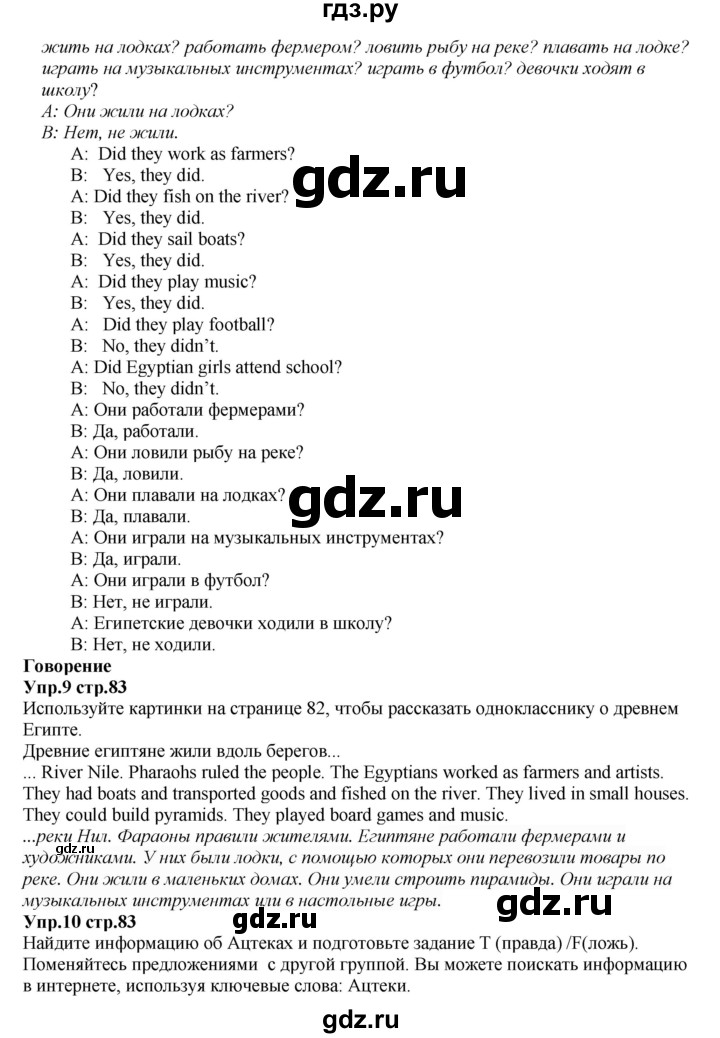
* **live on boats?**
**A:** Did they live on boats?
**B:** No, they didn't.
* **work as farmers?**
**A:** Did they work as farmers?
**B:** Yes, they did.
* **fish on the river?**
**A:** Did they fish on the river?
**B:** Yes, they did.
* **sail boats?**
**A:** Did they sail boats?
**B:** Yes, they did.
* **play music?**
**A:** Did they play music?
**B:** Yes, they did.
* **play football?**
**A:** Did they play football?
**B:** No, they didn't.
* **girls attend school?**
**A:** Did girls attend school?
**B:** No, they didn't.
---
#### **Exercise 9 (Speaking)**
**Пример рассказа о древних египтянах:**
Ancient Egyptians lived in mud-brick houses near the River Nile. Men and women worked hard. Many men worked as farmers or fishermen. They fished on the river and sailed boats. In their free time, they played board games and listened to music. Boys attended school, but most girls stayed at home and helped their mothers.
---
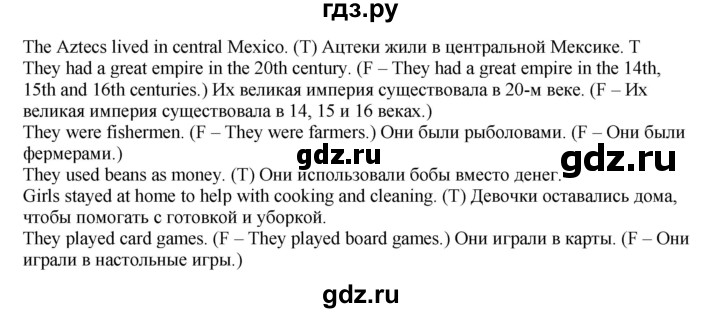
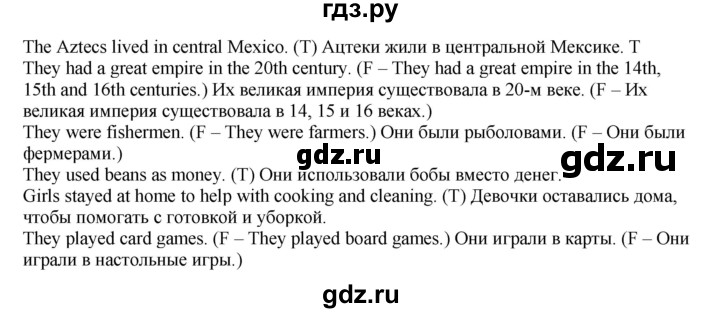
#### **Exercise 10 (ICT) — The Aztecs**
1. The Aztecs lived in Mexico. (**T**)
2. They built large pyramids and temples. (**T**)
3. Aztec children didn't go to school. (**F** — *Both boys and girls attended school.*)
4. They loved hot chocolate made from cacao beans. (**T**)
5. The Aztecs designed cars and planes. (**F** — *They didn't have cars or planes; they walked or used canoes.*)
6. They played a popular ball game called Ullamaliztli. (**T**)
---
### Подробное объяснение грамматических правил
1. **Past Simple (Прошедшее простое время):**
* Используется для описания действий, произошедших в определённое время в прошлом (*yesterday, last year, in 981 AD*).
* **Правильные глаголы:** к основе добавляется окончание **-ed** (*work $\rightarrow$ worked*).
* **Отрицания и вопросы:** вспомогательный глагол **did / didn't** «забирает» прошедшее время, поэтому основной глагол возвращается в свою первую (начальную) форму:
*He played* $\rightarrow$ *He **didn't play*** $\rightarrow$ ***Did** he **play**?*
2. **Правила чтения окончания -ed (Exercise 6 c):**
* **/ɪd/** — читается после звуков **/t/** и **/d/** (*want $\rightarrow$ wanted, exist $\rightarrow$ existed*).
* **/t/** — читается после глухих согласных звуков (кроме /t/): **/k/, /p/, /s/, /ʃ/, /tʃ/, /f/** (*ask $\rightarrow$ asked, stop $\rightarrow$ stopped*).
* **/d/** — читается после звонких согласных (кроме /d/) и всех гласных звуков (*arrive $\rightarrow$ arrived, play $\rightarrow$ played, design $\rightarrow$ designed, hurry $\rightarrow$ hurried, travel $\rightarrow$ travelled, discover $\rightarrow$ discovered*).
Оцени решение:
Спасибо за оценку!