ГДЗ по английскому языку 6 класс Баранова рабочая тетрадь Starlight Углубленный уровень страница - 58

Авторы: К. М. Баранова, Д. Дули, В. В. Копылова, Р. П. Мильруд, В. Эванс
Серия: Starlight
Тип книги: Рабочая тетрадь
Год: 2016-2023
Рекомендуем посмотреть


Подробное решение страница № 58 по английскому языку рабочая тетрадь Starlight для учащихся 6 класса Starlight Углубленный уровень, авторов Баранова, Дули, Копылова, Мильруд, Эванс 2016-2023

 ИИ-решебник / страница / 58
Ответ подготовлен нейросетью и может содержать ошибки
Объяснение и пошаговое решение
### Итоговые ответы
#### Vocabulary
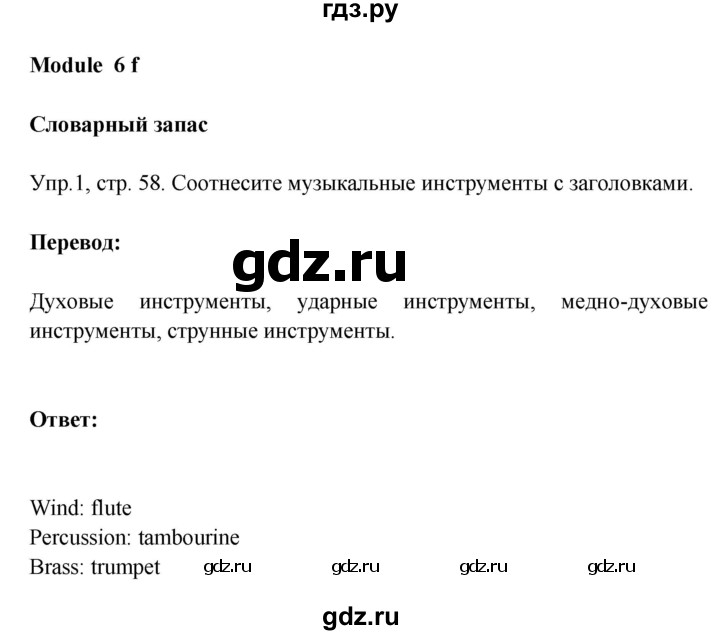
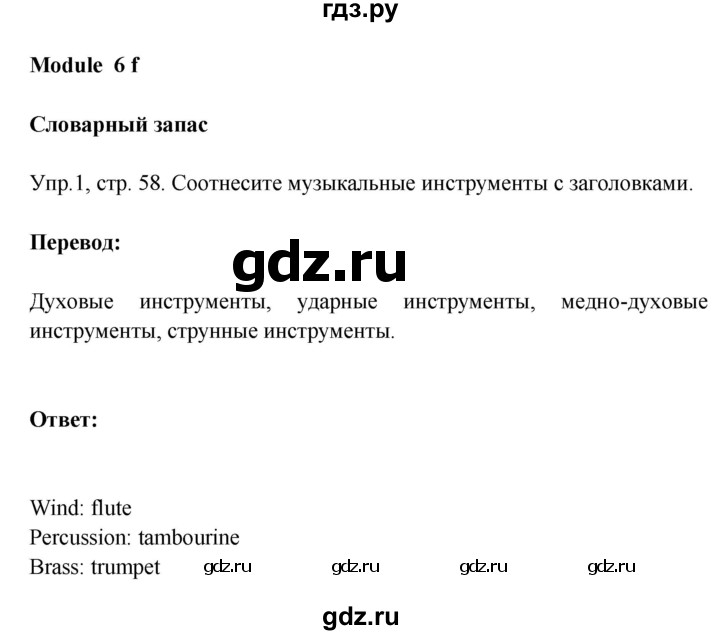
**1. Match the musical instruments to the headings.**
1. **String** — Violin
2. **Percussion** — Tambourine
3. **Wind** — Flute
4. **Brass** — Trumpet
---
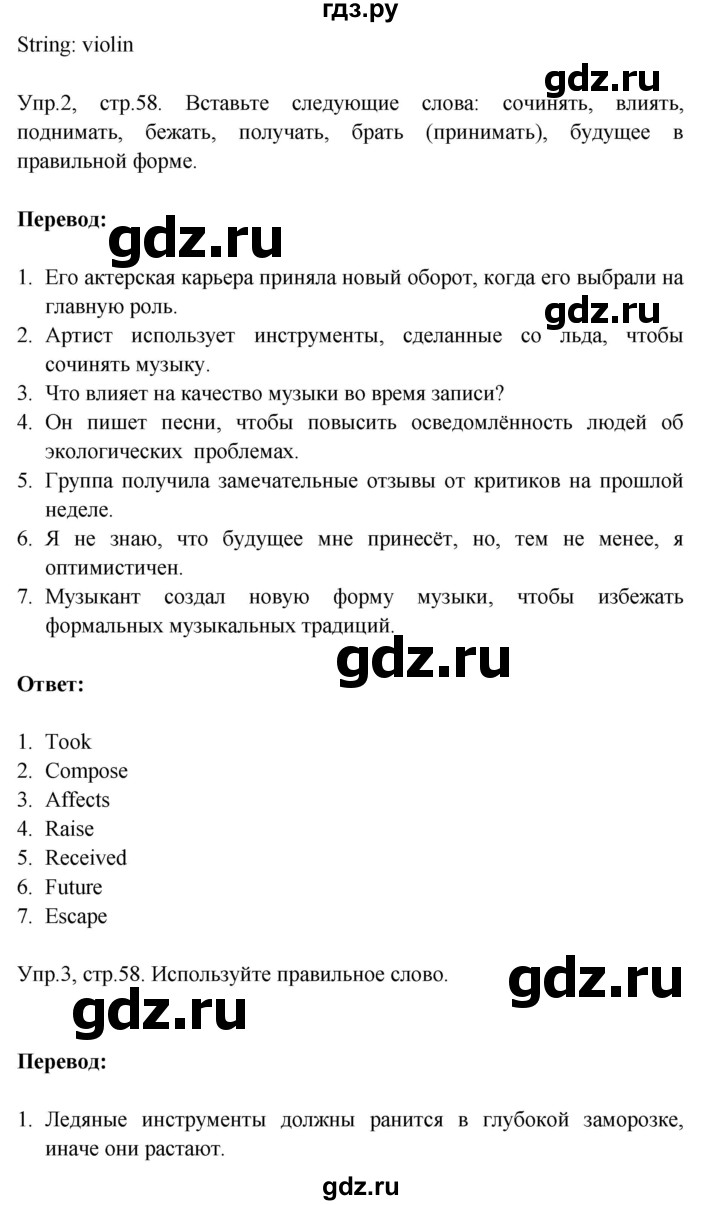
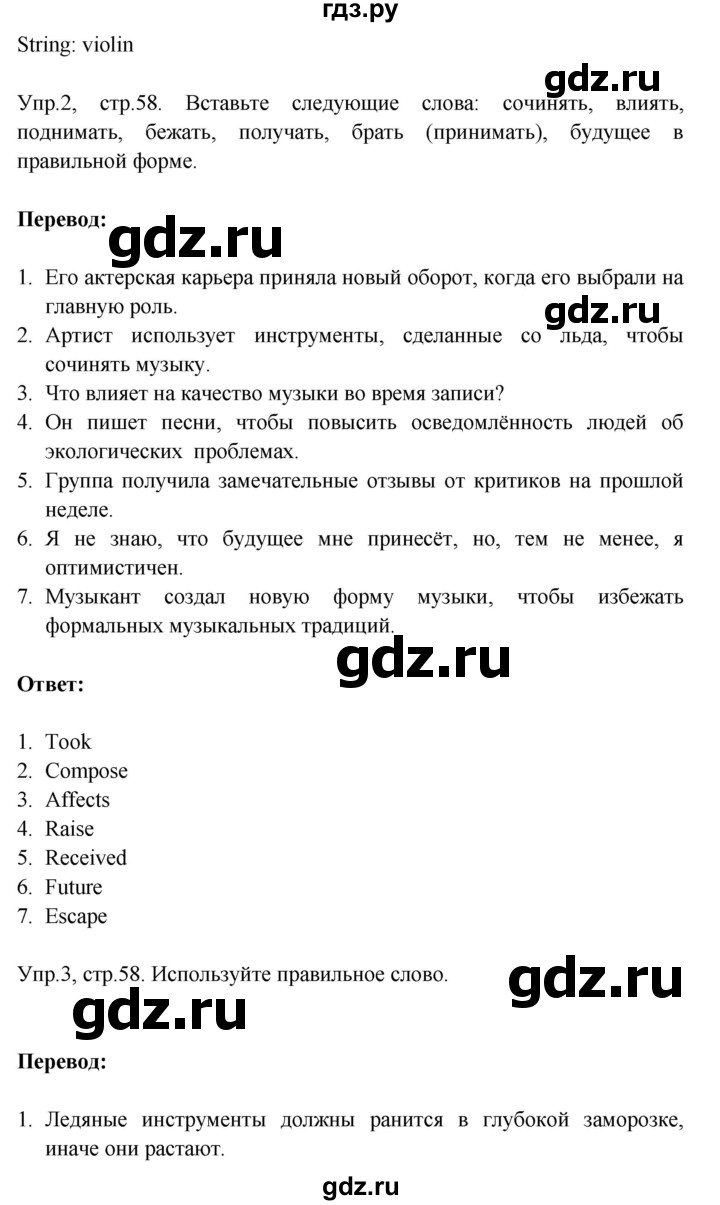
**2. Fill in: compose, affect, raise, escape, receive, take and future in the correct form.**
1. His acting career **took** a new direction when he was cast in a leading role.
2. The artist uses instruments made from ice to **compose** music.
3. What **affects** the sound quality during a recording?
4. He writes songs to **raise** people's awareness of environmental problems.
5. The band **received** great reviews from the critics last week.
6. I don't know what the **future** holds for me; but I am optimistic nonetheless.
7. The musician created a new form of music to **escape** normal musical traditions.
---
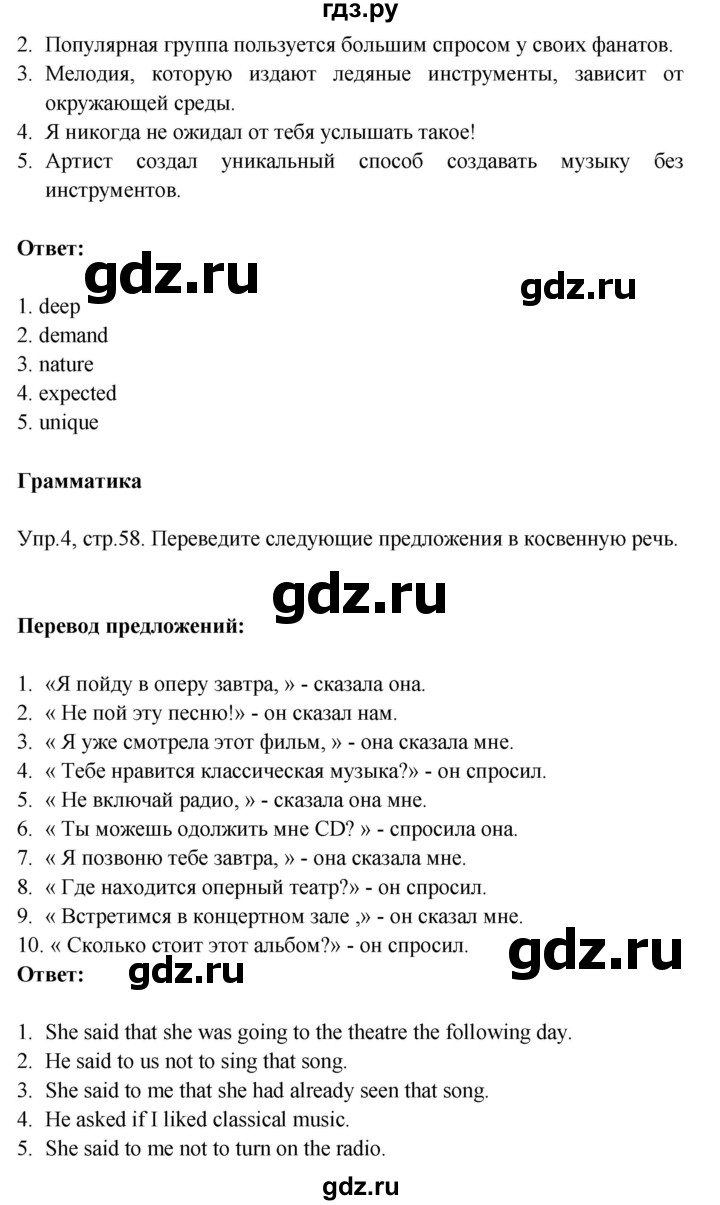
**3. Choose the correct word.**
1. Ice instruments must be kept in a **deep** freeze or they will melt.
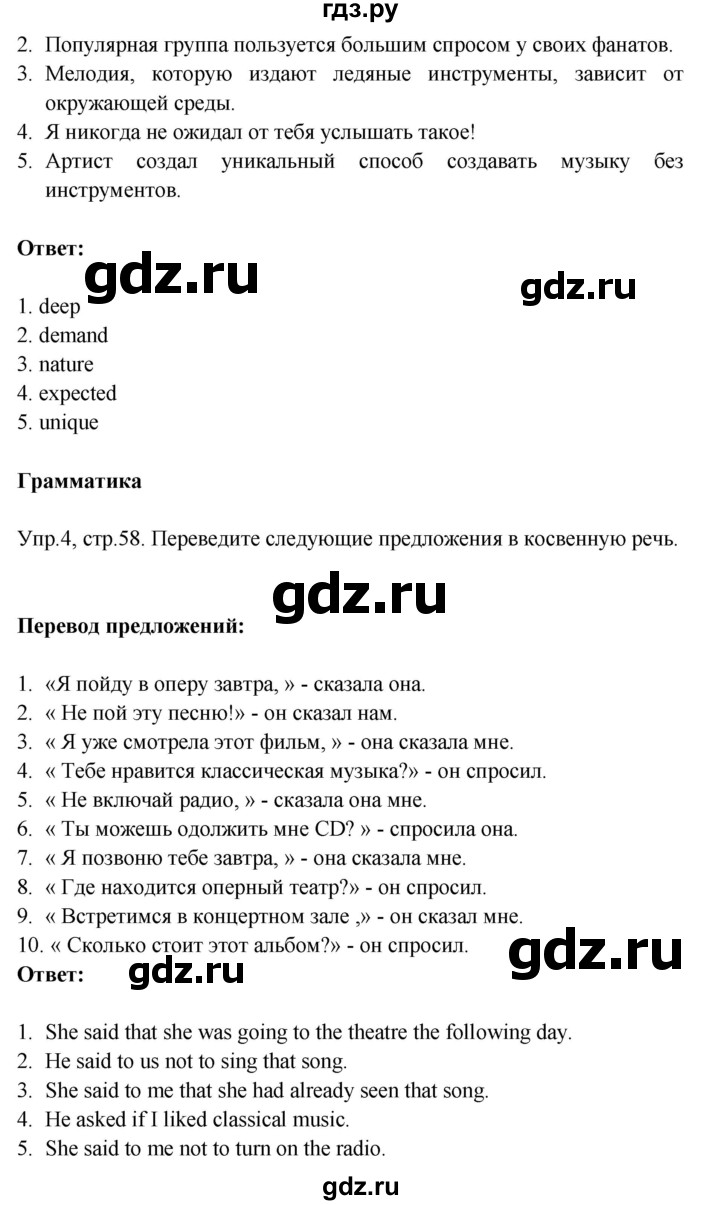
2. The popular band was in **demand** by their fans.
3. The kind of melody the ice instruments make during a concert is up to **nature**.
4. I never **expected** to hear you say such a thing!
5. The artists have created a **unique** way of making music without instruments.
---
#### Grammar
**4. Turn the following into reported speech.**
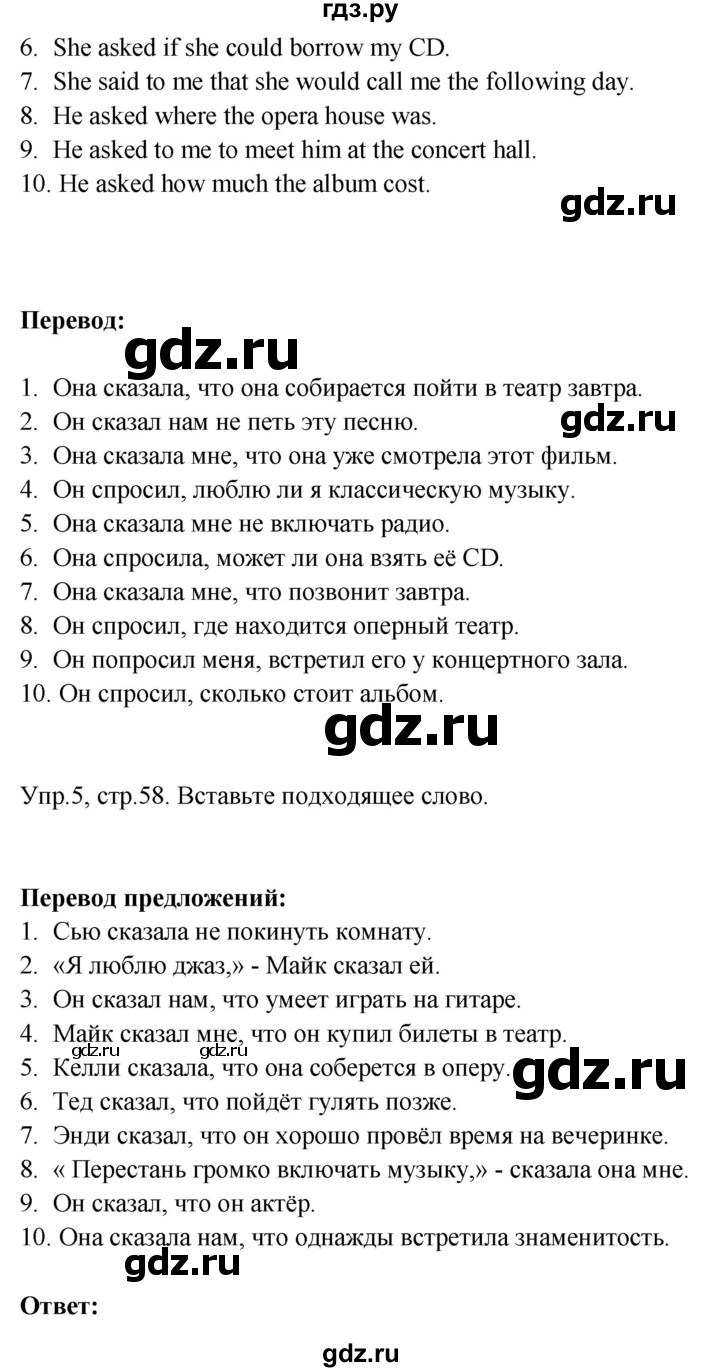
1. She said (that) she was going to the opera the following day *(или: the next day)*.
2. He told us not to sing that song.
3. She told me (that) she had already seen that film.
4. He asked if / whether I liked classical music.
5. She told me not to turn on the radio.
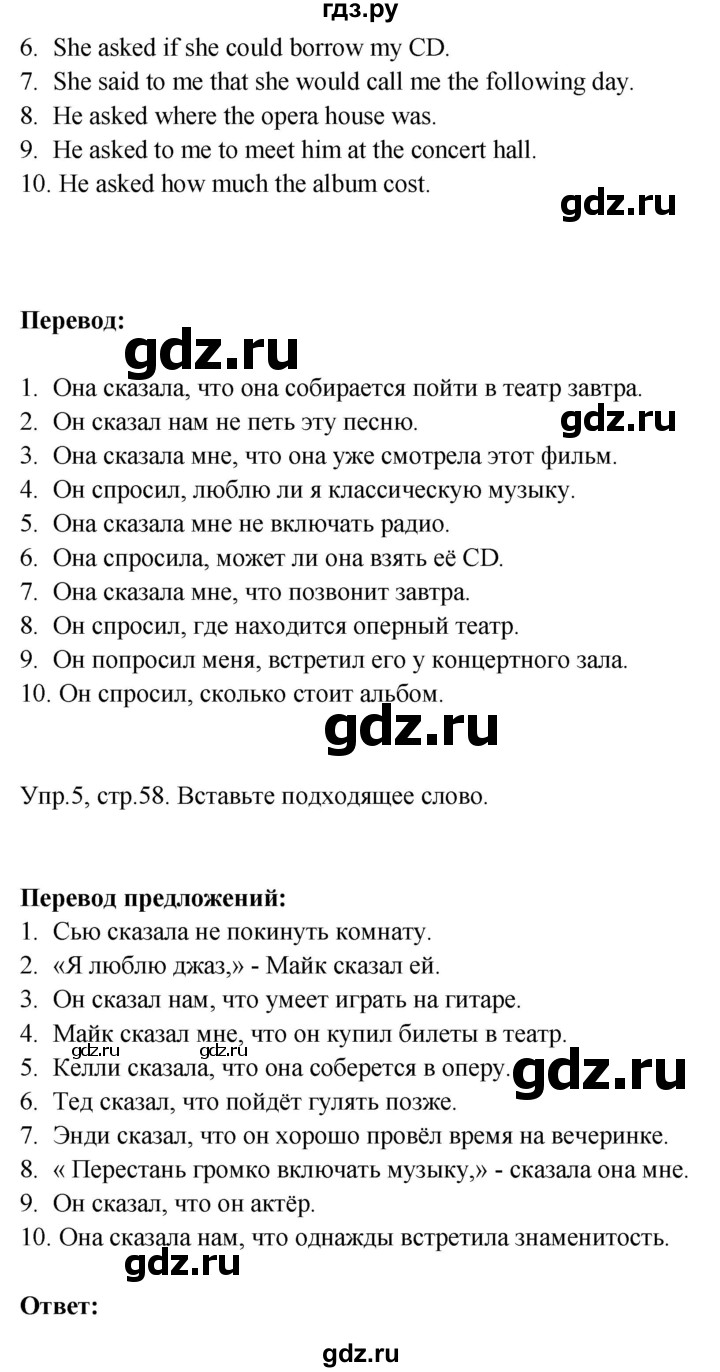
6. She asked if / whether she could borrow my CD.
7. She told me (that) she would call me the following day *(или: the next day)*.
8. He asked where the opera house was.
9. He told me to meet him at the concert hall.
10. He asked how much the album had cost.
---
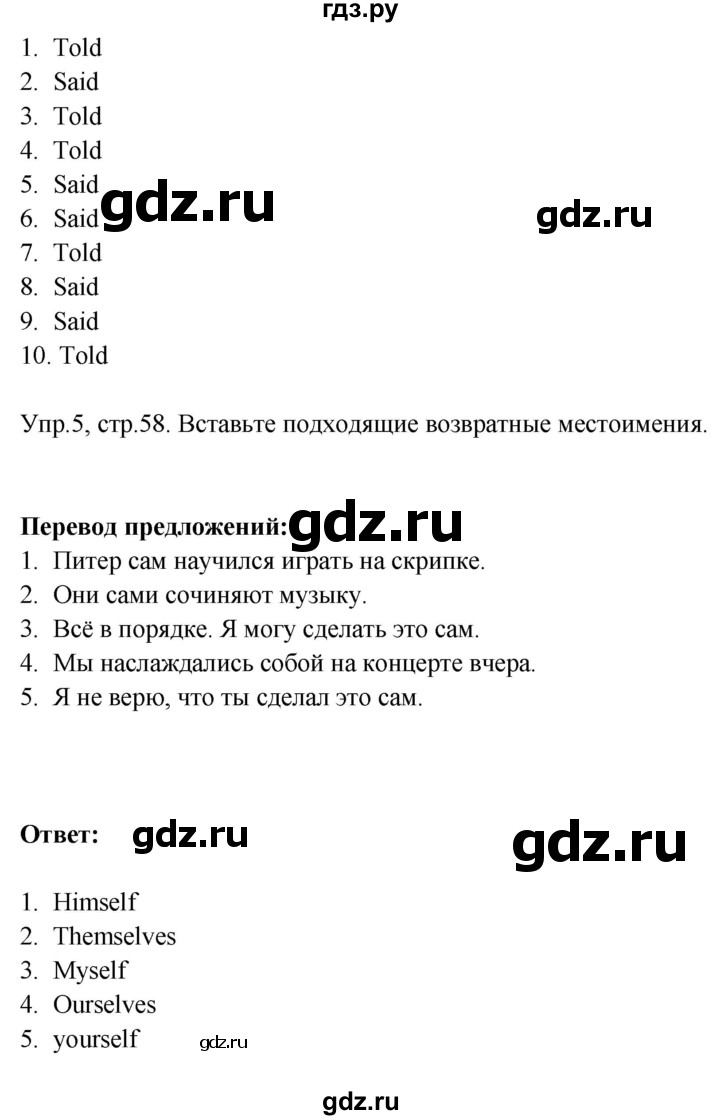
**5. Fill in: said or told.**
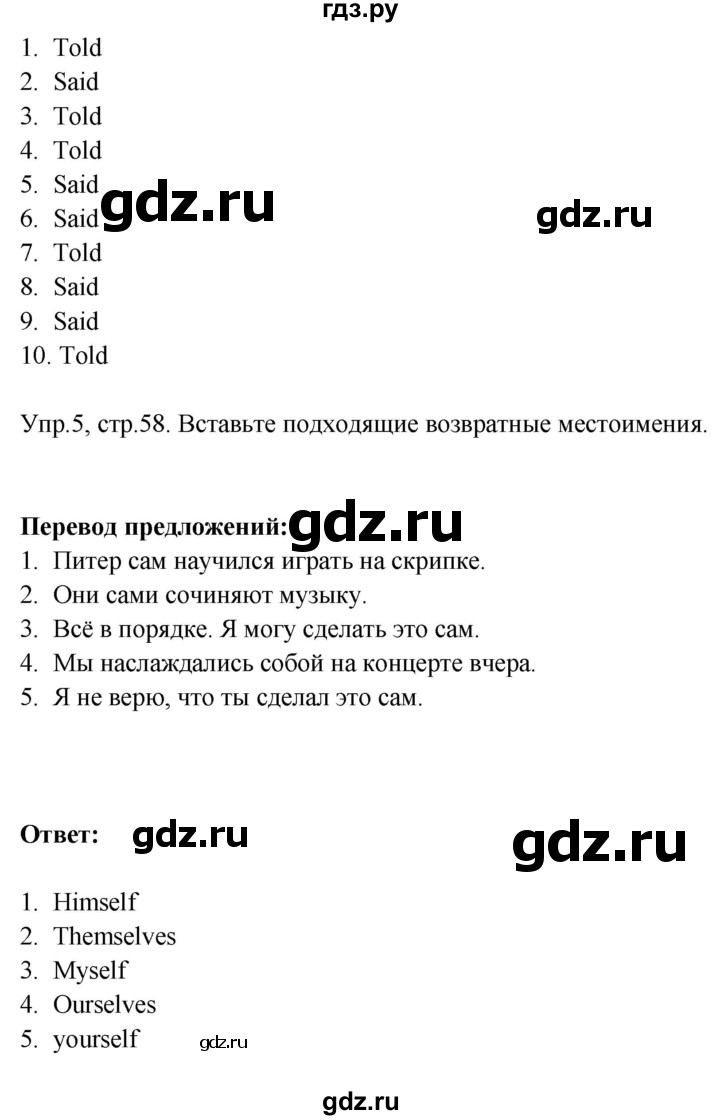
1. Sue **told** me to leave the room.
2. "I love jazz," Mike **said** to her.
3. He **told** us that he could play the guitar.
4. Mark **told** me he had bought the theatre tickets.
5. Kelly **said** that she was going to the opera.
6. Ted **said** that we would go out later.
7. Andy **told** me that he was having a great time at the party.
8. "Stop playing loud music," she **said** to me.
9. He **said** he was an actor.
10. She **told** us that she had met a famous celebrity once.
---
**6. Fill in the correct reflexive pronoun.**
1. Peter taught **himself** how to play the violin.
2. They composed the music **themselves**.
3. It's OK. I can do it **myself**.
4. We enjoyed **ourselves** at the concert last night.
5. I can't believe you made this **yourself** *(или: **yourselves**)*.
---
### Подробное объяснение и правила
#### Упражнение 1 (Группы музыкальных инструментов)
* **String** (струнные) — *Violin* (скрипка).
* **Percussion** (ударные) — *Tambourine* (бубен).
* **Wind** (деревянные духовые) — *Flute* (флейта).
* **Brass** (медные духовые) — *Trumpet* (труба).
#### Упражнение 2 (Словообразование и выбор слова)
1. **took** — устойчивое выражение *take a new direction* (взять новое направление). Так как действие произошло в прошлом (*was cast*), используем форму Past Simple глагола *take*.
2. **compose** — после частицы *to* ставится инфинитив: *to compose music* (сочинять музыку).
3. **affects** — вопрос к подлежащему в Present Simple (*What affects...?* — Что влияет...?). К глаголу добавляется окончание **-s**.
4. **raise** — устойчивое сочетание *to raise awareness* (повышать осведомленность).
5. **received** — указатель времени *last week* требует времени Past Simple (добавляем окончание **-ed**).
6. **future** — существительное: *what the future holds* (что готовит будущее).
7. **escape** — после частицы *to* используется инфинитив: *to escape traditions* (уйти от / избежать традиций).
#### Упражнение 3 (Лексическая сочетаемость)
1. **deep freeze** — устойчивое выражение (глубокая заморозка / морозильная камера).
2. **in demand** — устойчивое выражение (пользующийся спросом).
3. **up to nature** — зависит от природы (*be up to* = зависеть от).
4. **expected** — *expect to hear* (ожидать услышать). Глагол *wait* требует предлога *for*.
5. **unique** — «уникальный» способ создания музыки (*talented* обычно относится к человеку).
#### Упражнение 4 (Косвенная речь — Reported Speech)
При переводе прямой речи в косвенную глаголы сдвигаются на одно время назад (**Backshift**), местоимения меняются по смыслу, а указатели времени перефразируются:
* *Present Continuous* $\rightarrow$ *Past Continuous* (`am going` $\rightarrow$ `was going`, `tomorrow` $\rightarrow$ `the following day`).
* Повелительное наклонение (просьбы/приказы): `Don't do...` $\rightarrow$ `not to do...`, `Do...` $\rightarrow$ `to do...`.
* *Present Perfect* $\rightarrow$ *Past Perfect* (`have seen` $\rightarrow$ `had seen`).
* Общие вопросы начинаются с **if / whether**, порядок слов становится прямым (`Do you like...?` $\rightarrow$ `if I liked...`).
* Модальный глагол: `can` $\rightarrow$ `could`.
* *Future Simple*: `will` $\rightarrow$ `would`.
* Специальные вопросы сохраняют вопросительное слово, но порядок слов становится повествовательным (`is` $\rightarrow$ `was` в конце предложения: `where the opera house was`).
* *Past Simple* $\rightarrow$ *Past Perfect* (`did cost` $\rightarrow$ `had cost`).
#### Упражнение 5 (Разница между said и told)
* **Told** используется, когда указано лицо, к которому обращаются (косвенное дополнение без предлога): *told me, told us, told him*.
* **Said** используется, когда адресат не указан (*said that...*) либо когда перед адресатом стоит предлог **to** (*said to me*).
#### Упражнение 6 (Возвратные местоимения — Reflexive Pronouns)
Местоимение согласуется с подлежащим:
1. Peter (*he*) $\rightarrow$ **himself** (научился сам).
2. They $\rightarrow$ **themselves** (сами).
3. I $\rightarrow$ **myself** (я сам).
4. We $\rightarrow$ **ourselves** (*enjoy oneself* — хорошо проводить время).
5. You $\rightarrow$ **yourself** (ты сам) или **yourselves** (вы сами).
Оцени решение:
Спасибо за оценку!