


ГДЗ по английскому языку 11 класс Афанасьева Spotlight Базовый уровень страница - 43

Авторы: Афанасьева О.В., Дули Д., Михеева И.В., Оби Б., Эванс В.
Серия: Spotlight
Тип книги: Учебник
Год: 2015-2024
Рекомендуем посмотреть


 Премиум
Подробное решение страница № 43 по английскому языку Spotlight для учащихся 11 класса Spotlight Базовый уровень, авторов Афанасьева, Дули, Михеева, Оби, Эванс 2015-2024
### RNE Reading: Matching headings to paragraphs
#### Ответ:
| A | B | C | D | E | F | G |
|---|---|---|---|---|---|---|
| 4 | 2 | 7 | 1 | 5 | 8 | 3 |
*Лишний заголовок:* **6 Fashion conscious**
---
#### Пояснение к соответствиям:
* **A — 4 (Dealing with bullying):** Фраза *«Being picked on at school»* обозначает школьную травлю (буллинг), а в тексте рассказывается о том, как разные школы справляются с этой проблемой (*«how schools deal with the situation»*).
* **B — 2 (Relationship ups and downs):** Речь идет о дружбе, ее радостях (*«most fulfilling things»*) и сложностях, когда всё идет не так (*«upsetting if things go wrong»*).
* **C — 7 (Solving problems):** Текст посвящен программе помощи сверстников-посредников (*peer mediation*), которая помогает решать конфликты мирным путем (*«help them to develop their own solution to the conflict»*).
* **D — 1 (Unrealistic expectations):** Говорится о недостижимых стандартах красоты (*«unattainable standards»*), навязанных знаменитостями, которым подростки пытаются соответствовать.
* **E — 5 (Generation gap):** Описывается проблема взаимопонимания между родителями и подростками («проблема отцов и детей» / *generation gap*).
* **F — 8 (Meeting the costs):** Рассматриваются способы покрытия подростковых расходов (*«cover their expenses»*) — подработка или выполнение домашних обязанностей за карманные деньги.
* **G — 3 (Feeling the pressure):** Текст рассказывает о стрессе из-за экзаменов и давлении (*«feel under so much stress»*, *«pressures they will face»*).
---
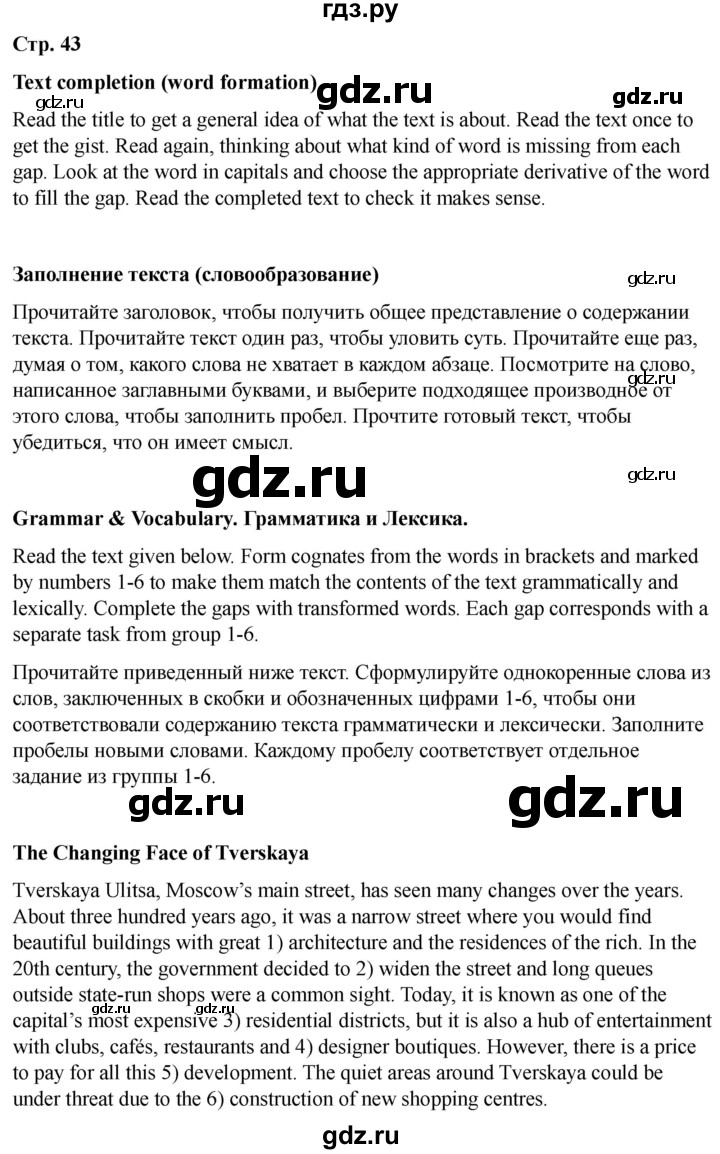
### RNE Grammar & Vocabulary: Text completion (word formation)
#### Ответ:
1. **architecture**
2. **widen**
3. **residential**
4. **designer**
5. **development**
6. **construction**
---
#### Пояснение к словообразованию:
1. **architecture** — после прилагательного *great* требуется существительное со значением «архитектура» (не человек-*architect*, а характеристика зданий).
2. **widen** — после частицы *to* в конструкции *decided to do something* требуется инфинитив глагола. От прилагательного *wide* глагол образуется с помощью суффикса *-en*.
3. **residential** — перед существительным *districts* требуется прилагательное («жилые районы»). Образуется с помощью суффикса *-ial*.
4. **designer** — устойчивое сочетание *designer boutiques* («дизайнерские бутики»).
5. **development** — после определителя *all this* требуется существительное, образованное от глагола *develop* при помощи суффикса *-ment*.
6. **construction** — перед нами конструкция с определенным артиклем и предлогом (*the ... of*), требующая существительного: *the construction of* («строительство»).
---
### RNE Writing: Informal Letter
#### Образец письма:
Moscow, Russia
May 15th
Dear Fiona,
Thanks for your letter! It's always great to hear from you.
Our anti-bullying week went really well. We had special workshops where we learned how to resolve conflicts peacefully and support each other. We also created posters and put on a short play about the consequences of bullying. In my opinion, events like this are very effective because they raise awareness and teach students not to stay silent when someone is being mistreated.
Anyway, tell me more about the party you're going to! Where is it going to take place? How many people are invited? What are you planning to wear?
I have to go now as I need to help my mum. Write back soon!
Best wishes,
Alex
*(123 слова)*
---
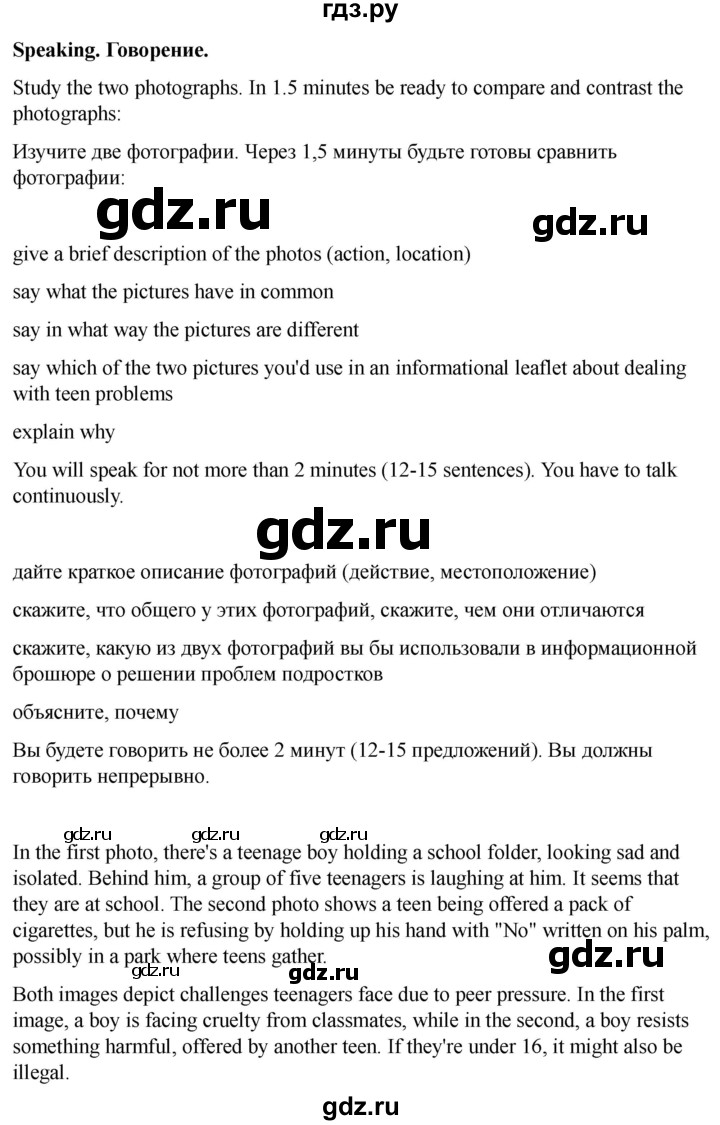
### RNE Speaking: Comparing and contrasting photographs
#### Пример устного ответа (12–15 фраз):
1. I would like to compare and contrast these two photographs, which are both related to everyday teenage experiences.
2. In the first picture, we can see a stressed teenager, probably in a classroom or a bedroom, sitting at a desk and holding his head in despair over his textbooks.
3. In the second picture, there are two teenagers sitting on a bench outside, talking openly and supporting one another.
4. Both pictures have something in common: they show young people dealing with the difficulties of growing up.
5. In addition, each image captures strong emotions typical of adolescence.
6. However, the photographs are quite different in tone and atmosphere.
7. While the first picture illustrates school-related stress, pressure from exams, and loneliness, the second picture highlights friendship, communication, and emotional support.
8. Another difference is the setting: the first photo is taken indoors, whereas the second photo is set outdoors in a relaxed environment.
9. If I had to choose one picture for an informational leaflet about dealing with teen problems, I would choose the second one.
10. The reason is that it delivers a positive and encouraging message.
11. It shows that opening up and talking to a trusted friend or mediator is an effective way to overcome difficulties and solve conflicts.
12. That is all I wanted to say.
Спасибо за оценку!










Открой больше возможностей
Войди через VK — задавай вопросы ИИ и сохраняй ГДЗ в избранное
