


ГДЗ по английскому языку 11 класс Афанасьева Spotlight Базовый уровень страница - 184

Авторы: Афанасьева О.В., Дули Д., Михеева И.В., Оби Б., Эванс В.
Серия: Spotlight
Тип книги: Учебник
Год: 2015-2024
Рекомендуем посмотреть


 Премиум
Подробное решение страница № 184 по английскому языку Spotlight для учащихся 11 класса Spotlight Базовый уровень, авторов Афанасьева, Дули, Михеева, Оби, Эванс 2015-2024
### Итоговые ответы
#### Exercise 1
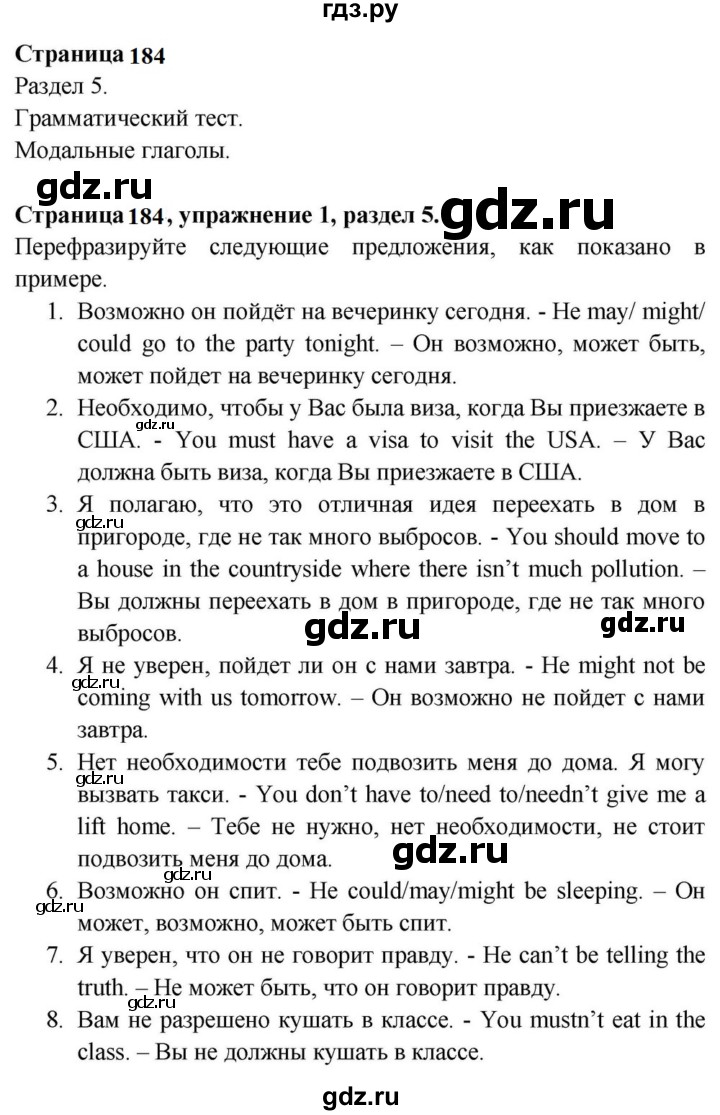
1. **He may / might / could go to the party tonight.** *(Пример)*
2. **You must / have to / need to have a visa to visit the USA.**
3. **We should / ought to move to a house in the countryside, where there isn't so much pollution.**
4. **He may / might (not) be coming with us tomorrow.**
5. **You don't have to / don't need to / needn't give me a lift home. I can take a taxi.**
6. **He may / might / could be sleeping.**
7. **He can't be telling the truth.**
8. **You mustn't / can't eat in class.**
---
#### Exercise 2
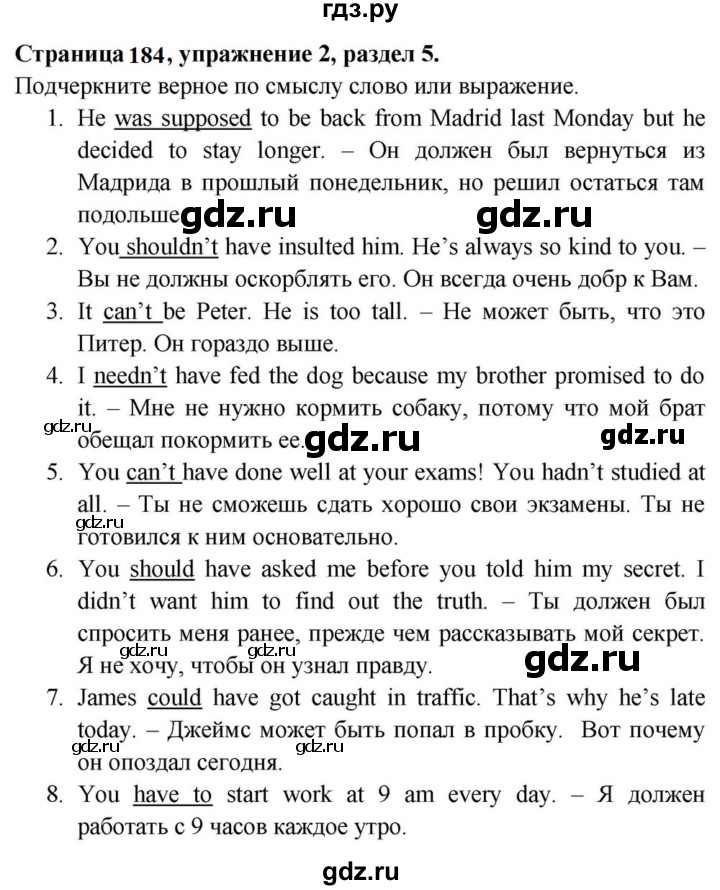
1. He **was supposed to be** back from Madrid last Monday but he decided to stay longer.
2. You **shouldn't** have insulted him. He's always so kind to you.
3. That **can't** be Peter. He is too tall.
4. I **didn't need to feed** the dog because my brother had already done it.
5. You **can't** have done well at your exams! You hadn't studied at all.
6. You **should** have asked me before you told him my secret. I didn't want him to find out the truth.
7. James **could** have got caught in traffic. That's why he's late today.
8. You **have to** start work at 9am every day.
---
#### Exercise 3
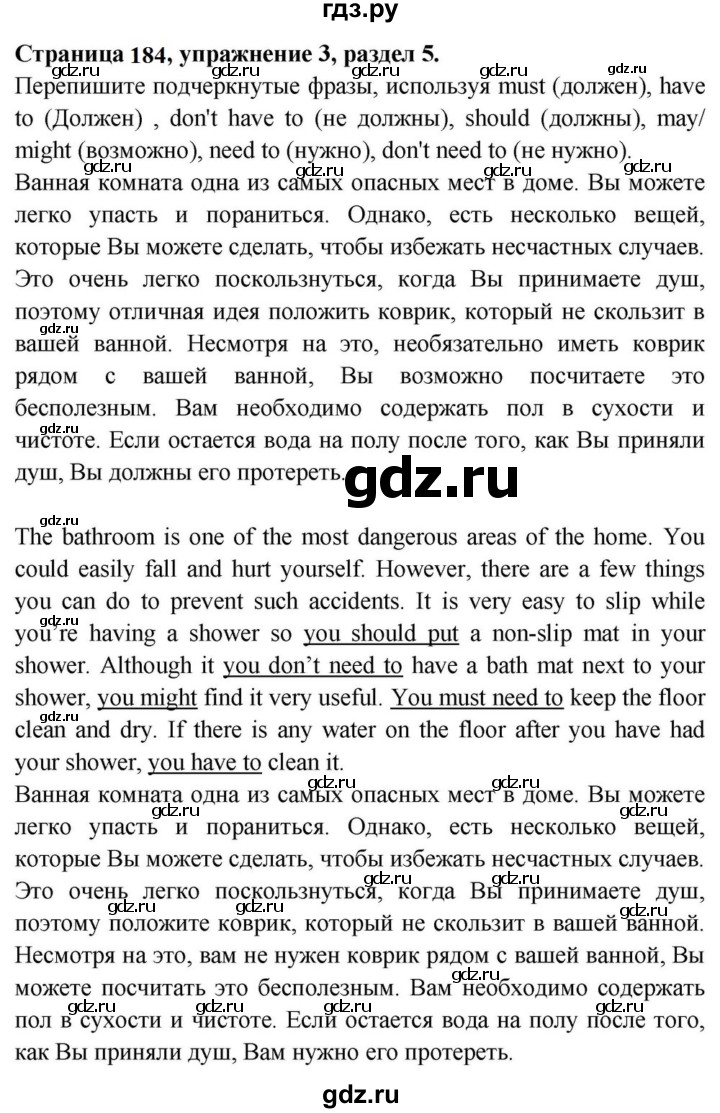
1. **you should put**
2. **you don't have to / don't need to have**
3. **you may / might find it**
4. **you must / have to / need to keep**
5. **you should / must clean it**
---
#### Exercise 4
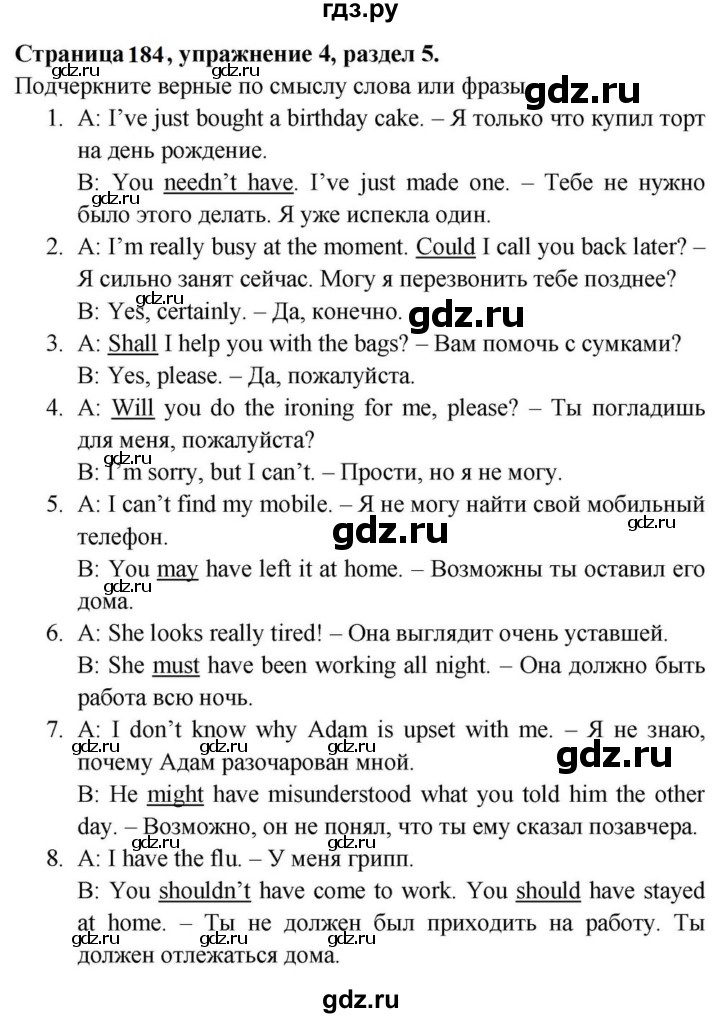
1. B: You **needn't have**. I've just made one.
2. A: **Could** I call you back later?
3. A: **Shall** I help you with the bags?
4. A: **Will** you do the ironing for me, please?
5. B: You **may** have left it at home.
6. B: She **must** have been working all night.
7. B: He **might** have misunderstood what you told him the other day.
8. B: You **shouldn't** have come to work. You **should** have stayed at home.
---
### Пояснения к решениям
#### Exercise 1
* **2:** *It's necessary* выражает необходимость $\rightarrow$ используем **must** или **have to**.
* **3:** *It's a good idea* выражает совет или рекомендацию $\rightarrow$ используем **should / ought to**.
* **4:** *I'm not sure* указывает на неуверенность и вероятность $\rightarrow$ используем **may / might**.
* **5:** *It isn't necessary* выражает отсутствие необходимости $\rightarrow$ **don't have to / don't need to / needn't**.
* **6:** *Perhaps* указывает на предположение о происходящем сейчас $\rightarrow$ **may / might / could + Continuous Infinitive (be sleeping)**.
* **7:** *I'm sure he isn't...* — уверенность в невозможности действия в настоящем $\rightarrow$ **can't + Continuous Infinitive (be telling)**.
* **8:** *Aren't allowed to* выражает запрет $\rightarrow$ **mustn't / can't**.
#### Exercise 2
1. **was supposed to be** — действие планировалось/ожидалось по договоренности, но не произошло.
2. **shouldn't have** — упрек/критика совершенного действия в прошлом («тебе не следовало его оскорблять»).
3. **can't** — логический вывод с отрицанием в настоящем («не может быть, чтобы это был Питер»).
4. **didn't need to feed** — не было необходимости делать действие, поэтому его и не совершили (*needn't have fed* значило бы, что собаку по ошибке покормили).
5. **can't have done** — уверенное предположение о невозможности действия в прошлом (*mustn't* не используется для логических выводов).
6. **should have asked** — сожаление или упрек о том, что нужно было сделать в прошлом, но сделано не было.
7. **could have got** — теоретическая возможность события в прошлом («возможно, он застрял в пробке»).
8. **have to** — внешнее правило / рабочий распорядок.
#### Exercise 3
1. *it'd be a good idea to put* $\rightarrow$ совет $\rightarrow$ **you should put**.
2. *it isn't necessary to have* $\rightarrow$ отсутствие необходимости $\rightarrow$ **you don't have to / don't need to have**.
3. *you'll perhaps find it* $\rightarrow$ вероятность в будущем $\rightarrow$ **you may / might find it**.
4. *it is necessary to keep* $\rightarrow$ строгая необходимость/правило $\rightarrow$ **you must / have to / need to keep**.
5. *you are supposed to clean it* $\rightarrow$ обязательство/рекомендация $\rightarrow$ **you should / must clean it**.
#### Exercise 4
1. **needn't have** — действие уже совершено зря (торт уже куплен).
2. **Could I** — вежливая просьба/вопрос о разрешении.
3. **Shall I** — классическая формула предложения помощи от первого лица (*Shall I help...?*).
4. **Will you** — прямая просьба к собеседнику сделать что-либо.
5. **may have left** — предположение о возможном действии в прошлом.
6. **must have been working** — уверенный логический вывод о продолжительном действии в прошлом («должно быть, она работала всю ночь»).
7. **might have misunderstood** — предположение о возможном событии в прошлом (*can have* в утвердительных догадках не употребляется).
8. **shouldn't have come / should have stayed** — критика и сожаление по поводу неправильно совершенного действия в прошлом.
Спасибо за оценку!

Открой больше возможностей
Войди через VK — задавай вопросы ИИ и сохраняй ГДЗ в избранное
