


ГДЗ по английскому языку 11 класс Афанасьева Spotlight Базовый уровень страница - 49

Авторы: Афанасьева О.В., Дули Д., Михеева И.В., Оби Б., Эванс В.
Серия: Spotlight
Тип книги: Учебник
Год: 2015-2024
Рекомендуем посмотреть


 Премиум
Подробное решение страница № 49 по английскому языку Spotlight для учащихся 11 класса Spotlight Базовый уровень, авторов Афанасьева, Дули, Михеева, Оби, Эванс 2015-2024
### Итоговый ответ
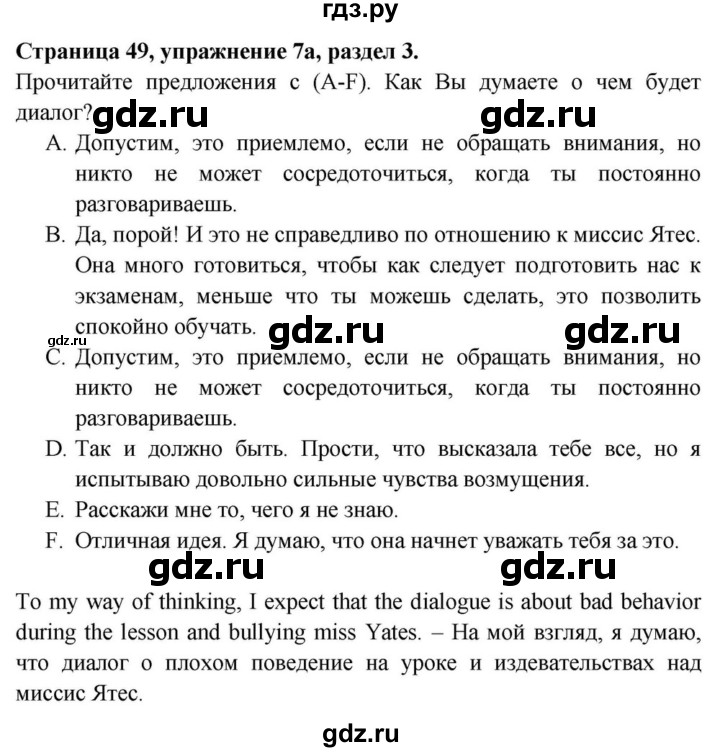
#### Ex. 7a (p. 49)
**Prediction:**
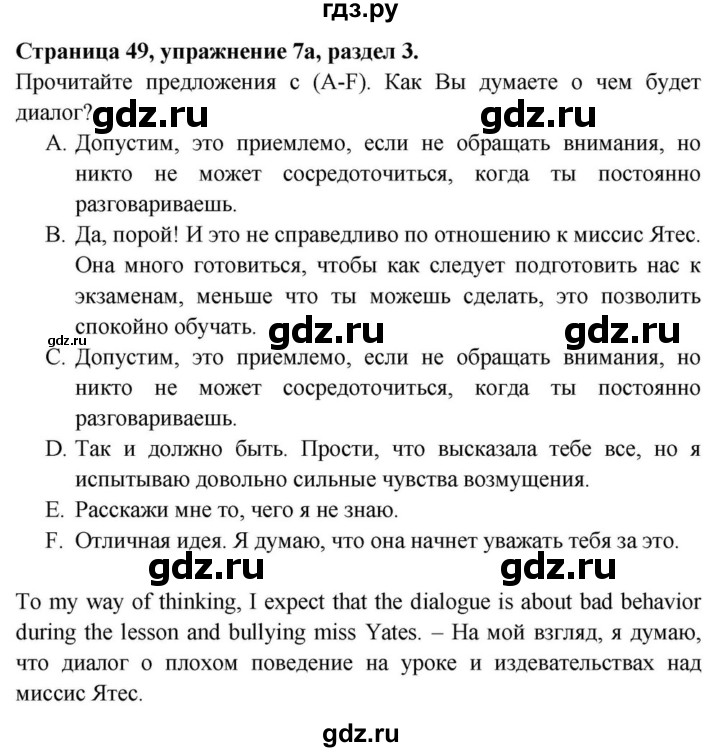
> The dialogue is likely to be about a student misbehaving during class (talking, not paying attention, disrupting others) and a classmate confronting him about his disruptive behavior and its impact on the teacher and other students.
---
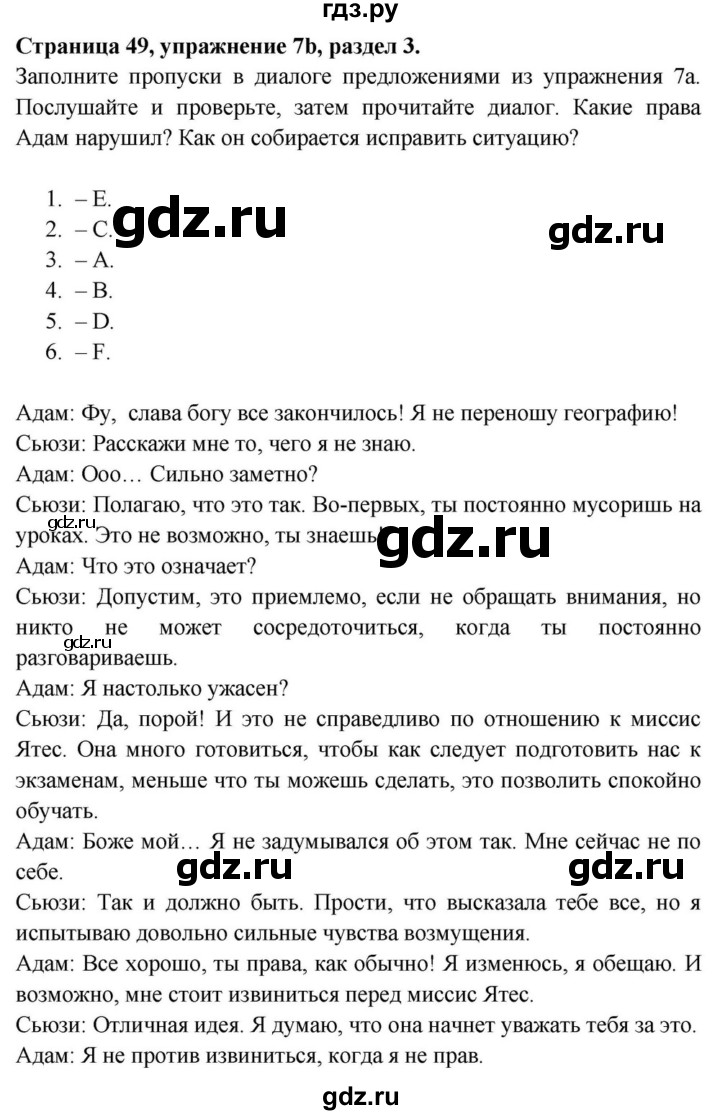
#### Ex. 7b (p. 49)
**Dialogue Completion:**
1. **E** (*Tell me something I don't know!*)
2. **C** (*I'm afraid so. You're always messing around in the lessons, for a start. It's not on, you know.*)
3. **A** (*Well, it's fine if you don't want to pay attention, but no one else can concentrate either if you're talking all the time.*)
4. **B** (*Yes, sometimes! And it's really unfair on Miss Yates. She's doing her best to prepare us well for the exam, so the least you could do is let her teach.*)
5. **D** (*So you should! I'm sorry to get at you, but I feel quite strongly about this.*)
6. **F** (*Oh, that's a great idea. I think she'd really respect you for that.*)
**Answers to questions:**
* **What right(s) is Adam violating?**
He is violating his classmates' right to learn (to concentrate in class) and the teacher’s right to teach in a respectful, calm environment.
* **How is he going to put the situation right?**
He promises to change his behaviour in lessons and plans to apologise to Miss Yates.
---
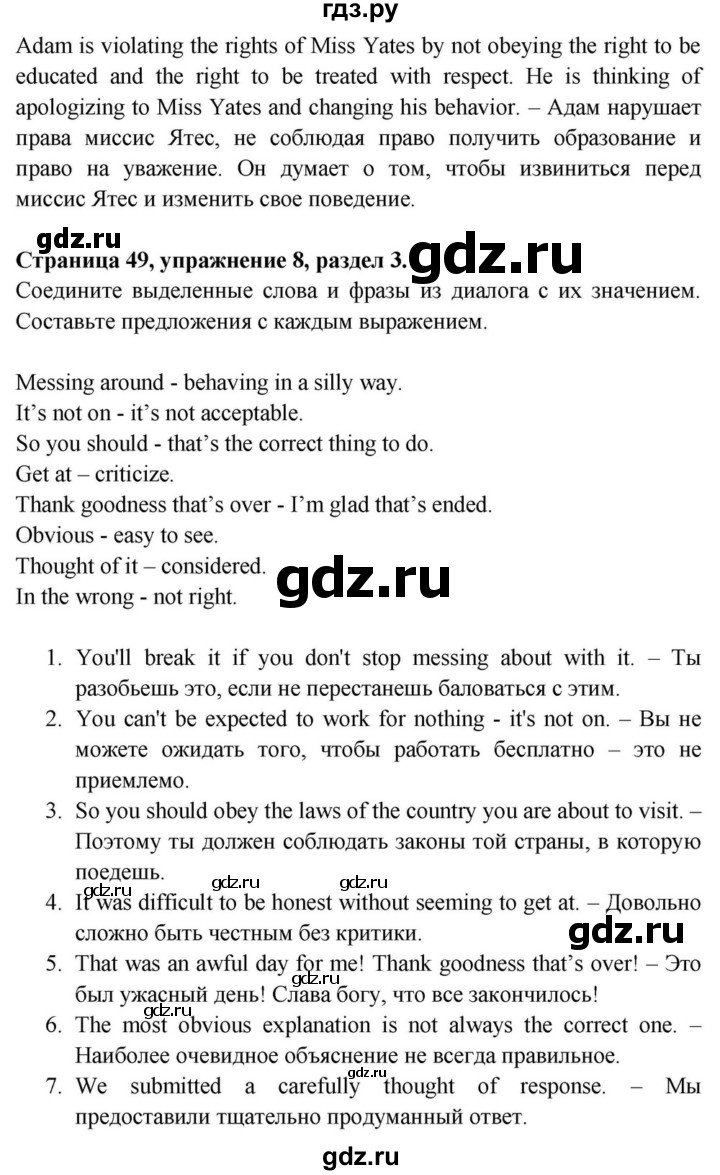
#### Ex. 8 (p. 49)
**Matching phrases to meanings & Example sentences:**
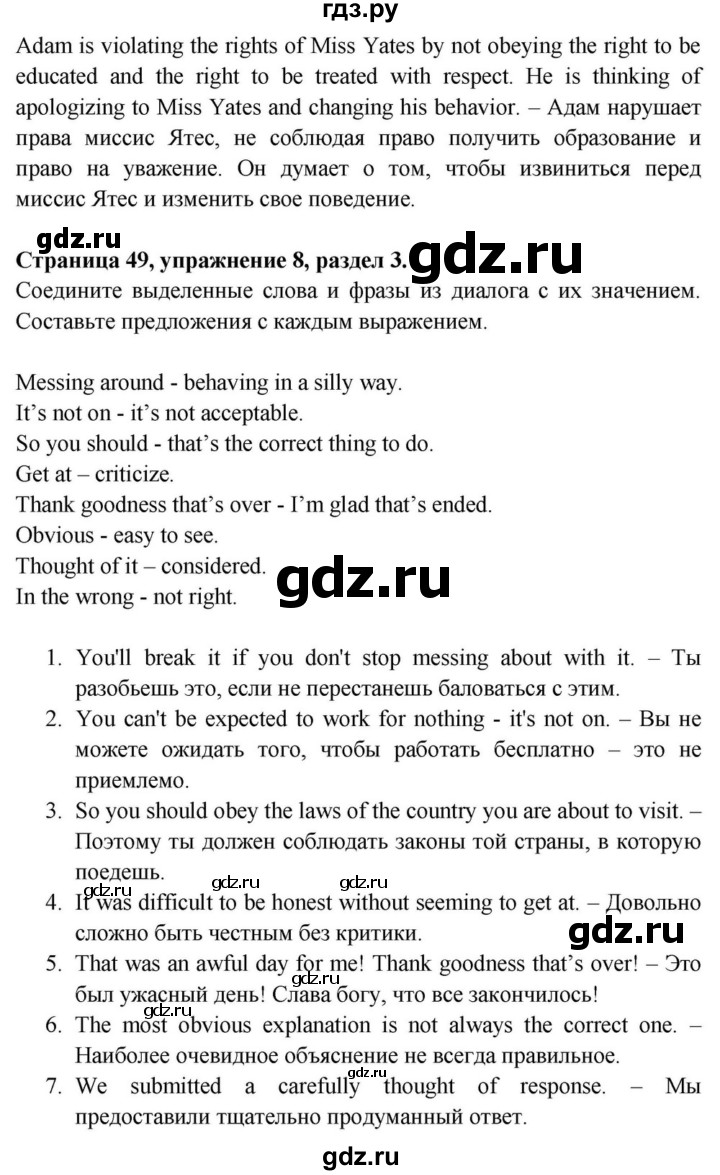
1. **thank goodness that's over** = *I'm glad that's ended*
* *Example:* The exam was exhausting — thank goodness that's over!
2. **obvious** = *easy to see*
* *Example:* It was obvious that she was very nervous before the interview.
3. **messing around** = *behaving in a silly way*
* *Example:* Stop messing around and start doing your homework!
4. **it's not on** = *it's not acceptable*
* *Example:* Bullying is definitely not on in our school.
5. **thought of** = *considered*
* *Example:* I hadn't thought of that solution before you suggested it.
6. **so you should** = *that's the correct thing to do*
* *Example:* You said you're going to study harder? So you should!
7. **get at you** = *criticise*
* *Example:* I'm not trying to get at you, I just want to help.
8. **in the wrong** = *not right*
* *Example:* When you are in the wrong, you should find the courage to admit it.
---
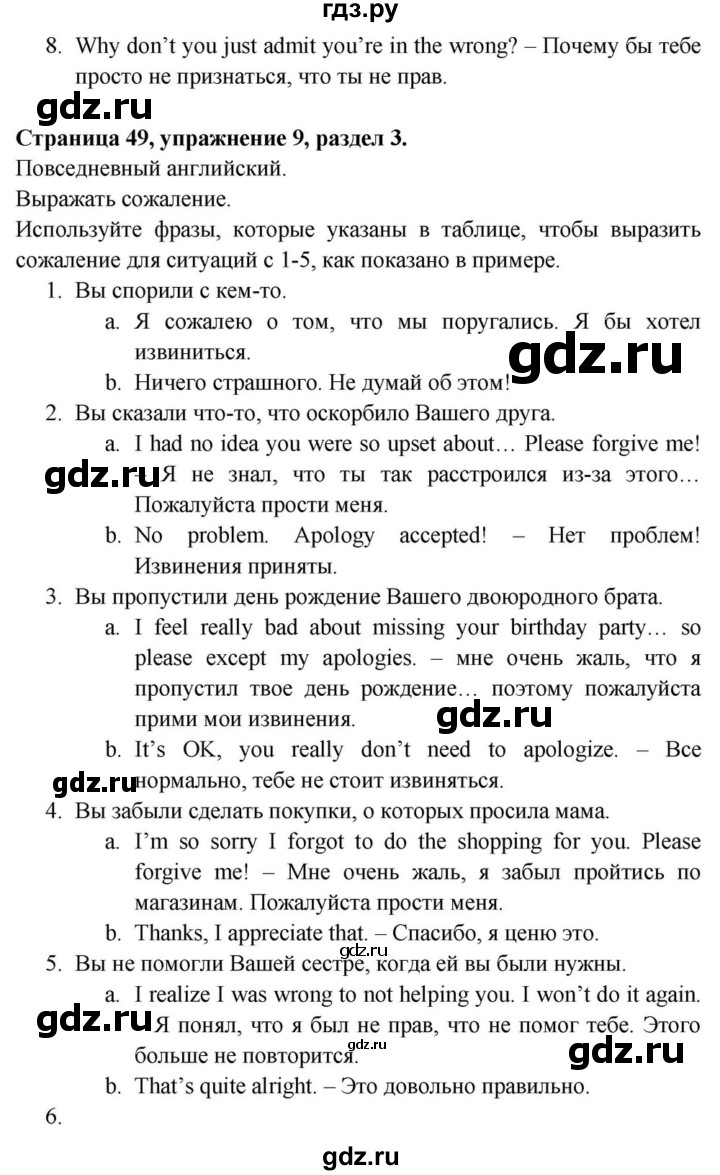
#### Ex. 9 (p. 49) Expressing regret
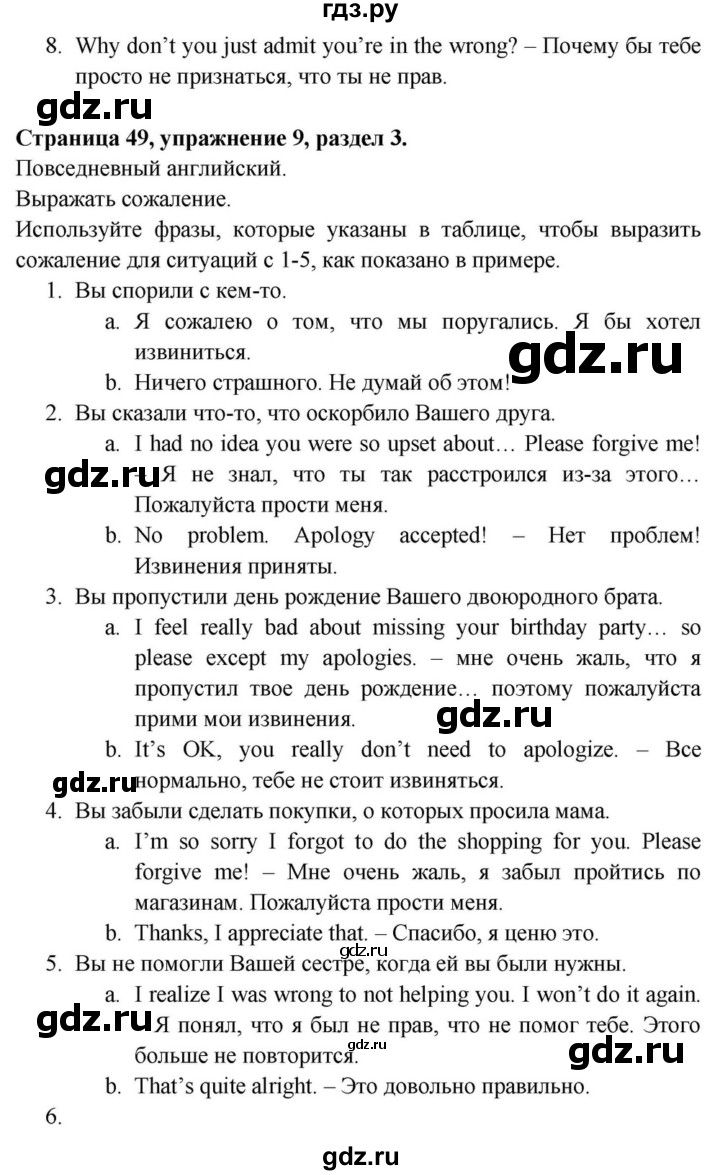
* **2. You said something that offended a friend.**
* **A:** I'm sorry I said that. I didn't mean to hurt your feelings.
* **B:** That's quite alright. Thanks, I really appreciate your apology.
* **3. You missed your cousin's birthday party.**
* **A:** I feel really bad about missing your birthday party, so please accept my apologies.
* **B:** Don't worry about it! I know you were busy.
* **4. You forgot to do the shopping for your mum.**
* **A:** I'm sorry, Mum. I had no idea you needed those groceries urgently. I realise it was wrong to forget, and I won't do it again.
* **B:** It's OK, you really don't need to apologise. We can go together later.
* **5. You didn't help your sister when she needed you.**
* **A:** I feel really bad about not helping you yesterday. I'd like to apologise.
* **B:** Oh, it was nothing. Don't give it another thought!
---
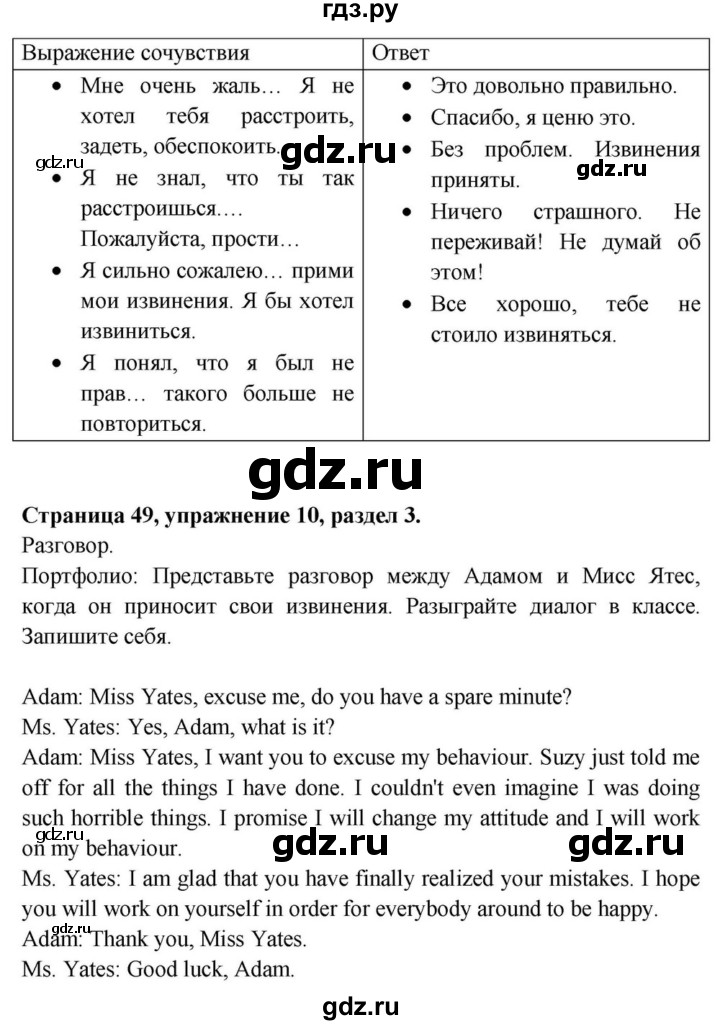
#### Ex. 10 (p. 49) Speaking: Portfolio
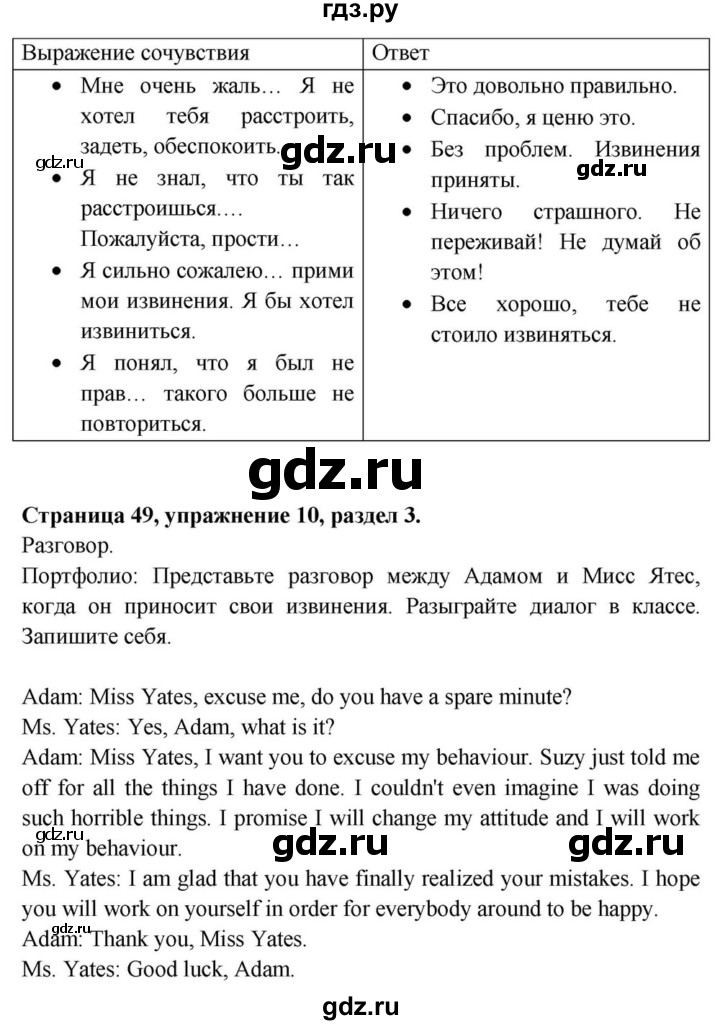
**Dialogue between Adam and Miss Yates:**
> **Adam:** Excuse me, Miss Yates. Do you have a moment?
> **Miss Yates:** Yes, Adam. What is it?
> **Adam:** I'd like to apologise for my behaviour during Geography today. I realise it was wrong of me to mess around and talk constantly. I didn't mean to disrupt your lesson or distract the class.
> **Miss Yates:** Thank you for saying that, Adam. It really was difficult to teach with all the noise. I appreciate your honesty.
> **Adam:** I promise it won't happen again. I'll pay attention from now on.
> **Miss Yates:** That's great to hear. Apology accepted!
---
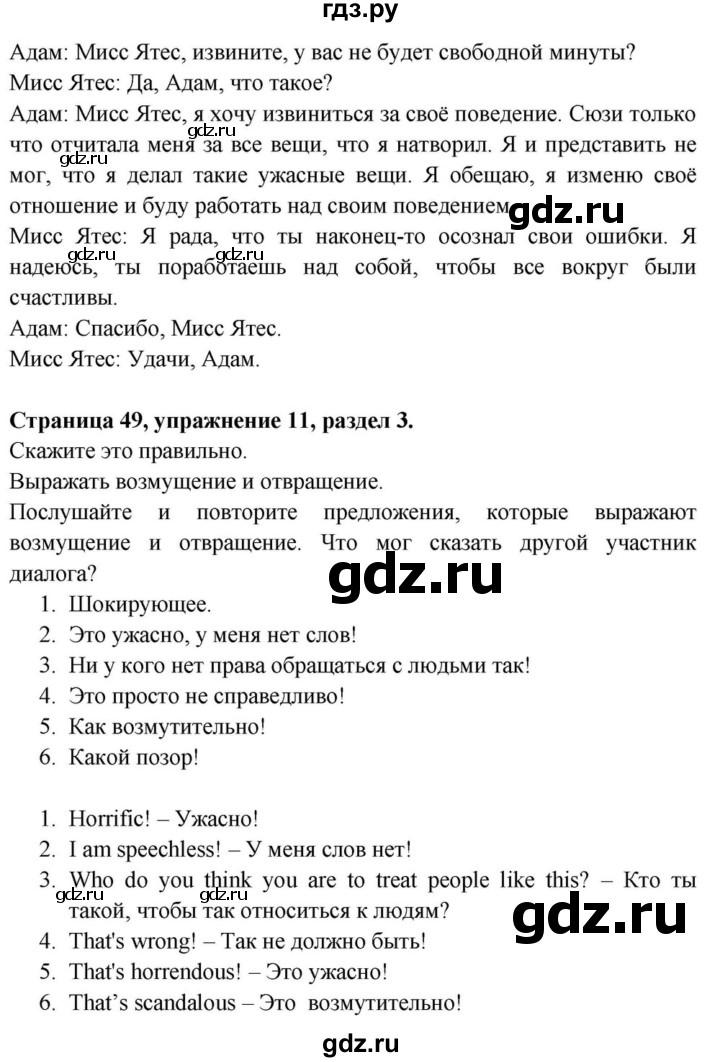
#### Ex. 11 (p. 49) Say it right: Expressing outrage/disgust
**Possible statements by the first speaker:**
1. *Speaker A:* "Someone stole an elderly lady's handbag in broad daylight."
*Speaker B:* **That's shocking!**
2. *Speaker A:* "The company dumped toxic waste into the local river."
*Speaker B:* **That's so awful, I'm lost for words!**
3. *Speaker A:* "The manager shouted at the new intern and called him useless."
*Speaker B:* **No one has the right to treat someone like that!**
4. *Speaker A:* "The referee disallowed our winning goal for no reason."
*Speaker B:* **That's just not fair!**
5. *Speaker A:* "They doubled the price of bus tickets overnight without any warning."
*Speaker B:* **How outrageous!**
6. *Speaker A:* "Some teenagers vandalised the war memorial in the park."
*Speaker B:* **That's totally disgraceful!**
---
### Разбор и объяснение
1. **Ex. 7 (Чтение и логика диалога):**
* В реплике 1 Сьюзи саркастично реагирует на слова Адама о ненависти к географии: *«Tell me something I don't know!»* («Скажи то, чего я ещё не знаю!»).
* В реплике 2 она подтверждает, что неприязнь Адама очевидна (*«I'm afraid so...»*), так как он постоянно балуется на уроках (*messing around*).
* В реплике 3 Сьюзи поясняет, что болтовня мешает другим ученикам сосредоточиться (*«no one else can concentrate either...»*).
* В реплике 4 она защищает учительницу мисс Йейтс, которая готовит их к экзамену.
* В реплике 5 на раскаяние Адама (*«I feel really bad now»*) Сьюзи отвечает: *«So you should!»* («И правильно!»), добавляя, что не хотела нападать (*get at you*), но это важный вопрос.
* В реплике 6 Сьюзи поддерживает идею извиниться перед учителем (*«Oh, that's a great idea...»*).
2. **Ex. 8 (Фразеология и лексика):**
* Идиома *it's not on* в британском английском означает *«это недопустимо / так не пойдет»*.
* Фразовый глагол *to get at someone* означает *«критиковать, придираться к кому-либо»*.
* *To be in the wrong* переводится как *«быть неправым, ошибаться»*.
3. **Ex. 9 и 11 (Речевой этикет):**
* Для выражения сожаления используются конструкции с герундием (*feel bad about doing smth*) или инфинитивом (*didn't mean to do smth*).
* В упр. 11 для сильных эмоциональных реакций (*outrage/disgust* — возмущение/отвращение) подбираются ситуации нарушения этических, социальных или правовых норм (кража, вандализм, несправедливость).
Спасибо за оценку!



Открой больше возможностей
Войди через VK — задавай вопросы ИИ и сохраняй ГДЗ в избранное
