


ГДЗ по английскому языку 11 класс Афанасьева Spotlight Базовый уровень страница - 73

Авторы: Афанасьева О.В., Дули Д., Михеева И.В., Оби Б., Эванс В.
Серия: Spotlight
Тип книги: Учебник
Год: 2015-2024
Рекомендуем посмотреть


 Премиум
Подробное решение страница № 73 по английскому языку Spotlight для учащихся 11 класса Spotlight Базовый уровень, авторов Афанасьева, Дули, Михеева, Оби, Эванс 2015-2024
### Итоговый ответ
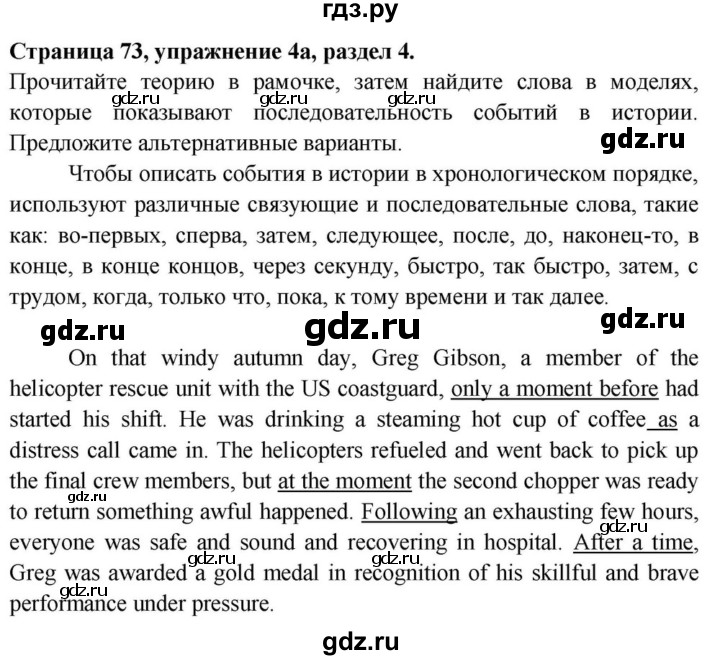
#### Exercise 4a
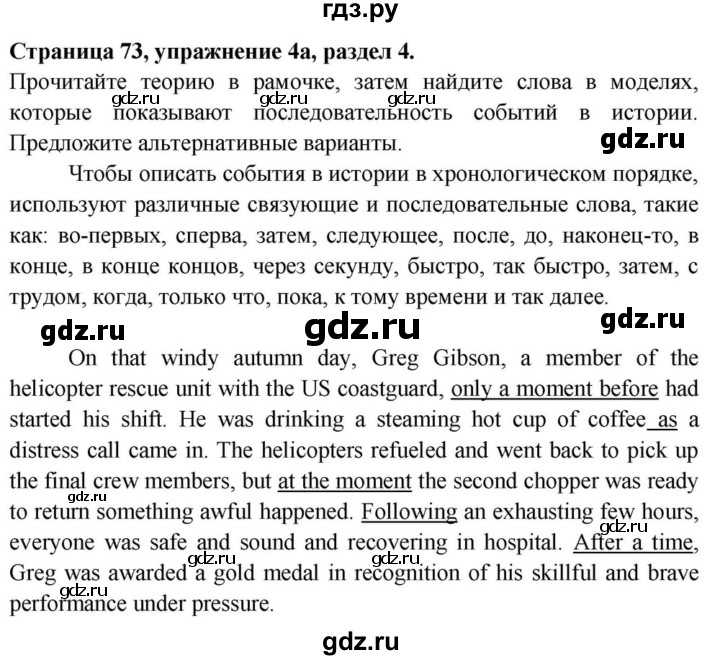
**Linking/sequence words from the story (Слова-связки последовательности из текста) & Alternatives (Альтернативы):**
* **had just ... when** $\rightarrow$ *no sooner ... than*, *hardly ... when*
* **Within minutes** $\rightarrow$ *Shortly after*, *Soon afterwards*
* **As** $\rightarrow$ *While*, *When*
* **By the time** $\rightarrow$ *Before*
* **Then** $\rightarrow$ *Next*, *Afterwards*
* **Meanwhile** $\rightarrow$ *In the meantime*
* **Eventually** $\rightarrow$ *Finally*, *In the end*
* **Finally** $\rightarrow$ *At last*, *In the end*
---
#### Exercise 4b
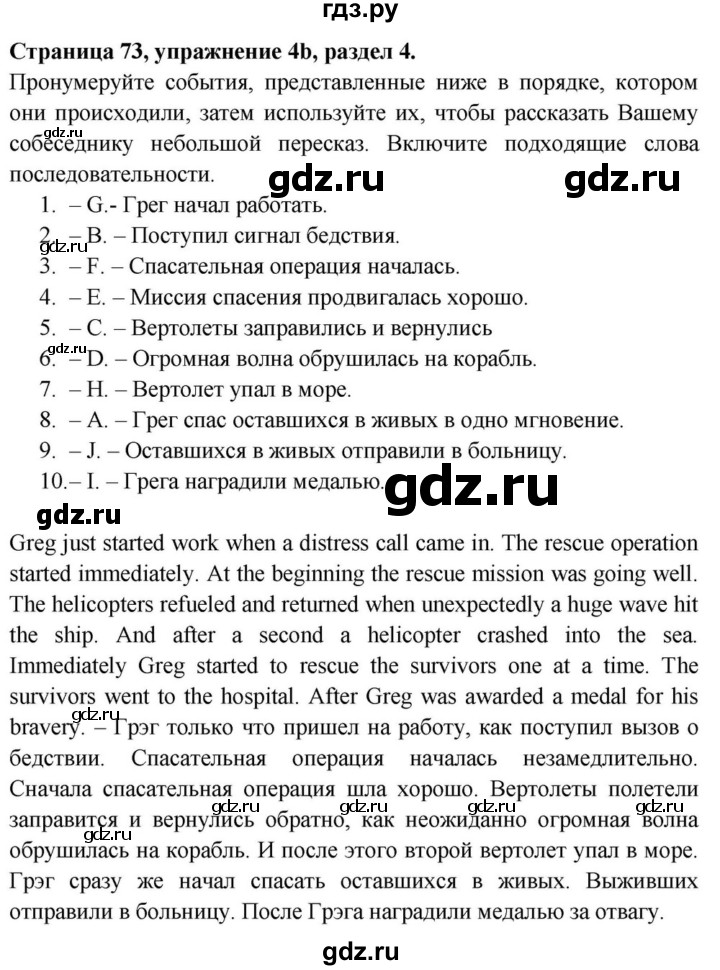
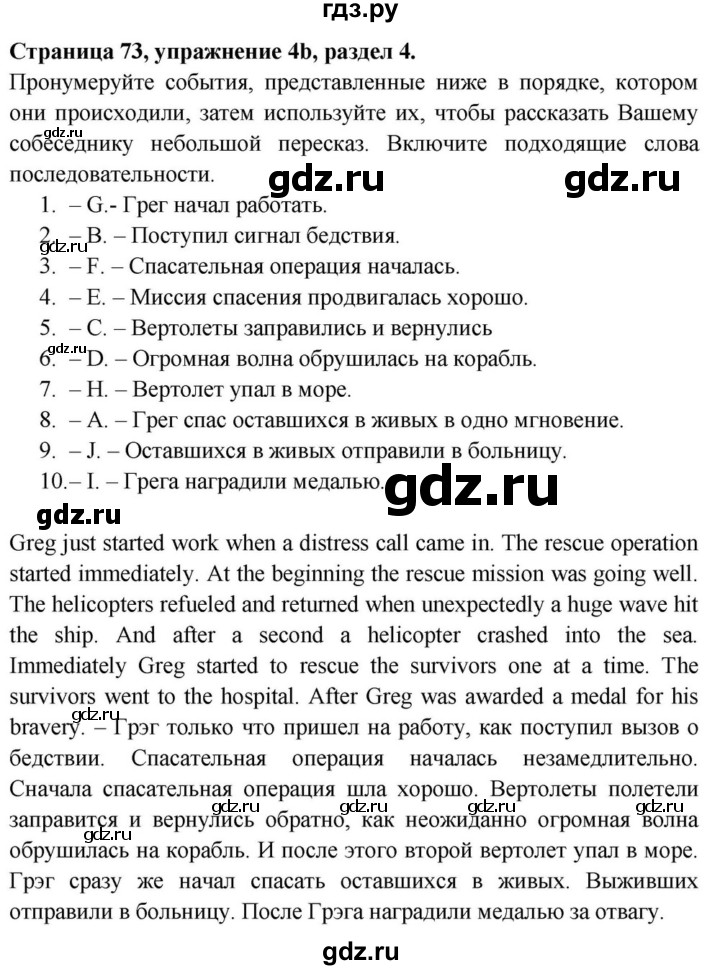
**1. Хронологический порядок событий:**
1. Greg started work.
2. A distress call came in.
3. The rescue operation started.
4. Greg rescued the survivors one at a time.
5. The rescue mission was going well.
6. A huge wave hit the ship.
7. The helicopter crashed into the sea.
8. The helicopters refuelled and returned.
9. The survivors went to hospital.
10. Greg was awarded a medal.
**2. Краткий пересказ (Summary):**
> **First**, Greg started work. **Suddenly**, a distress call came in, and **immediately** the rescue operation started. **At first**, the rescue mission was going well **while** Greg rescued the survivors one at a time. **Then**, a huge wave hit the ship and the helicopter crashed into the sea. **After that**, the helicopters refuelled and returned to pick them up. **Eventually**, the survivors went to hospital, and **finally**, Greg was awarded a medal for his bravery.
---
#### Exercise 4c
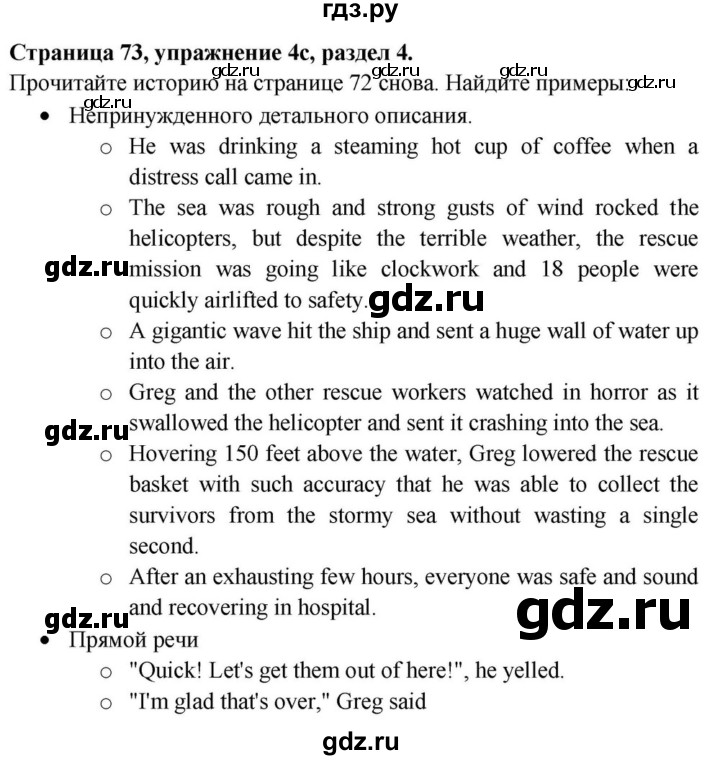
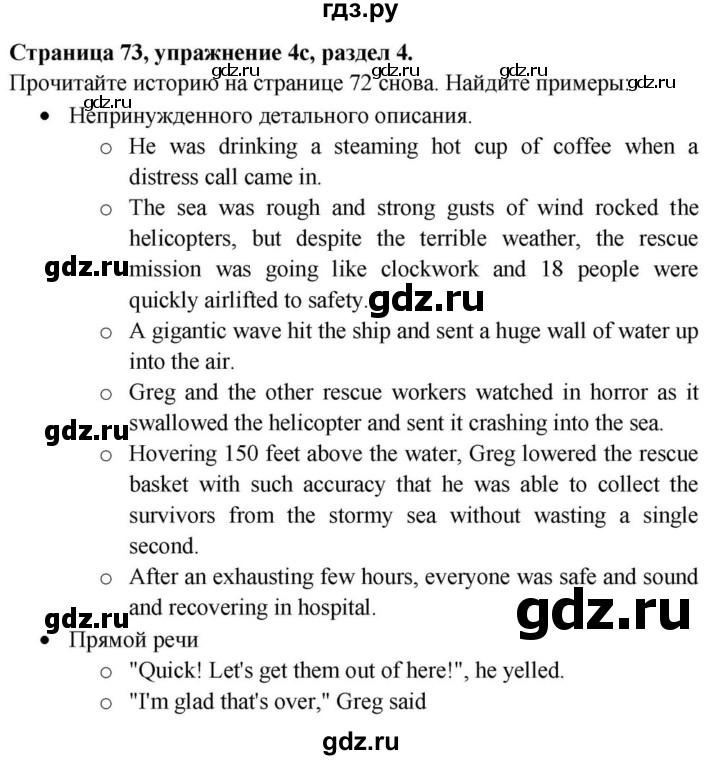
* **Detailed descriptions (Подробные описания):** *steaming hot coffee*, *stormy night with torrential rain and gale-force winds*, *violent, choppy sea*, *terrified crew members*.
* **Direct speech (Прямая речь):** *"Hold on tight!"*, *"We're going down!"*, *"Take my hand!"*
---
#### Exercise 5
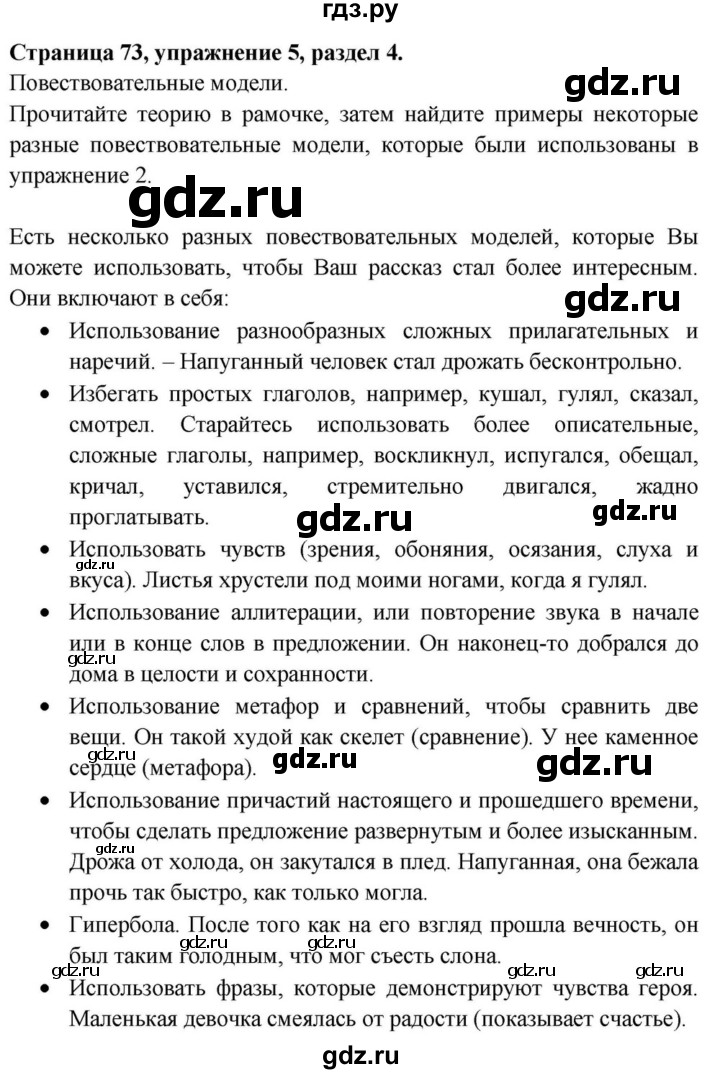
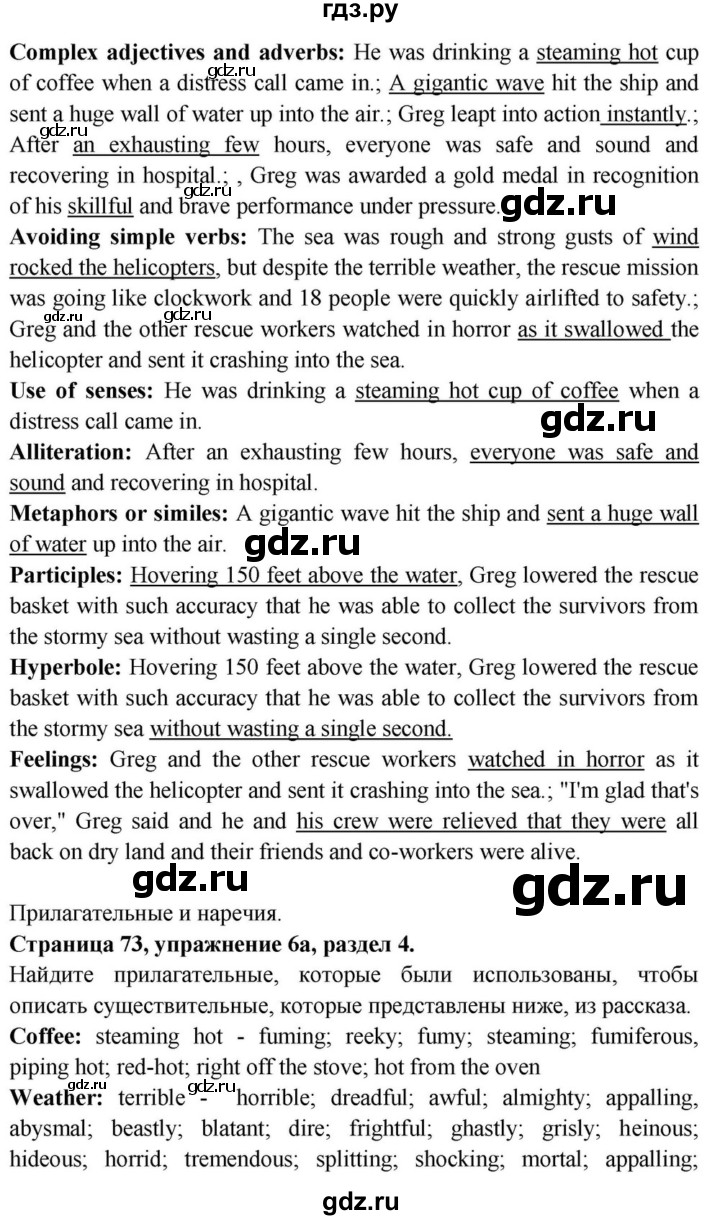
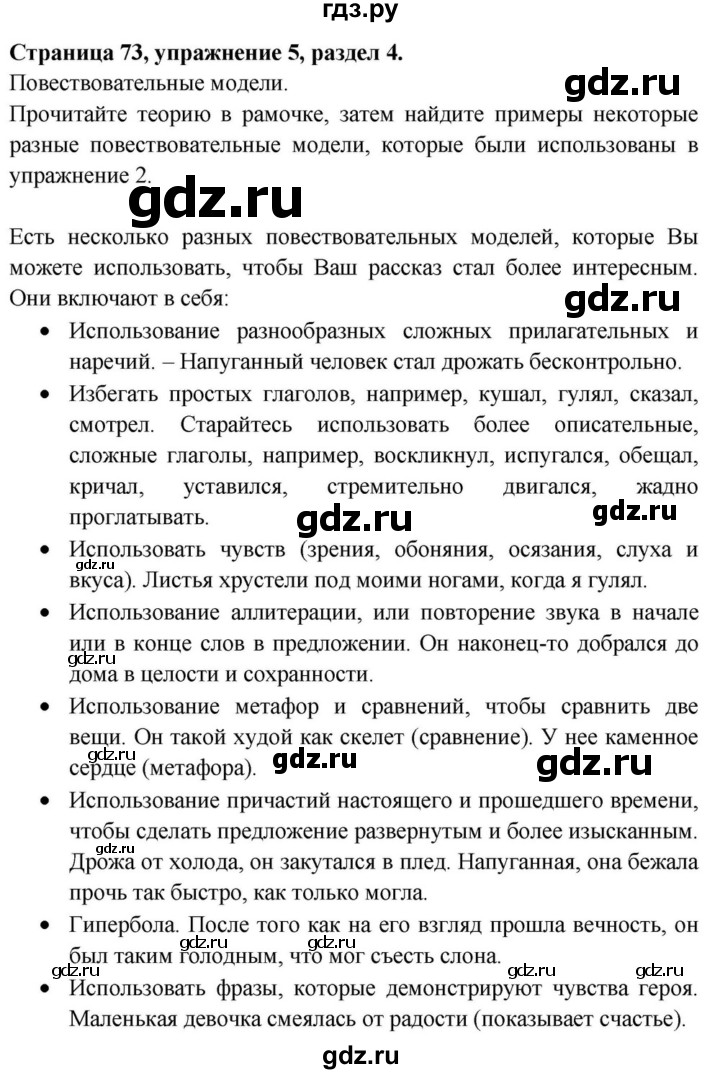
**Примеры приемов повествования (Narrative techniques):**
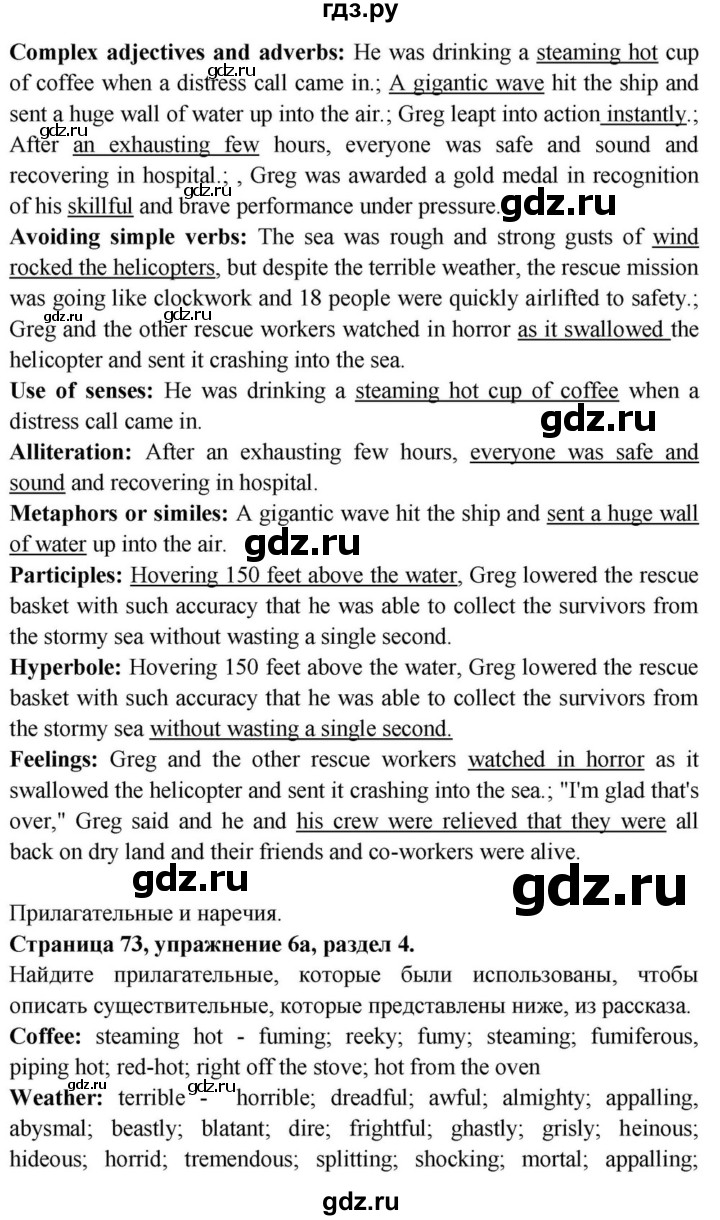
* **Complex adjectives/adverbs:** *torrential*, *gale-force*, *treacherous*, *desperately*, *relentlessly*.
* **Descriptive verbs (вместо простых):** *poured*, *screamed*, *battled*, *swallowed*, *winched*.
* **Senses (Органы чувств):** *steaming hot coffee* (touch/sight), *the alarm blared* (sound), *howling wind and roaring waves* (sound).
* **Participles (Причастия):** *Holding on tightly to the cable...*, *Exhausted and freezing cold, he waited...*
* **Metaphors/Similes/Hyperbole:** *the sea was like a raging monster* (simile), *it felt like an eternity* (hyperbole).
* **Feelings (Эмоции):** *shivering with terror*, *sighed with relief*.
---
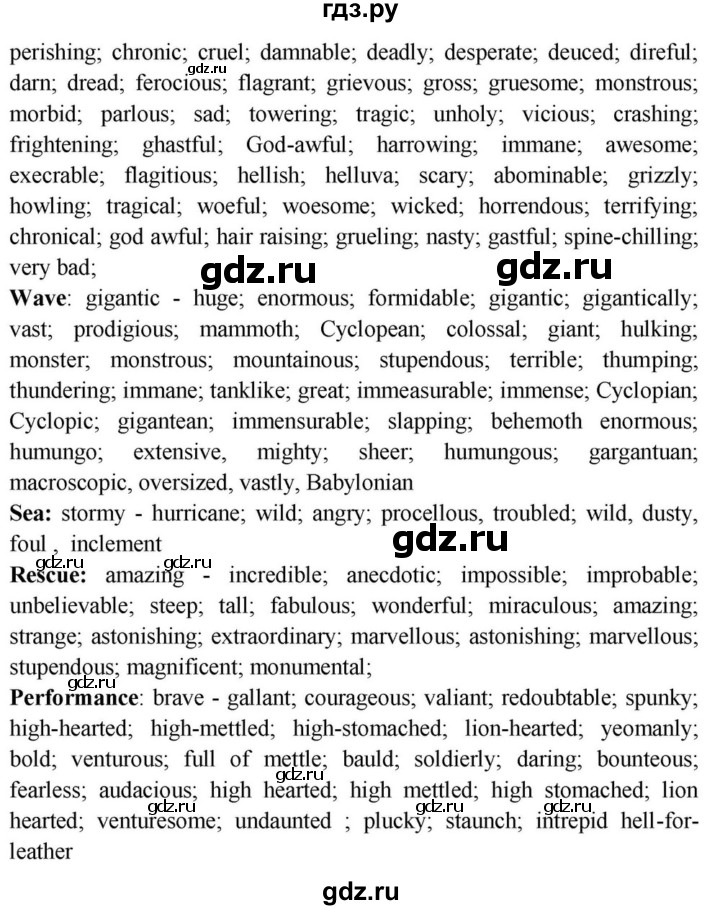
#### Exercise 6a
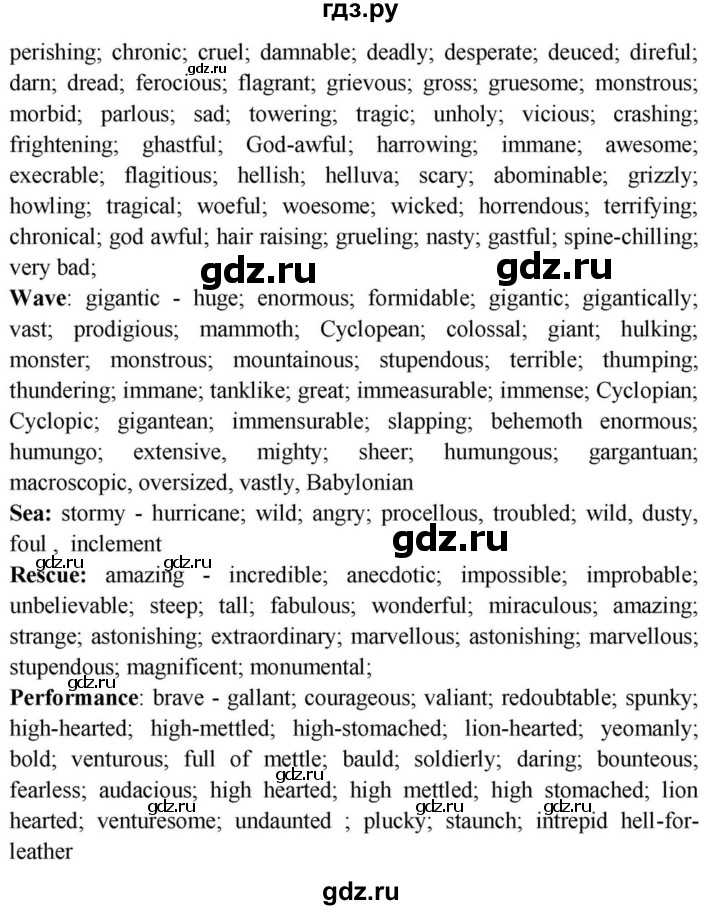
* **coffee:** *steaming hot* $\rightarrow$ **Alternatives:** *piping hot, freshly brewed, boiling*
* **weather:** *stormy / terrible* $\rightarrow$ **Alternatives:** *foul, severe, harsh, dreadfully bad*
* **wave:** *huge / massive* $\rightarrow$ **Alternatives:** *colossal, gigantic, towering*
* **sea:** *violent / choppy* $\rightarrow$ **Alternatives:** *rough, turbulent, raging*
* **rescue:** *daring / heroic* $\rightarrow$ **Alternatives:** *courageous, risky, brave*
* **performance:** *exceptional / outstanding* $\rightarrow$ **Alternatives:** *remarkable, superb, extraordinary*
---
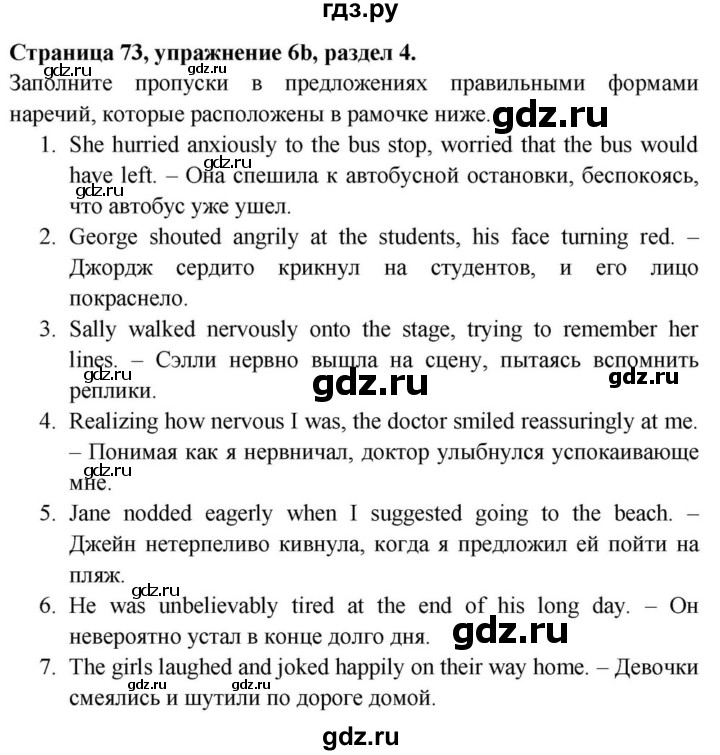
#### Exercise 6b
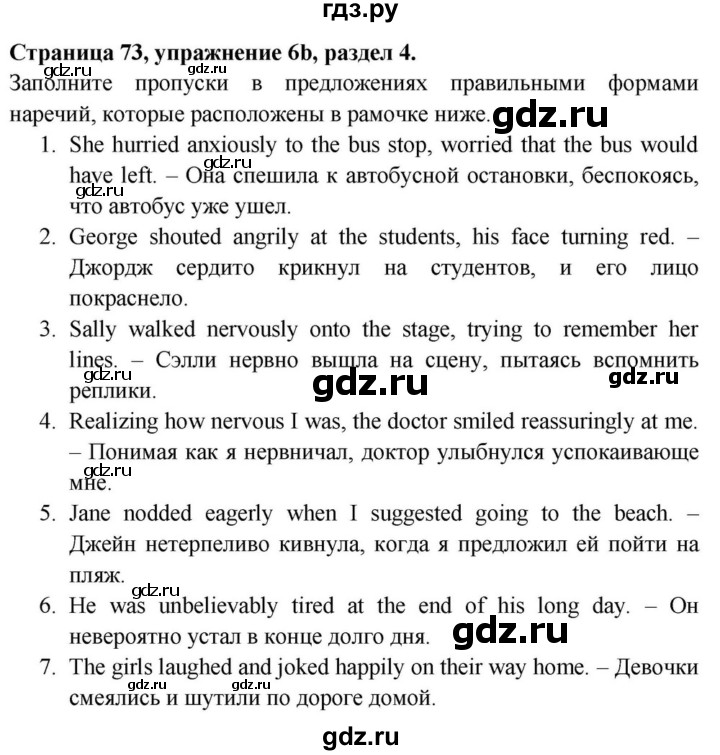
1. She hurried **anxiously** to the bus stop, worried that the bus would have left.
2. George shouted **angrily** at the students, his face turning red.
3. Sally walked **nervously** onto the stage, trying to remember her lines.
4. Realising how nervous I was, the doctor smiled **reassuringly** at me.
5. Jane nodded **eagerly** when I suggested going to the beach.
6. He was **unbelievably** tired at the end of his long day.
7. The girls laughed and joked **happily** on their way home.
---
### Пояснения и разбор заданий
* **Ex. 4a–4b:** Слова-связки времени (*time linkers/sequence words*) помогают логично и последовательно выстроить ход событий в рассказе (narrative essay). Они показывают начало действия (*first, at first*), одновременность (*while, as*), неожиданность (*suddenly*) и завершение истории (*eventually, finally*).
* **Ex. 5:** Использование выразительных средств (деепричастные обороты, яркие глаголы, синонимы простых прилагательных) делает текст художественным и живым, что оценивается высокими баллами на экзаменах (ЕГЭ/FCE).
* **Ex. 6b (значения наречий по контексту):**
1. *worried* (волновалась) $\rightarrow$ шла с тревогой (**anxiously**).
2. *face turning red* (лицо покраснело от злости) $\rightarrow$ кричал со злостью (**angrily**).
3. *trying to remember her lines* (пытаясь вспомнить реплики) $\rightarrow$ шла на сцену нервничая (**nervously**).
4. *Realising how nervous I was* (понимая моё волнение) $\rightarrow$ улыбнулся ободряюще (**reassuringly**).
5. *suggested going to the beach* (предложил пойти на пляж) $\rightarrow$ закивала с готовностью / с энтузиазмом (**eagerly**).
6. *tired at the end of his long day* (устал после долгого дня) $\rightarrow$ невероятно уставший (**unbelievably**).
7. *laughed and joked* (смеялись и шутили) $\rightarrow$ весело/счастливо (**happily**).
Спасибо за оценку!

Открой больше возможностей
Войди через VK — задавай вопросы ИИ и сохраняй ГДЗ в избранное
