


ГДЗ по английскому языку 11 класс Афанасьева Spotlight Базовый уровень страница - 21

Авторы: Афанасьева О.В., Дули Д., Михеева И.В., Оби Б., Эванс В.
Серия: Spotlight
Тип книги: Учебник
Год: 2015-2024
Рекомендуем посмотреть


 Премиум
Подробное решение страница № 21 по английскому языку Spotlight для учащихся 11 класса Spotlight Базовый уровень, авторов Афанасьева, Дули, Михеева, Оби, Эванс 2015-2024
### Итоговый ответ
#### Exercise 1
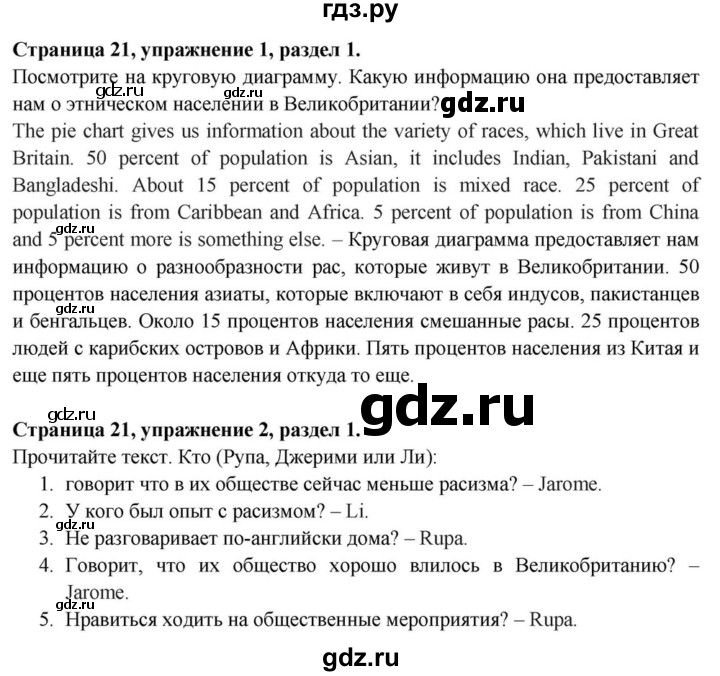
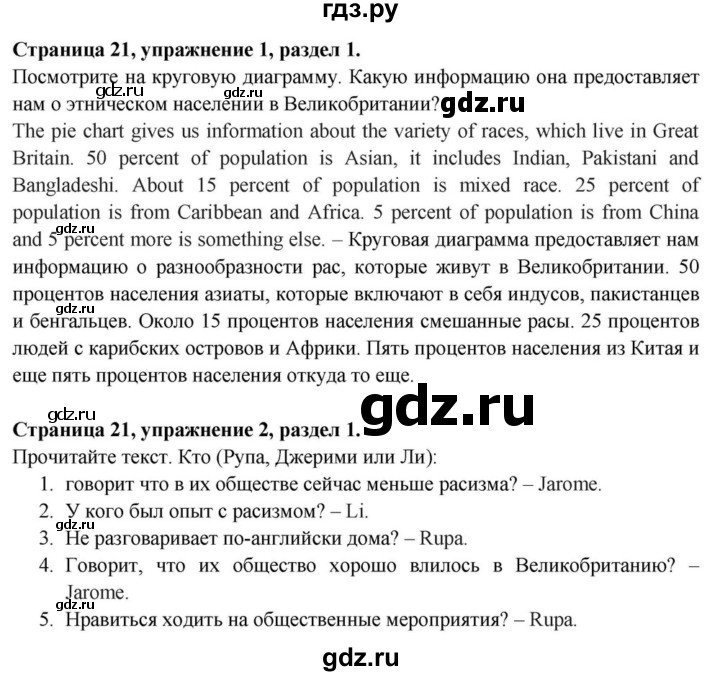
The pie chart gives information about the ethnic composition of the population in Britain. It shows the proportion of the white majority compared to various ethnic minority groups (such as British Asian / Indian, Pakistani, Bangladeshi, Black Caribbean, Black African, Chinese, and mixed-race people).
---
#### Exercise 2
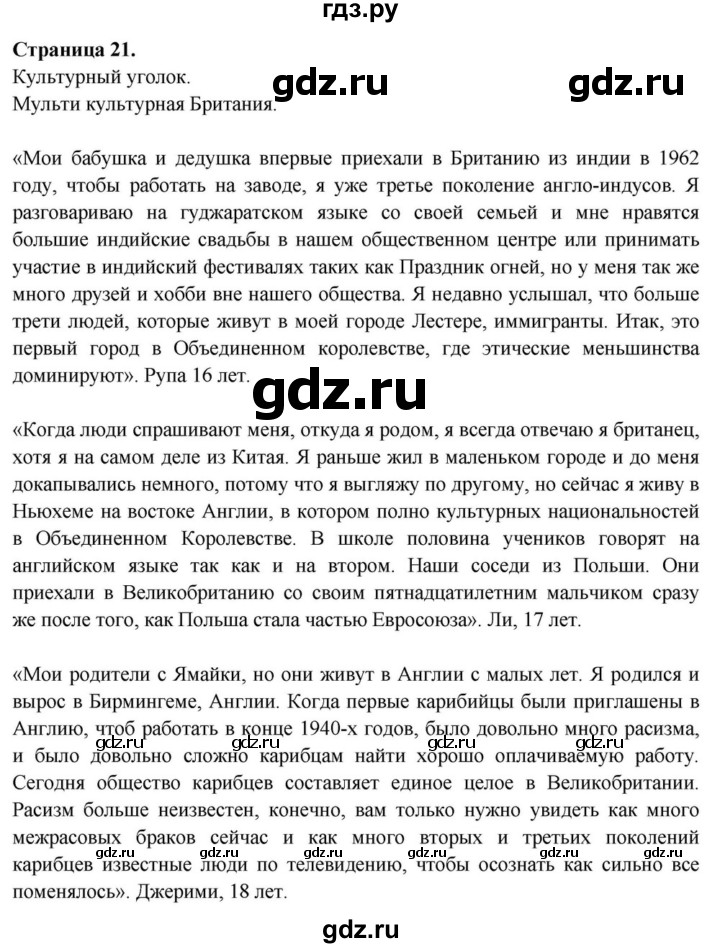
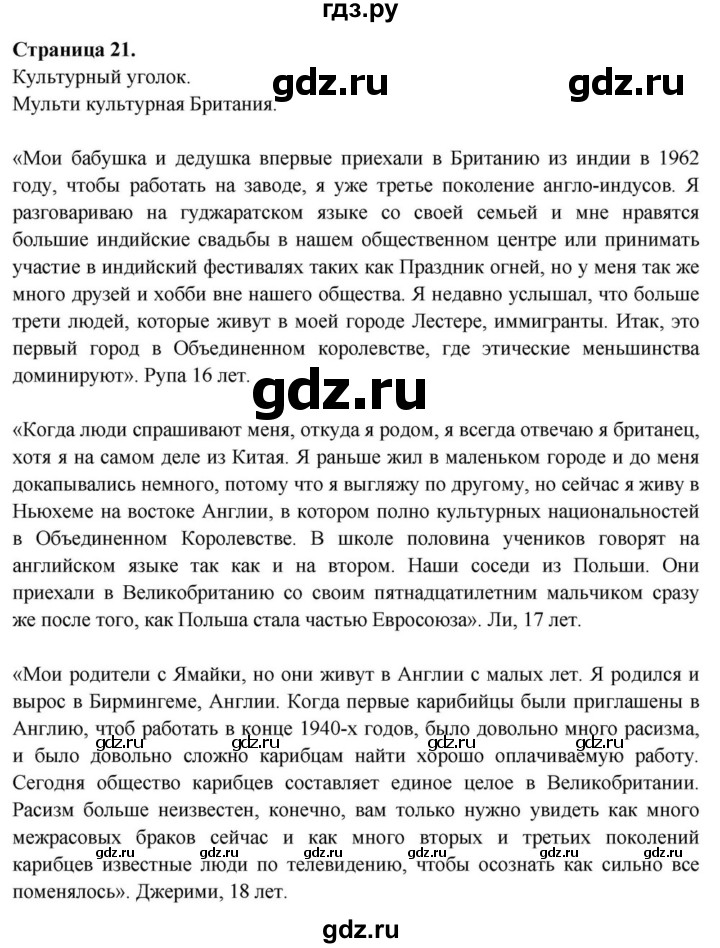
1. **Jerome** (*"...things have improved massively since then."*)
2. **Li** (*"...I was picked on because of the way I looked."*)
3. **Rupa** (*"At home we speak Gujarati..."*)
4. **Jerome** (*"The Caribbean community is now one of the most integrated in Britain..."*)
5. **Rupa** (*"I love joining in with all the big Indian weddings and Hindu festivals..."*)
---
#### Exercise 3
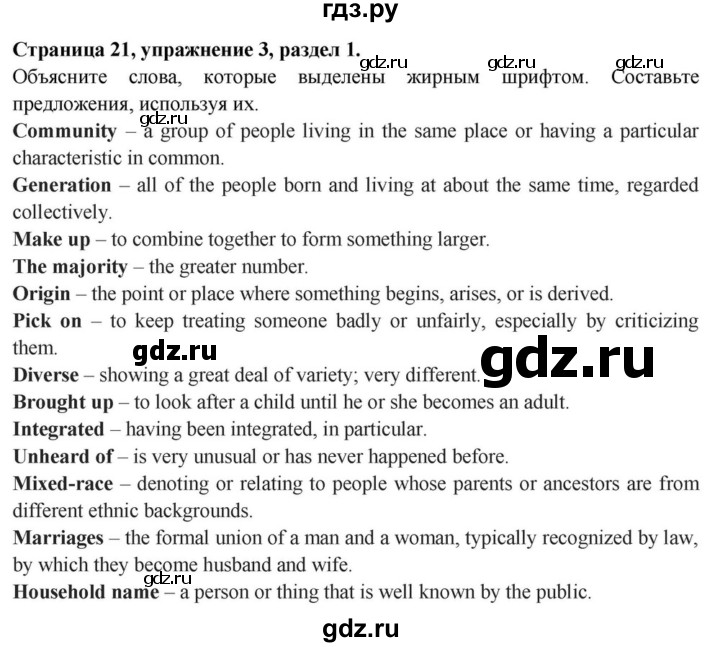
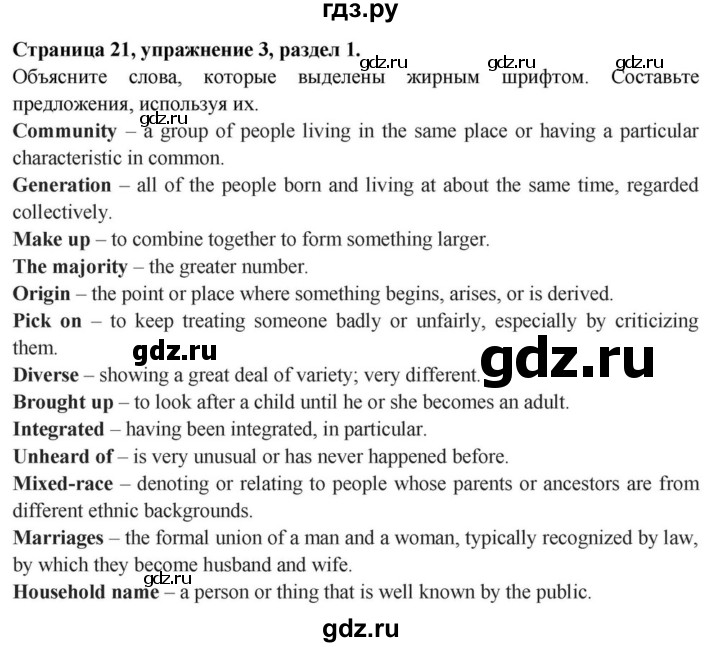
* **Community** (сообщество / община) — all the people who live in a particular area, or a group of people who share the same culture, religion, or nationality.
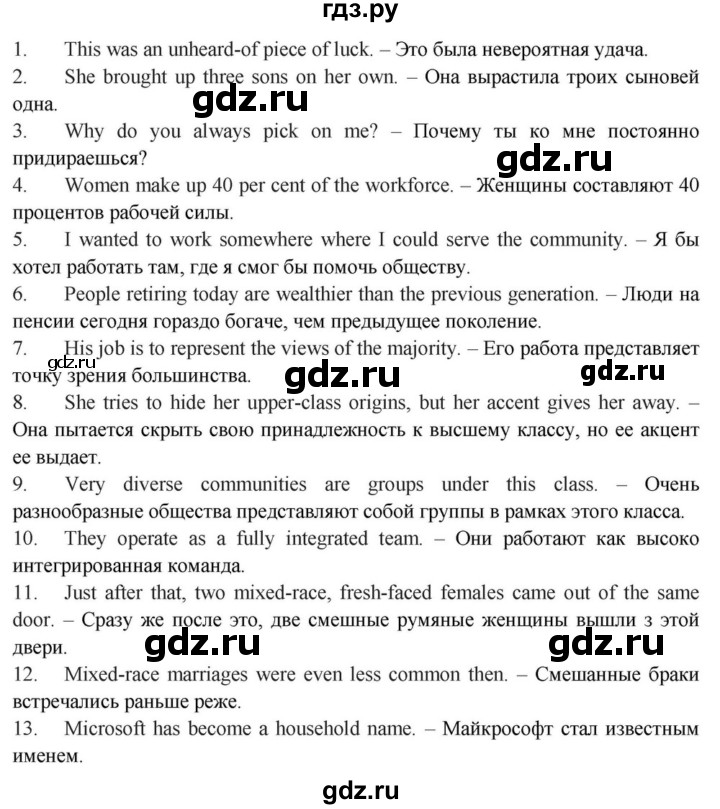
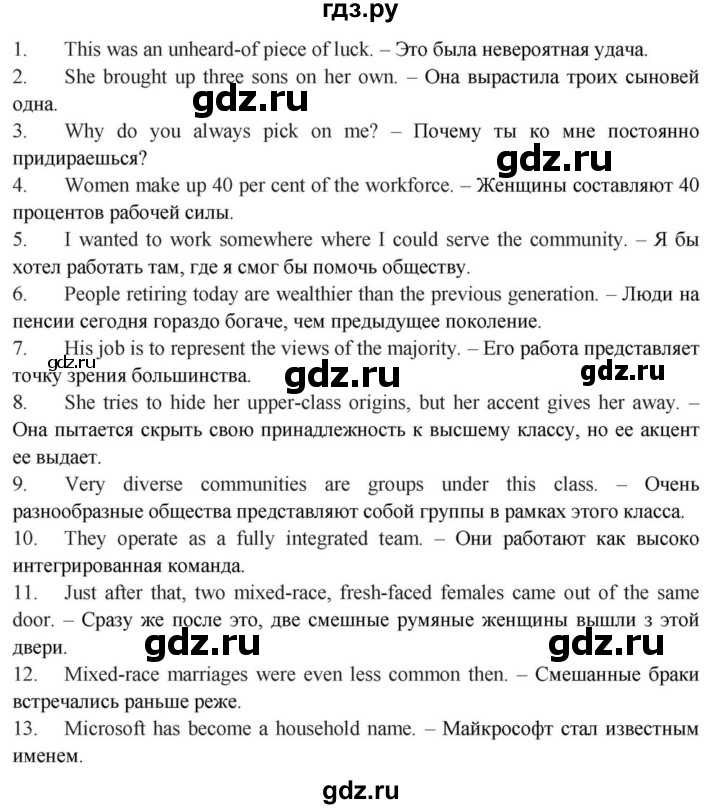
*Example:* The local community organized a food festival to celebrate different cultures.
* **Make up the majority** (составлять большинство) — to form the largest part or percentage of a group or population.
*Example:* In this primary school, girls make up the majority of pupils.
* **Origin** (происхождение) — a person's family, racial, or social background.
*Example:* Many citizens of London are of Indian or Caribbean origin.
* **Diverse** (разнообразный) — very different from each other; showing a lot of variety.
*Example:* Our university has a very diverse student community from all over the world.
* **Picked on** (подвергавшийся нападкам / кого дразнили) — bullied or treated unfairly by others.
*Example:* When Jack transferred to a new school, he was picked on because of his accent.
* **Brought up** (воспитанный / выросший) — cared for and raised as a child until adulthood.
*Example:* Although she was born in France, she was brought up in Manchester.
* **Integrated** (интегрированный / гармонично влившийся в общество) — successfully joined and accepted into a larger community or culture.
*Example:* Over the decades, many immigrants have become fully integrated into British society.
* **Unheard of** (неслыханный) — something that has never happened or existed before, or is extremely surprising.
*Example:* Fifty years ago, seeing ethnic minorities in high government posts was practically unheard of.
* **Mixed-race** (смешанной расы) — having parents of different racial backgrounds.
*Example:* There are many mixed-race families in modern multicultural cities.
---
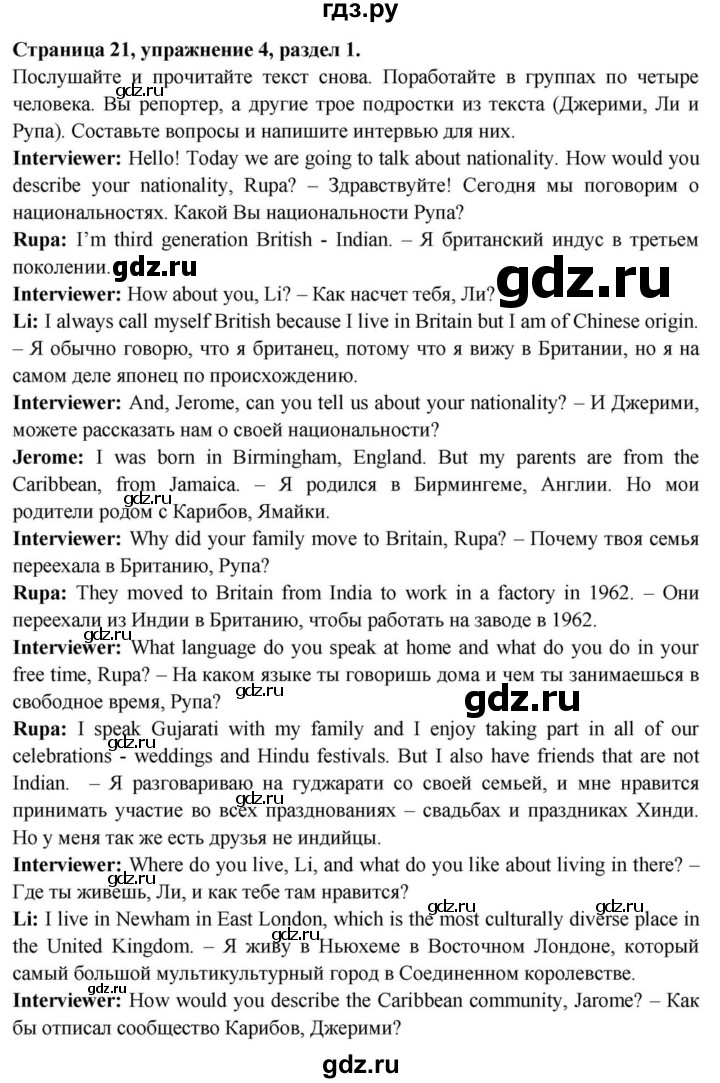
#### Exercise 4
**Sample Interview:**
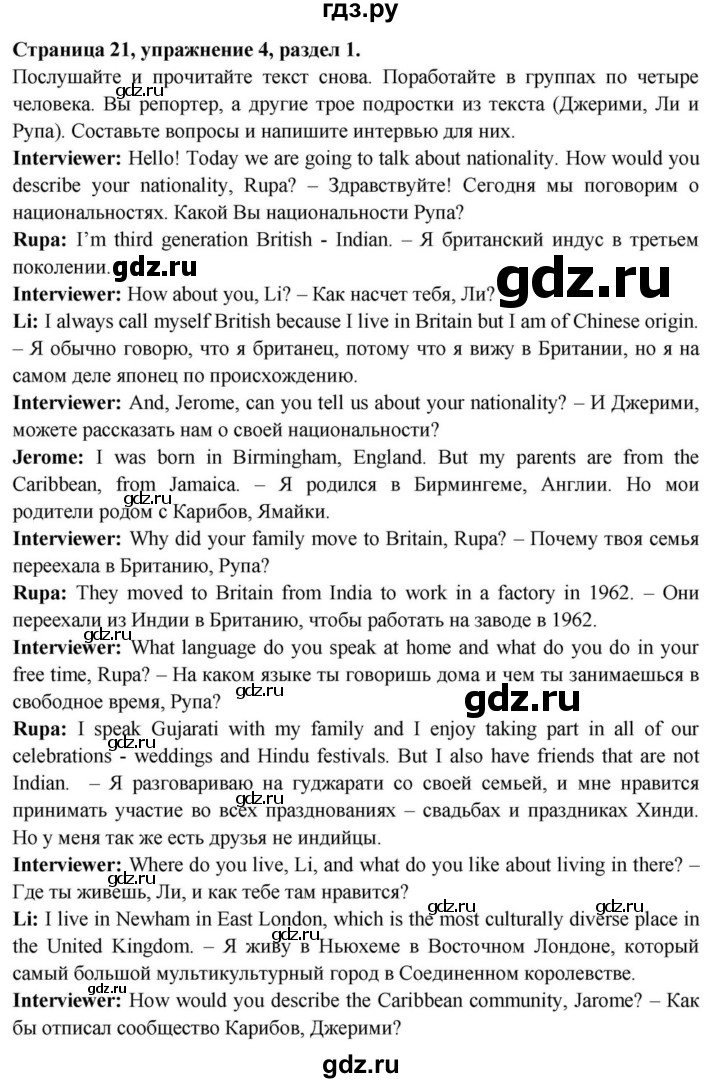
* **Interviewer:** Hello everyone! Thank you for joining us today. Rupa, how important is your cultural background to you?
**Rupa:** It’s very important. We speak Gujarati at home, and I enjoy celebrating Hindu festivals like Diwali. I am proud to be British and of Indian heritage.
* **Interviewer:** Li, how did you feel growing up in the UK?
**Li:** When I was younger and lived in a small town, it was tough because I was picked on for looking different. But now I live in Newham in East London, which is very diverse, and I feel comfortable and proud to be British.
* **Interviewer:** Jerome, how has life changed for Caribbean people in Britain over time?
**Jerome:** When my parents’ generation arrived, they faced a lot of racism and discrimination. Today, things are much better: the Caribbean community is fully integrated, and people from our community are successful in sports, media, and politics.
---
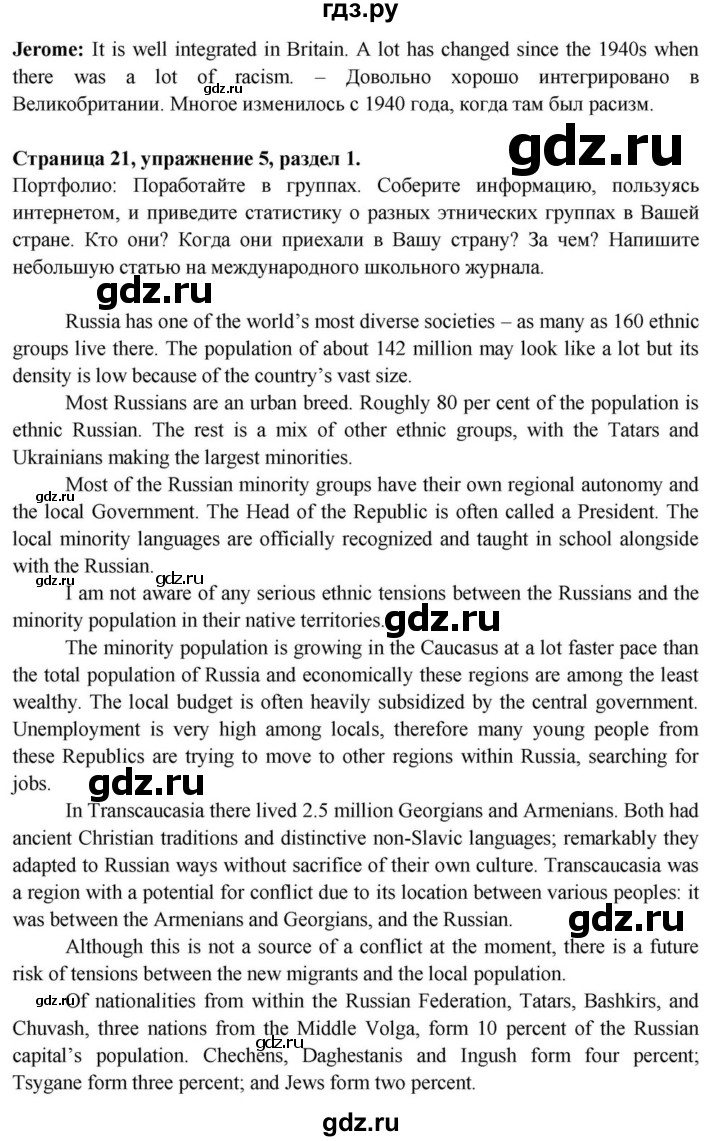
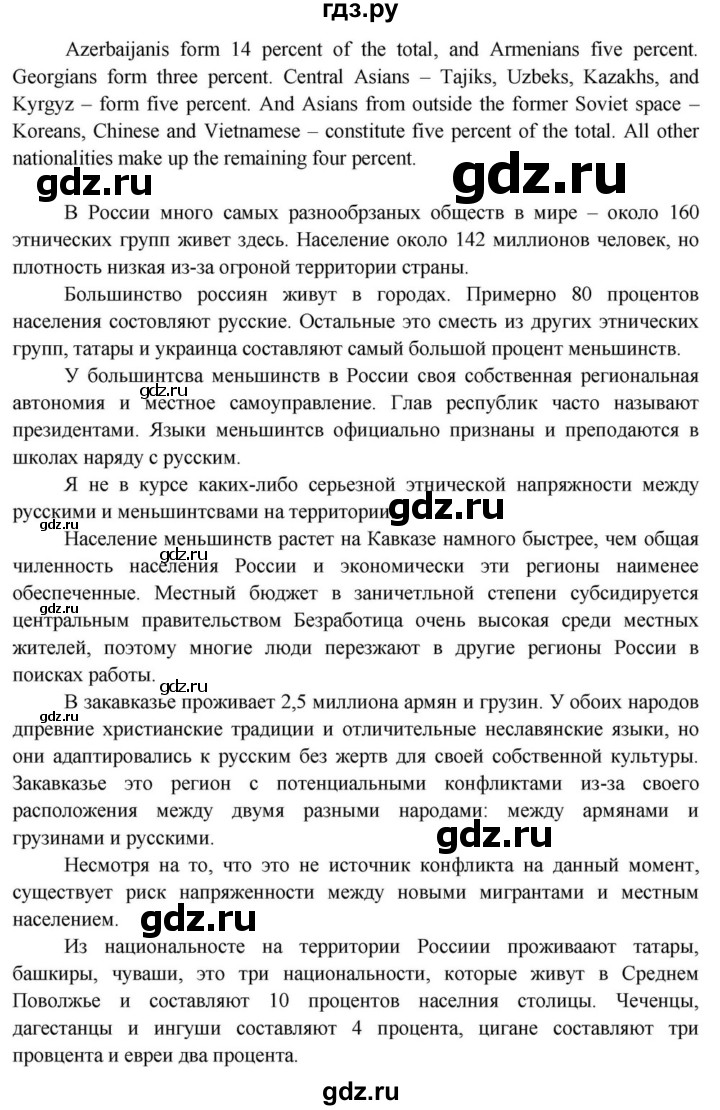
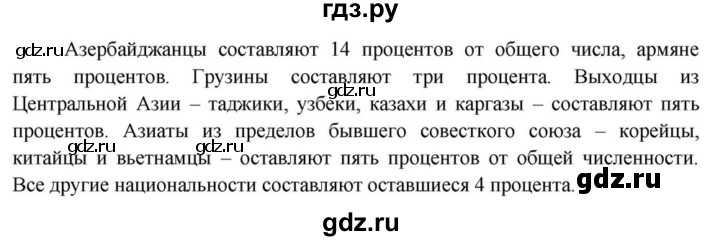
#### Exercise 5
**Article for an International School Magazine:**
> **A Tapestry of Cultures: Ethnic Groups in Russia**
>
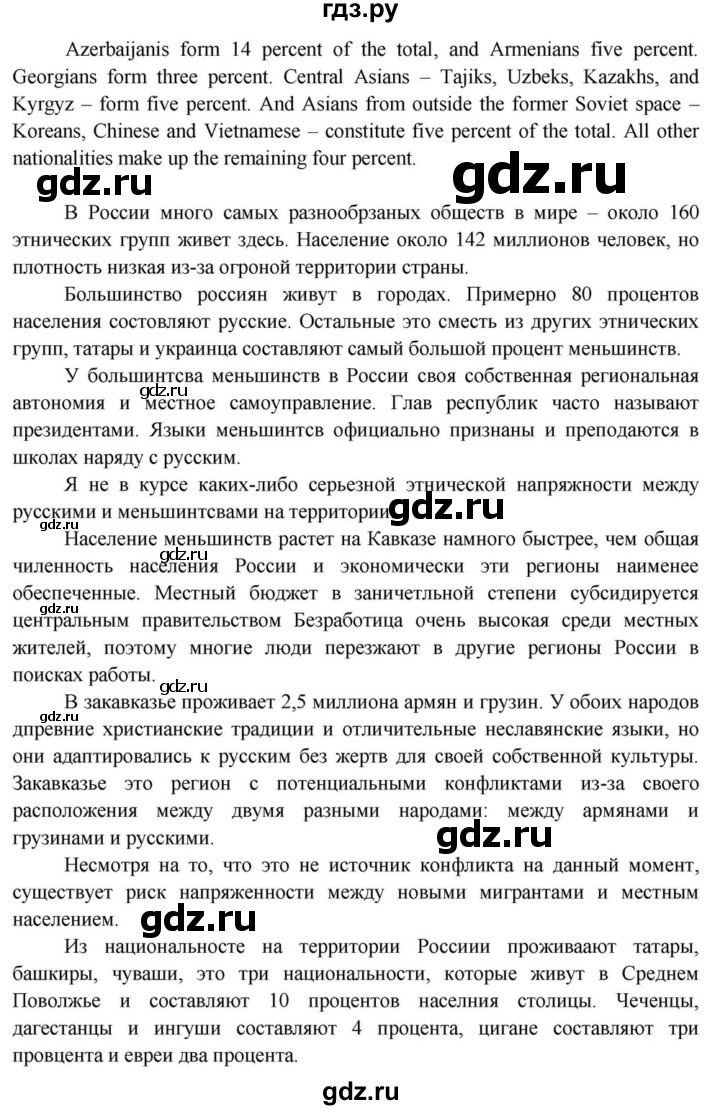
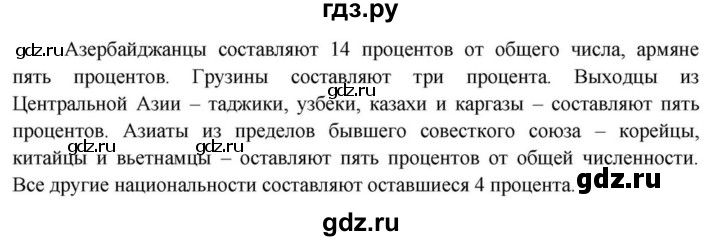
> Russia is home to more than 190 different ethnic groups, making it one of the most culturally diverse countries in the world. Alongside ethnic Russians, who constitute around 70–80% of the population, there are millions of people representing indigenous nations and communities with deep historical roots.
>
> The Tatars and Bashkirs are among the largest groups, predominantly living in the Volga-Ural region. Many settled there centuries ago and have preserved their Turkic languages, traditions, and Islamic heritage while contributing significantly to national culture. In the North Caucasus, groups like the Chechens, Avars, and Circassians have lived in the mountains for thousands of years, known for their unique languages and customs.
>
> In addition, over the past few decades, many people from Central Asian republics (such as Uzbekistan, Tajikistan, and Kyrgyzstan) have moved to major cities for work and education. Today, Russian cities represent a dynamic mix of traditions, languages, and religions, living harmoniously in a single multicultural state.
---
### Пояснение к выполнению заданий
1. **Ex. 1**: Круговая диаграмма (*pie chart*) на странице 21 визуализирует перепись населения (Census) Соединённого Королевства, показывая соотношение коренного белого населения и представителей различных национальных меньшинств.
2. **Ex. 2**: Поиск ответов основан на детальном чтении текстов подростков:
* Пункт 1: Джером отмечает, что ситуация кардинально улучшилась со времён первого поколения мигрантов.
* Пункт 2: Ли признаётся, что в маленьком городе его дразнили из-за азиатской внешности.
* Пункт 3: Рупа говорит, что дома её семья говорит на гуджарати.
* Пункт 4: Джером упоминает, что карибская диаспора — одна из самых интегрированных.
* Пункт 5: Рупа с удовольствием посещает индийские свадьбы и праздники.
3. **Ex. 3**: Значения выделенных в тексте слов объясняются через синонимы или простые английские дефиниции уровня B1–B2 с последующим закреплением в контекстных предложениях.
4. **Ex. 4 & Ex. 5**: Задания на развитие продуктивных навыков речи (диалог-интервью) и проектную деятельность (статья-портфолио). Текст статьи выдержан в публицистическом стиле и отвечает на все поставленные в условии вопросы (кто, когда и почему).
Спасибо за оценку!


Открой больше возможностей
Войди через VK — задавай вопросы ИИ и сохраняй ГДЗ в избранное
