


ГДЗ по английскому языку 11 класс Афанасьева Spotlight Базовый уровень страница - 32

Авторы: Афанасьева О.В., Дули Д., Михеева И.В., Оби Б., Эванс В.
Серия: Spotlight
Тип книги: Учебник
Год: 2015-2024
Рекомендуем посмотреть


 Премиум
Подробное решение страница № 32 по английскому языку Spotlight для учащихся 11 класса Spotlight Базовый уровень, авторов Афанасьева, Дули, Михеева, Оби, Эванс 2015-2024
### Итоговые ответы
---
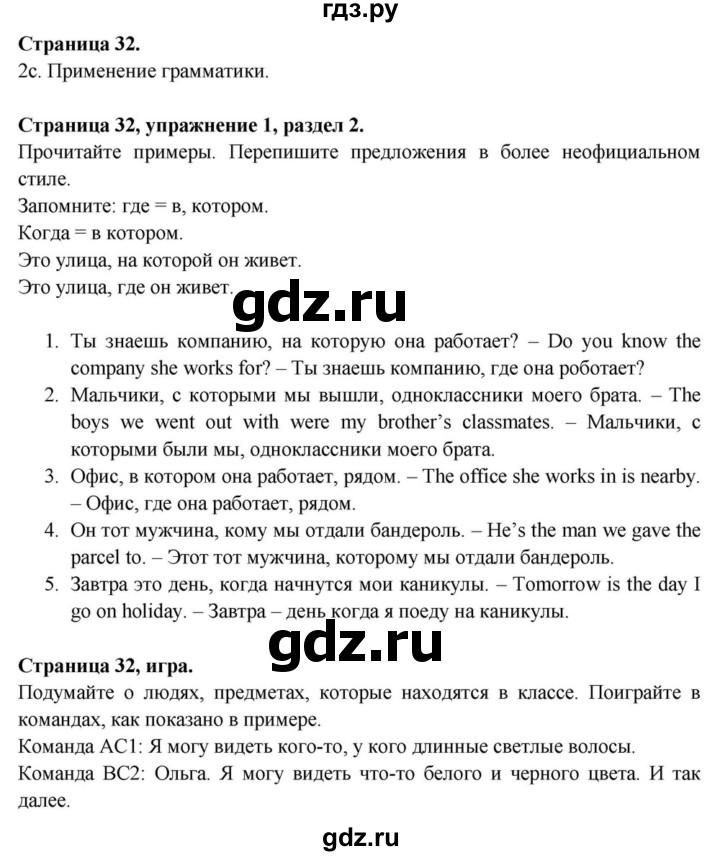
#### Exercise 1 (p. 32)
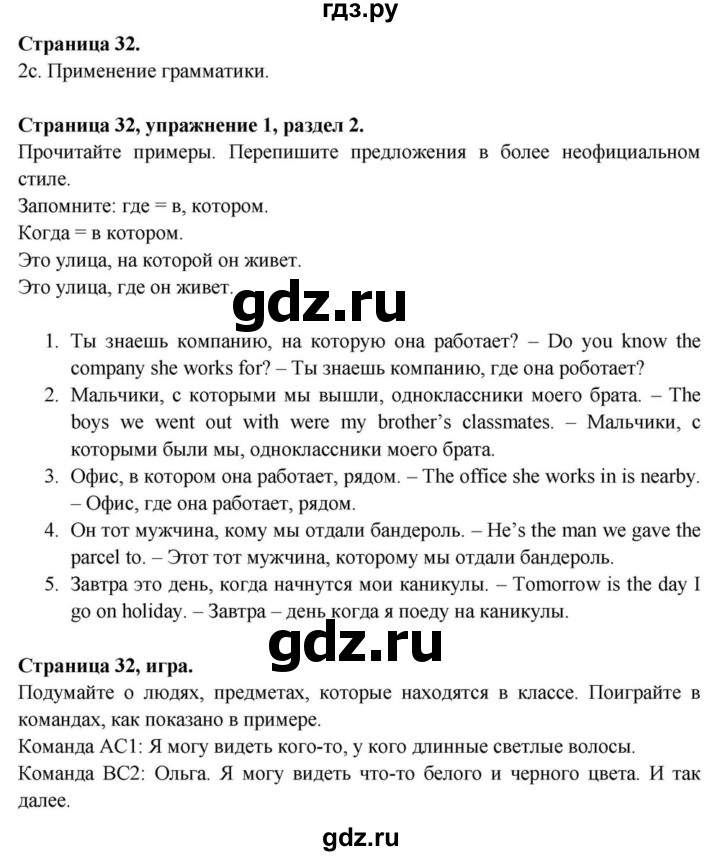
1. Do you know the company **(which/that)** she works **for**?
2. The boys **(who/that)** we went out **with** were my brother’s classmates.
3. The office **(which/that)** she works **in** is nearby.
4. He’s the man **(who/that)** we gave the parcel **to**.
5. Tomorrow is the day **(which/that)** I go on holiday **on**. *(или: Tomorrow is the day I go on holiday.)*
---
#### Game (Пример диалога)
* **Team A, S1:** I can see someone who has got glasses and dark curly hair.
* **Team B, S1:** Maxim. I can see something which is made of wood and stands near the window.
* **Team A, S2:** The teacher's desk. I can see someone whose backpack is bright yellow.
* **Team B, S2:** Anna.
---
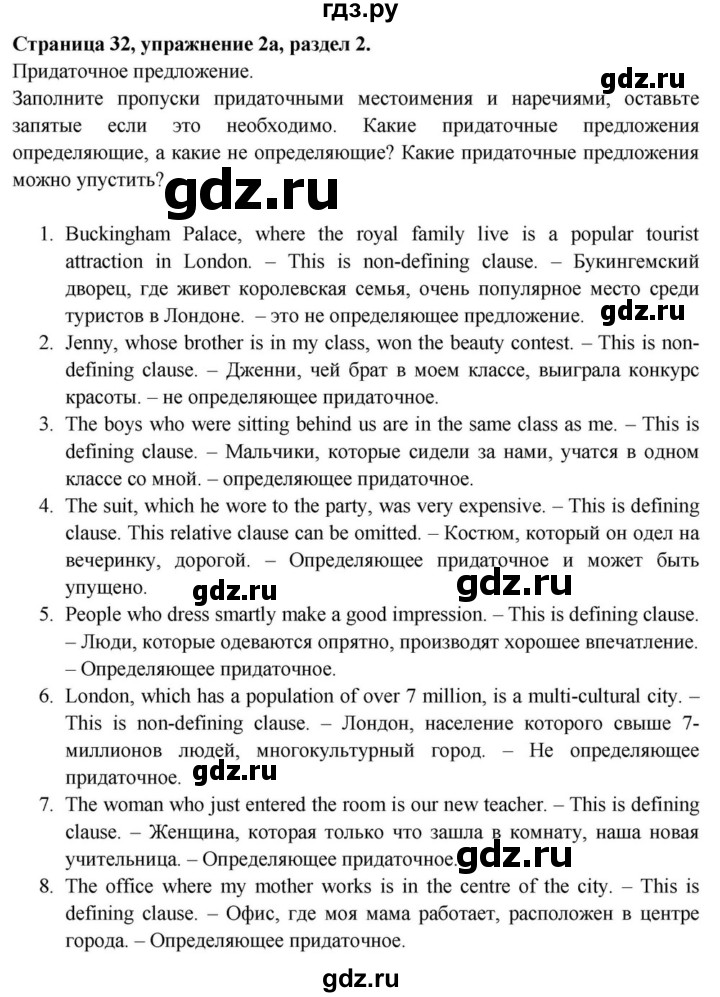
#### Exercise 2a (p. 32)
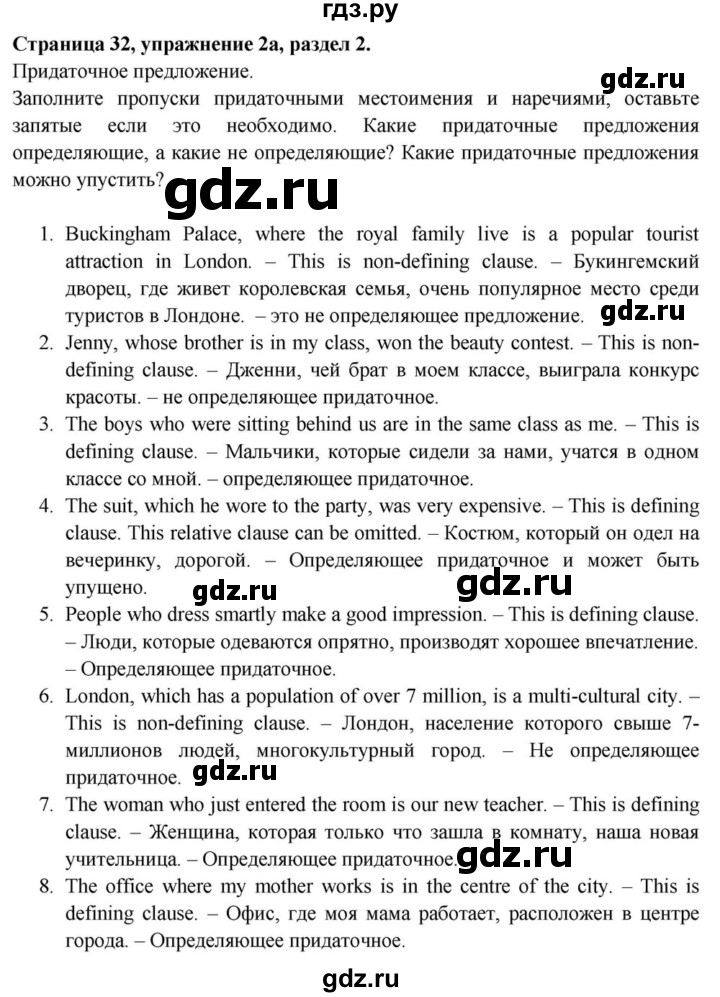
1. Buckingham Palace**, where** the Royal Family lives**,** is a popular tourist attraction in London.
*(Non-defining; pronoun cannot be omitted)*
2. Jenny**, whose** brother is in my class**,** won the beauty contest.
*(Non-defining; pronoun cannot be omitted)*
3. The boys **who / that** were sitting behind us are in the same class as me.
*(Defining; pronoun cannot be omitted)*
4. The suit **(which / that)** he wore to the party was very expensive.
*(Defining; pronoun **can be omitted**)*
5. People **who / that** dress smartly make a good impression.
*(Defining; pronoun cannot be omitted)*
6. London**, which** has a population of over 8 million**,** is a multicultural city.
*(Non-defining; pronoun cannot be omitted)*
7. The woman **who / that** has just entered the room is our new teacher.
*(Defining; pronoun cannot be omitted)*
8. The office **where** my mother works is in the centre of the city.
*(Defining; adverb cannot be omitted)*
---
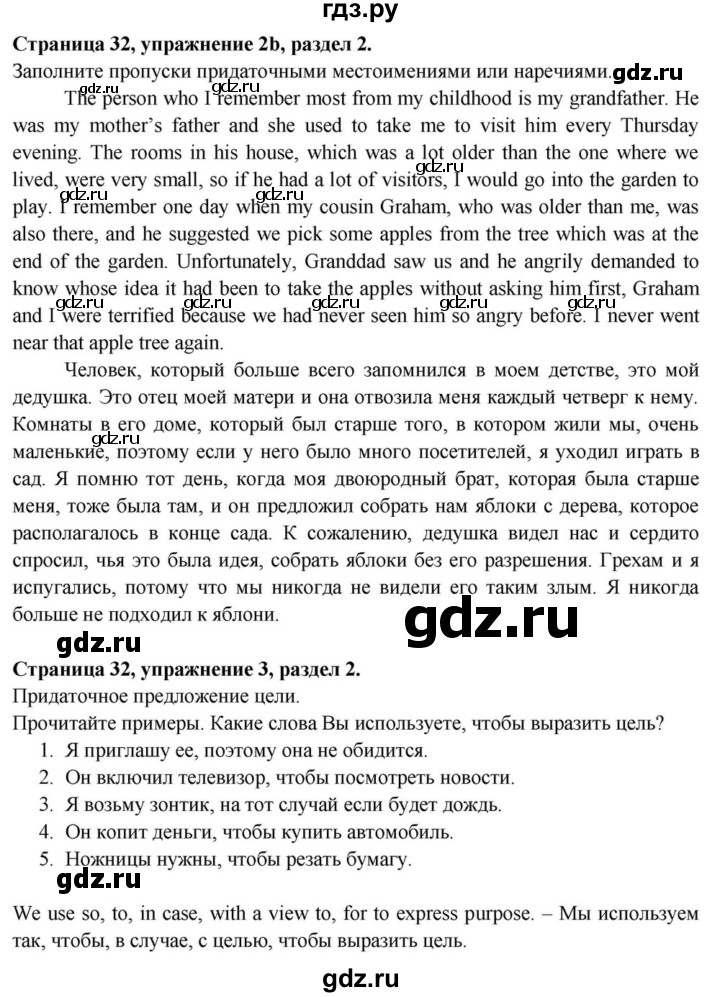
#### Exercise 2b (p. 32)
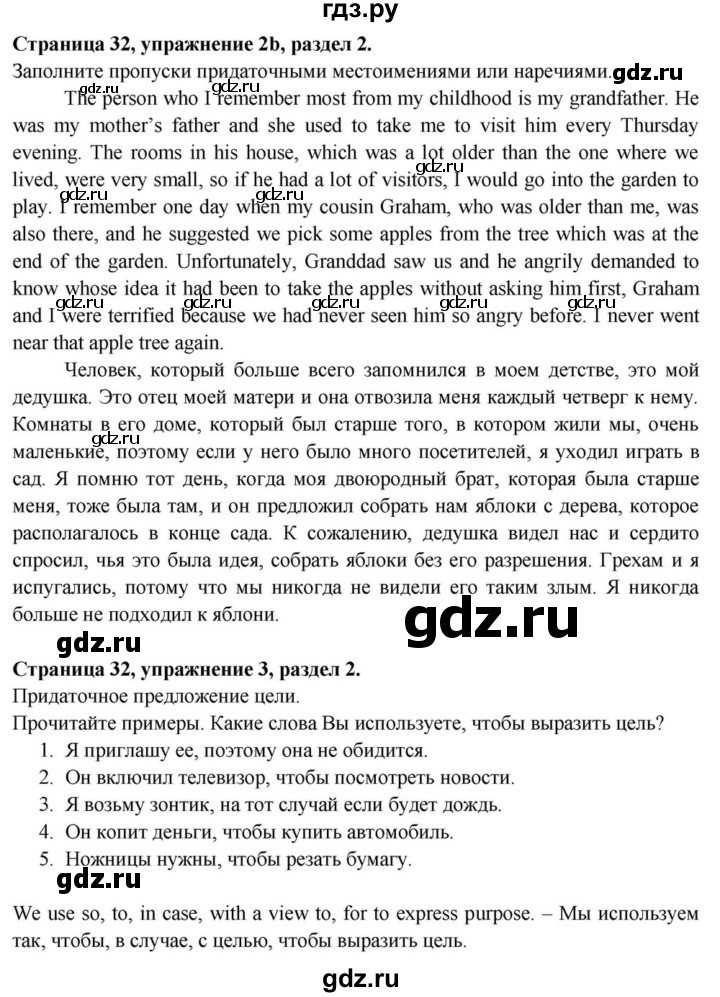
1. **who / whom / that** *(или можно опустить)*
2. **which**
3. **where**
4. **when**
5. **who**
6. **which / that**
7. **whose**
---
#### Exercise 3 (p. 32)
Слова и конструкции для выражения цели (purpose):
1. **so that** (+ придаточное предложение с модальным глаголом)
2. **to** (+ инфинитив / infinitive of purpose)
3. **in case** (+ придаточное предложение в Present/Past Simple)
4. **with a view to** (+ V-ing / герундий)
5. **for** (+ V-ing / существительное)
---
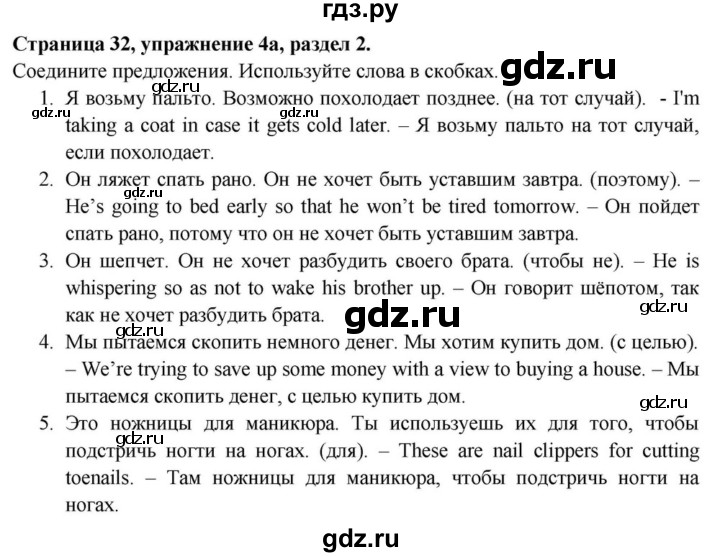
#### Exercise 4a (p. 32)
1. I'm taking a coat **in case** it gets cold later. *(Пример)*
2. He's going to bed early **so that** he won't / doesn't feel tired tomorrow.
3. He is whispering **so as not to** wake his brother up.
4. We're trying to save up some money **with a view to** buying a house.
5. These are nail clippers **for** cutting toenails.
---
#### Exercise 4b (p. 32)
*(Варианты перефразирования для трёх предложений из 4a)*
* **Предложение 2:**
* He is going to bed early **in order not to** be tired tomorrow.
* He is going to bed early **so as not to** be tired tomorrow.
* He is going to bed early **to avoid** being tired tomorrow.
* He is going to bed early **with a view to** not being tired tomorrow.
* **Предложение 3:**
* He is whispering **in order not to** wake his brother up.
* He is whispering **so that** he doesn't / won't wake his brother up.
* He is whispering **to prevent** waking his brother up.
* **Предложение 4:**
* We're trying to save up some money **to** buy a house.
* We're trying to save up some money **in order to** buy a house.
* We're trying to save up some money **so as to** buy a house.
* We're trying to save up some money **so that** we can buy a house.
---
### Подробное объяснение и правила
#### 1. Относительные придаточные: формальный и разговорный стиль (Ex. 1)
* В **формальном стиле** предлог ставится перед относительным местоимением (*for which*, *with whom*, *in which*, *to whom*).
* В **разговорном (неформальном) стиле** предлог переносится в конец придаточного предложения, а местоимение *which/who/that* часто опускается, если оно выступает в роли дополнения.
#### 2. Defining и Non-defining Relative Clauses (Ex. 2a, 2b)
* **Defining (определительные, ограничительные):** несут важную для понимания смысла информацию. Запятыми **не выделяются**. Местоимение *who/which* можно заменить на *that*.
* *Опущение местоимения:* местоимение можно опустить только в том случае, если после него идет подлежащее (т. е. оно является дополнением, как в предложении 4: *The suit [that] he wore...*). Если после местоимения идет глагол-сказуемое (оно само подлежащее), опускать его **нельзя**.
* **Non-defining (распространительные):** содержат лишь дополнительную (фоновую) информацию. Они **всегда выделяются запятыми**, местоимение *that* в них использовать нельзя, и относительное слово **никогда не опускается**.
* **Значения местоимений:**
* *who/whom* — люди;
* *which* — предметы, животные, целые ситуации;
* *whose* — принадлежность (чей);
* *where* — место (где);
* *when* — время (когда).
#### 3. Придаточные цели (Clauses of Purpose) (Ex. 3, 4a, 4b)
* **to / in order to / so as to + Infinitive** — «чтобы сделать что-либо» (в отрицании: *in order not to*, *so as not to*).
* **so that + subject + can/could/will/would + Verb** — «для того чтобы...».
* **in case + Present/Past Simple** — «на случай, если...» (предосторожность).
* **with a view to + V-ing** — «с целью / с намерением сделать что-либо».
* **for + V-ing / Noun** — выражает назначение или функцию предмета.
Спасибо за оценку!


Открой больше возможностей
Войди через VK — задавай вопросы ИИ и сохраняй ГДЗ в избранное
